



The Policy for protecting land for rice fields had to carefully take into consideration legal certainty for land owners and business operators. Aligning agrarian data, fit with spatial plan, and clarity with regards to the legal consequences for the people impacted were issues to address when applying such policy.
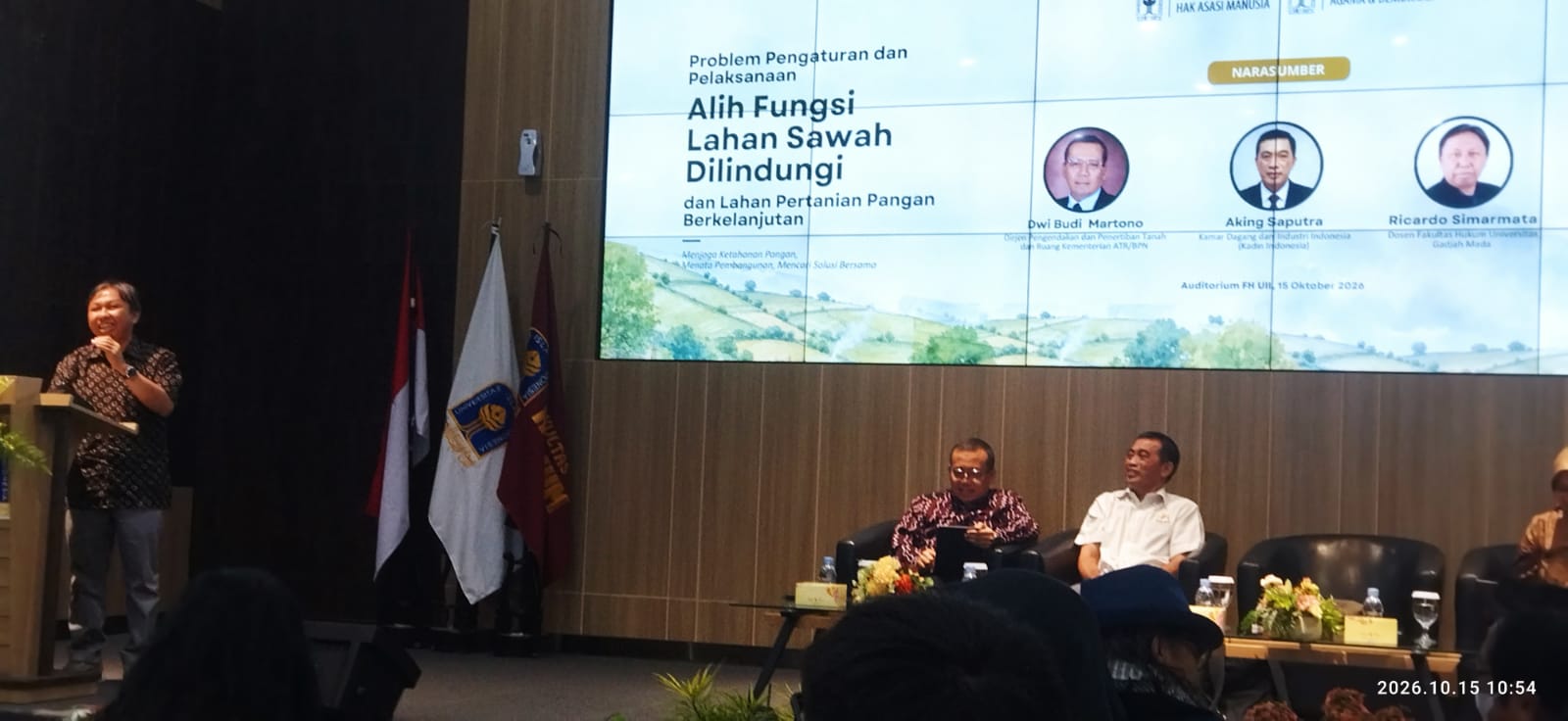
Aking Saputra of Chamber of Commerce and Industry (Kadin) was the resource person who explained the impacts of government policy for the protection of land for rice fields against plans for development, investment, and business financing during a public discussion organised by Pusham UII (Human Rights Study Centre of Islamic University of Indonesia) and Pusat Studi Agama dan Demokrasi (Religion and Democracy Study Centre) at Faculty Hall of Law Faculty, Islamic University of Indonesia, Yogyakarta, on Thursday (15/10/2026). He argued that legal certainty with regards to the land status was critical for housing and industrial zone developers who prepared long-term plan.
Uncertainty in legal status of land could disrupt the prepared development plan. The impacts would be felt by developers, contractors, banking sector, and other parties involved in investment. The issue could come to the surface when formulated development plan was turned out to be within an area with restricted land use. This situation potentially inhibited planned project implementation based on pre-obtained land status and permit.
Aking also explained the relation between land status and banking financing. Certainty of land right, including Rights-to-Build title, was one of the considerations in financing risk assessment. If there were legal issues or restriction on land use, the banks could conduct a review financing risks submitted to it. Yet, Aking highlighted that business operators had the obligation to follow the laws. He stated that policy implementation had to consider on-field situation so that protection of agricultural land could go hand-in-hand with legal certainty for the people and for business operators.
He further argued that the policy implementation-related issue(s) had to be openly discussed. Regulation adjustment had to be done by the competent authority by taking into consideration of the capacity of implementers and the needs of affected people.
Meanwhile, other resource person, a lecturer at Law Faculty of Gadjah Mada University, Ricardo Simarmata emphasised that policies on Protected Agricultura (Rice Fields) Land (LSD) and Sustainable Food Agricultural Land (LP2B) needed a review based on the legal foundation, objective of their establishment, and impacts of implementation. He reminded that land protection was not simply about the objective of a regulation, but about consistency in implementation and the consequences on land owners.
Ricardo explained that the social function of land was one consideration in land regulation in Indonesia. Land was not simply associated with the personal interests of the owner, but had also functions associated with community interests. In the context of agricultural land protection, food security and food sovereignty were public interests that could be the bases for land use regulation. Such protection was relevant for environmental sustainability and the sustainability of supporting infrastructure for agriculture, including irrigation networks.
Yet, Ricardo reminded that restriction of land use could influence landowners’ authority in using their land. Land within protection zone(s) might not be used for housing development or business purposes that were not consistent with the existing regulation. The impacts could go beyond to include land sale transaction, land economic value, and access to financing from the banks. For that reason, Ricardo argued that the government had to ensure that the communities understood fully the designation of an area and the legal consequences.
Aligning Spatial Plan and Agrarian Data
Ricardo emphasised the importance of consistency between spatial plan document and designation of protected agricultural zone(s). The government determined the spatial pattern and zoning areas through national and sub-national planning documents. Meanwhile, determination of protected land followed defined instruments and steps. Mismatch between planning documents and agrarian data could potentially lead to uncertainty for land owners and the government. Data limitation could also make it difficult to determine a land status and land use.
Ricardo argued that data collection had to include already registered land and land without certificates. The absence of certificate did not erase the obligation to observe rules with regards to spatial plan and land protection. Yet, the history of land tenure, available evidence, and conditions of physical tenure had to be carefully scrutinised so that there would not be any problem/errors in implementation. He also highlighted the importance of coordination between national and sub-national governments and the integration of land protection policies with development plan. Infrastructure development, including toll road Bawen–Yogyakarta project, was one example of a need that aligned development plan with agricultural zone protection.
In addition to data and policy alignment, Ricardo believed that the communities had to be empowered. Land owners had to have the information with regards to land status, the opportunities to examine data, and the space to lodge objections if there were issues with zone designation.
Land Protection and Peasants’ Welfare
Ricardo emphasised that LSD and PP2B policy success did not rely simply on the size of land designated for protection zone(s). The policy also needed to provide real benefits to peasants and to ensure sustainability of agriculture. He believed that prohibition of land use conversion had to be complemented by supports to allow peasants to continue their agricultural activities. Without such support and proper incentives, land protection might not necessarily improve peasants’ welfare. The benefits of policies might potentially go to land owners who had bigger economic resources.
Ricardo also emphasised the importance of considering the impacts of restriction to land owners. Land use restriction articulated in regulation(s) had to be separated from conditions which could legally lead to the rights for compensation. For that reason, the government needed to provide clear information about the basis of designation of a zone, the consequences of the restriction, and the complaint mechanism as well as conflict resolution that communities could use.
Agricultural land protection policy, Ricardo argued, needed to be implemented by taking into account the public interests, the legal certainty and justice for affected people. Alignment of spatial plan, agrarian data accuracy, inter-agency coordination, and supports to peasants were important components so that land protection could proceed effectively. (Ast)