



History was often written by the victors, and in many accounts in Indonesian history, the women’s movement narrative was frequently oversimplified or even deeply buried. Yet, the intellectual legacy of Indonesian women once inscribed in golden chapter that was remarkably sharp, bold, and ahead of its time.
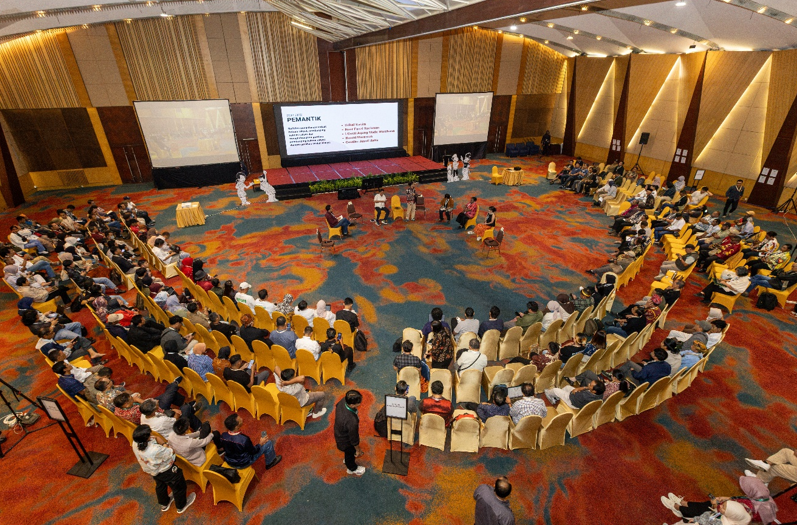
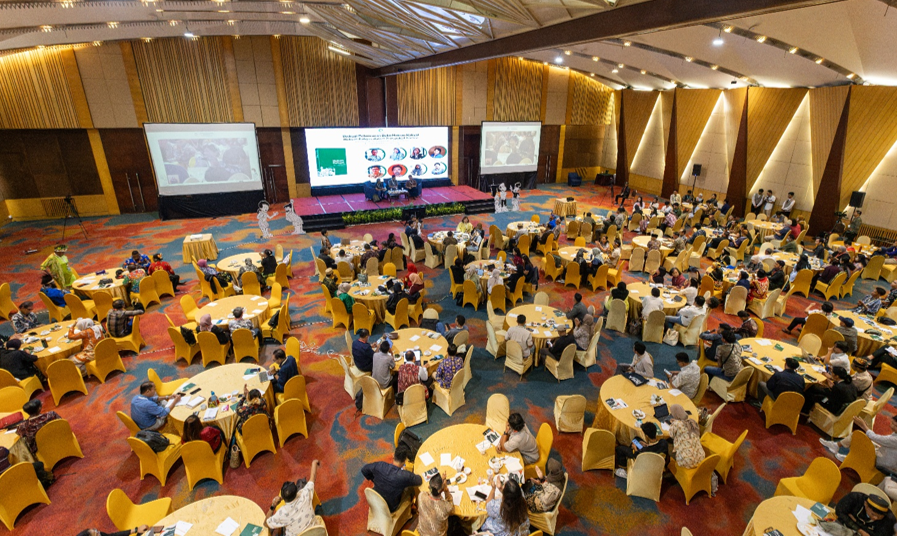
Through an online discussion titled "Dissecting Api Kartini Magazine, The Mak Ompreng Column, Gerwani Literature, and Critical Social Annotation" on Saturday (17/10), experts, activists, and the general public gathered to re-examine the archives of Api Kartini Magazine published between 1959 and 1964. Moderated by Annisa Beta, the discussion featured two speakers: Asri Saraswati (IRC UI, Assistant Professor) and Marissa Saraswati (Founder & Annotator).
The purpose of this discussion was not merely to indulge in historical nostalgia, but to transform archives about the past into "living texts” – a mirror through which we could scrutinise the injustices that women experienced to this day.
Tracing the Spark of Api Kartini: From the Kitchen to Global Politics
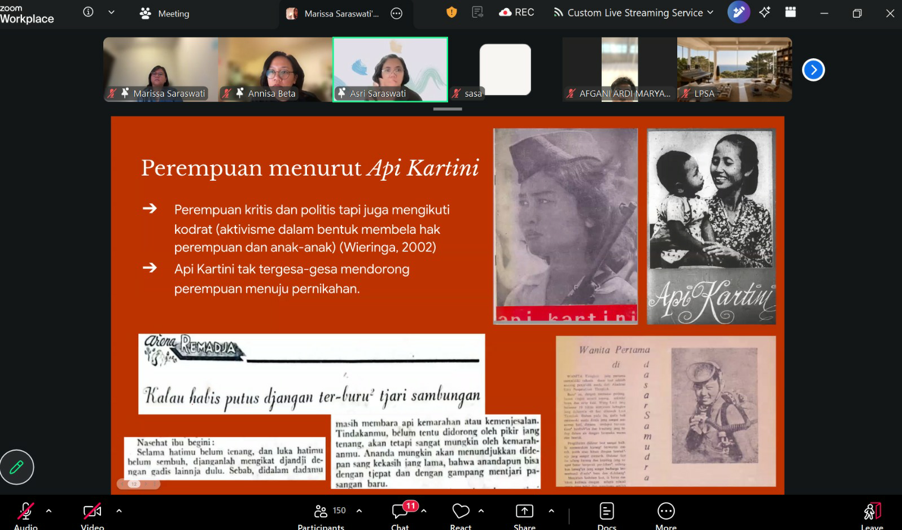
In her opening presentation, Asri highlighted the profile of Api Kartini. Monthly magazine published by the Indonesian Women’s Movement or Gerakan Wanita Indonesia (Gerwani) between 1959 and 1964, the magazine provided space for expression amongst activists, journalists, and cultural essayists. Staffed by prominent editorial figures such as SK Trimurti (former labour minister), Rukiah Kertapati, Sugiarti Siswandi, and Masha Siwi, the magazine catered to the middle-class women, as evidenced by the advertisements and prescription system, and the radical and inclusive contents.
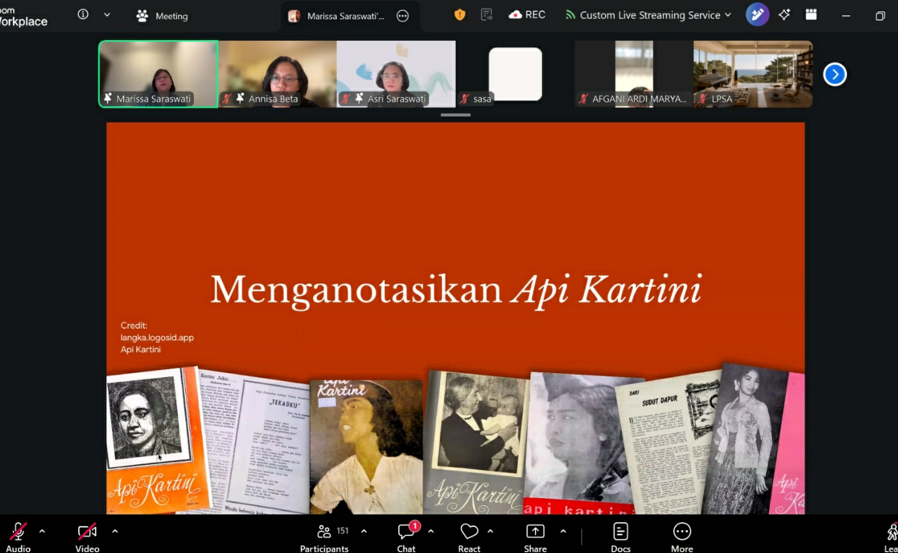
The primary uniqueness of Api Kartini lied in its ability to blend domestic matters with political struggle without diminishing either one. On one page, readers could find cooking recipes, sewing patterns, home care tips, to child psychology. Yet in the very next page, the magazine presented shar analysis of feudalism, colonialism, workers’ rights, to reports on international women’s movements, such as aksi anti-atomic bom actions and women’s solidarity in Cuba, China, Latin America, to Australia.
The special labour day edition of the magazine offered the most poignant example. The magazine asked middle-class women to inspect the condition of butter and soap factories. The message was unambiguous: Convenient staff used in upper-class homes came at the cost of labour and hardship endured by impoverished women workers.
Not only that, Api Kartini was closely associated with international networks. As part of Women’s International Democratic Federation (WIDF), the magazine editors actively exchanged publication with leftist women magazine all over the world, such as India and Argentina.
Mak Ompreng and Resistance Literature: When the Kitchen Became the Stage for Criticism
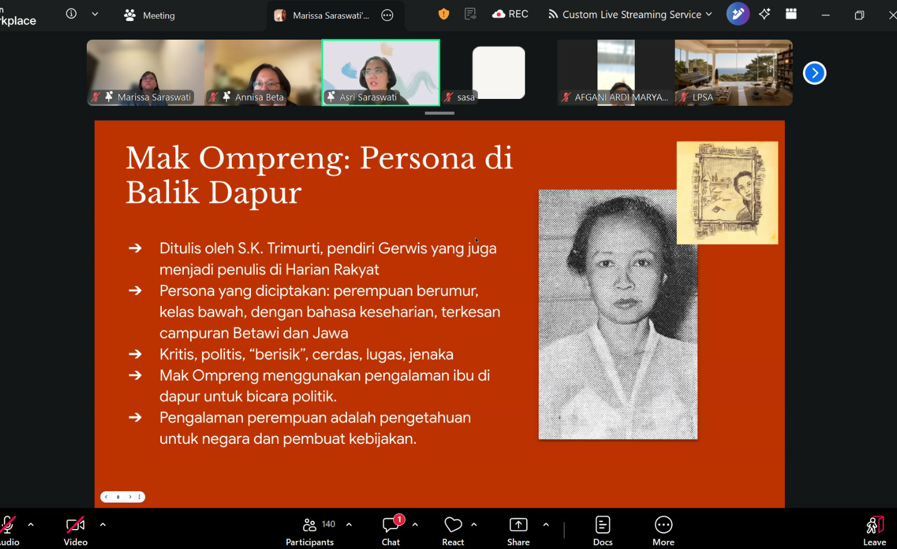
One of the magazine biggest draws was its special column titled Mak Ompreng written by SK Trimurti. "Ompreng" itself referred to a tiered lunchbox or traditional kitchen food container. Through the fictional character of Mak Ompreng, a lower-class housewife – witty, blunt, and talkative, SK Trimurti criticised the government economic policies and patriarchal culture using everyday language infused with Betawi and Javanese idioms.
Mak Ompreng proved that political and economic issues were not distant ideals for the parliamentary elites. From the price of rice, distribution of local aid at village level, to daily market trips were real political issues that strangled poor people.
Beside Mak Ompreng, every edition of Api Kartini always opened with a poem or a verse. Through the turba principle (going down to the grassroots) characteristics of the Institute of People’s Culture or Lembaga Kebudayaan Rakyat (Lekra), the poems and literatures functioned as instruments to sharpen the affection or emotion of the mass. Literature became a mirror of class consciousness, a means to condemn the corruption of the political elites, and the fuel to strengthen the ranks of women’s struggle.
Critical Social Annotation: Reviving Shared Archives
How do people who live in the 21th Century read the archive so far? Marissa Saraswati offered a method known as Critical Social Annotation.
In essence, annotation was the act of responding to text, which could take the form of margin notes, stickers, or comments. However, when this was done socially and critically, the process of reading was no longer a solitary and quiet activity. Many people read together, responded to one another, and built collective knowledge.
The core principle of the method was the belief that human life experience was a form of formal knowledge. This applied to women’s experience in the kitchen, workers in factories, and people on the street, all had equal analytical values. Critical social annotation was tasked with re-focusing the voices of marginal groups who were so far muzzled or ignored by mainstream history.
Participants Voices: A Mirror to Unfinished Problems
When the interactive discussion session was underway, participants learned to practice annotation on Mak Ompreng column sample and poems in Api Kartini. Participants’ reflections showed how the issues raised 60-years ago still hit the walls of reality today:
- Repression and class Inequality: Participants highlighted how Mak Ompreng criticism about women workers’ wages was consistent with modern social reproduction theory. Api Kartini managed to explain the structural inequality of capitalism using very down-to-earth language.
- Literary symbols and metaphors: Participants reviewed the poem Kalung Tanjung (Cape Flower Necklace). The simple Tanjung flower became the symbol of grassroots solidarity and a sense of responsibility, standing in stark contrast to the "Kalung Permata" (Jewelled Necklace) of the elite class often bought from the proceed of human exploitation.
- The Severing of History and the Danger of Neoliberalism: Participants emphasised how devastated the reference of women’s movement had become due to the systematic erasure of archives by the New Order Regime. As a result, women’s movement of today often felt isolated and cut off from its intellectual roots. In addition, as pointed out by other participant, the narrative of modern struggle was frequently trapped in "liberal feminism" which reduced inequality to merely individual choices or social media trend without dismantling the structure of patriarchy and capitalism.
- Double Burden and Social Reproduction: Participants underscored Mak Ompreng criticism about the double burden. Women were expected to the active outside the home, yet the burden of domestic care remained theirs alone to bear. Participants quoted the phenomenal sentence in Mak Ompreng column: "If a woman refused to become pregnant and to give birth, the world will turn into a graveyard." This served as an affirmation that care work was the key foundation of life, not a merely natural, unpaid duty.
- A Real Cry from the Field: The sharpest reflection came from Kak Amin – a worker at a nickel industrial zone in Morowali, Central Sulawesi. He testified that the condition of women workers in nickel factories remained deeply concerning: Poor occupational safety, a lack of lactation room, and the fulfilment of menstrual leave rights that still had to be fought tooth and nail. The issue which Mak Ompreng criticised in the 1960s remained valid to this day.
To Reconnect the Chain of Struggle
The discussion led to a very clear conclusion: women movement in Indonesia in the mid of the 20th Century had shown political awareness, class analysis, and very mature transnational insights. The erasure of archives from public memory was a major loss that forced us to start the fight from the beginning.
Yet, the pathway to revisit history was never shut. Today, digital archives of Api Kartini magazine and a number of other historical documents had been uploaded and could be accessed freely through Logos ID Encyclopaedia Platform.
Let Us Play Our Part!
Reading history was not a passive act to merely broaden one’s horizon, but a political act to preserve memories. As stated by Kak Amin from Morowali, the grand discourse and ideas from Api Kartini should not stop at comfortable academic discussion rooms or online discussion. The idea had to be brought home to factory floors, community kitchens, work places, and daily conversations.
Let us revive the courageous spirit of Mak Ompreng and women fighters in the past. Let us use history as fuel to critique to injustices around us, dismantle patriarchal structure and exploitation, and weave cross-class solidarity. As long as injustices and oppression remained, Api Kartini could not and should not be extinguished! (Anissa Ratna)