



A number of village heads in urban and rural areas highlighted the shrinking village funds and the implementation of village cooperative program implementation which they argued restricted village government authority to determine their development priorities. They feared that the policy would jeopardise basic services, community empowerment, and citizens’ participation in decision-making.
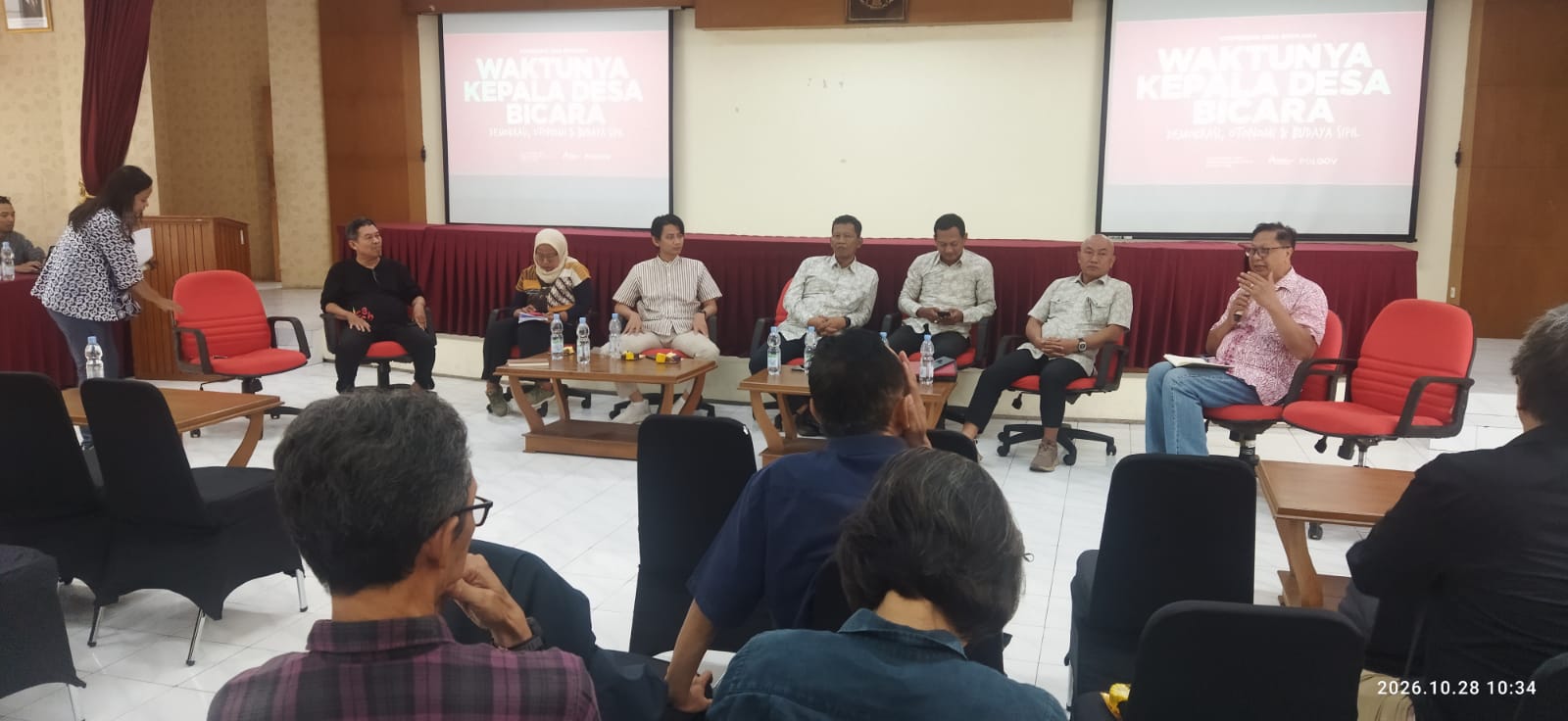
The issue was a key point during a conference titled “It Was Time for Village Heads to Speak, Democracy, Autonomy, and Culture” at Ruang Seminar Timur (East Seminar Room), Social and Political Faculty of Gadjah Mada University (Fisip UGM), on Wednesday (28/10/2026). Four village heads shared their experiences about changes in budget, management of local resources, and the challenges to exercising village authority under a flurry of National Government Policies.
Prawatan Village Head, in Jogonalan Sub-district, Klaten District, Sabiq Muhammad revealed that village funds were supposed to be used to meet the needs of the community, based on the results of deliberation. He argued that determining development priorities needed to consider the real condition and needs of the community, rather than simply following prescribed programs from the national government.
Sabiq explained that village governments had broad responsibility, from administering local government, development, community empowerment, to community guidance. The village governments were also required to execute several mandates from the district, provincial and central governments.
The problem arose when those various obligations could not be matched by adequate authority and budget. The reduction in fiscal space made it difficult for village governments to keep programs already planned with the community.
“Village funds are the rights of the community and cannot be interfered by national programs,” said Sabiq in his presentation.
He highlighted that village autonomy was not merely measured by the size of local income. Autonomy could also be sustained through strengthening human resources, business groups, and community organisations already existing locally.
Sabiq gave an example of a women’s group initiative in his village. In 2020, he village government conducted a mini research that found that average household monthly expenditure was Rp175,000 for social activities such as neighbourhood meetings, family welfare group activities, youth meetings, and assistance to neighbours who got married or who had grief.
The village government then urged the establishment of women’s business groups at neighbourhood level. After one year, the average household social expenditure decreased to Rp 85,000 per month.
For Sabiq, that achievement showed that community empowerment could result in direct benefits when it grew from the needs of the residents. The village government planned to develop such business by giving extra funds, but budget constraints remain an obstacle.
Sabiq argued that in 2025, three groups in his village had their own cooperative – women’s group, united peasant group, and youth group. Establishment of these economic groups were parts of efforts towards village autonomy based on local initiatives.
Therefore, he questioned the policy that forced villages to divert resources to new programs when local economic initiatives had worked. He believed that development policies had to give the space for communities to develop their own businesses based on local potentials and needs.
Sabiq also reminded of the impacts of budget reduction on vulnerable groups. Supports to health cadres, families of people with disability, elderly residents, and community groups that needed basic services could be affected when the village governments had to reduce program services.
He noted that the village government had endeavoured to use available income sources to fund social services. Financial limitation forced the government to re-prioritised program that it could sustain, despite ongoing public needs.
Sabiq also stated that he was one of the village heads who submitted a petition for a judicial review to the Constitutional Court. That action aimed to fight for village government authority and the financial relationship between central and local governments.
He affirmed that the fight was not merely to serve the village heads’ interests, rather to safeguard people’s space for determining the direction of their own development.
As was commonly known, Sabiq and Sajogyo Institute and the Koperasi Edukarya Negeri Lestari filed a lawsuit against Red-White Village Cooperative program (KDMP) to the Constitutional Court, accompanied by Koalisi Gugat Kopdes Merah Putih with membership from Celios, Themis Indonesia, ICW, Transparency International Indonesia, Trend Asia, Koperasi Indonesia Baru, and Solidaritas Perempuan on 27 October 2026.
Shrinking Budget, Stalled Village Programs
The village head outside Yogyakarta Special Province and chairperson of Nayantaka for 2025 to 2028, Gandang Harjanatasekaligus recalled the original village budget was around Rp1.8 billion, and it was now reduced to Rp 373 million.
Gandang said that the budget changes had put a number of programs already promised to the public at risk of not being implemented. The village governments had to adjust their plan to adjust to the remaining budget.
He explained that governance in the Special Province of Yogyakarta had its own characteristics because it was closely related to its special status, including culture, spatial plan, agrarian issues, and institutional structures. That condition affected the ways village heads carried out governance and developed communication with the community.
Gandang stated that village development was not always dependant on budget size. The village governments could encourage community participation to preserve public facilities and support environmental development.
Yet, people’s participation still needed policy support and sufficient budget. When the budget shrank, the village government ability to meet people’s needs was also limited.
A village head in Kulon Progo, Anwar Musadad also discussed the impacts of budget reduction on basic services. He explained that his village had a territory of around 700 hectares and a total population of more than 4,000 people.
The geographical condition of the area, which bordered the coastal region and surrounded by rivers made disaster mitigation a primary concern for the village government. Threats of floods, string winds, and tsunami necessitated community preparedness and financial support.
In addition to the agricultural sector, the village government developed a number of business units through Village Business Unit (BUM Desa). One such business was the provision of clean water that provided water to three surrounding sub-districts and became a source of village income.
Anwar explained that the development of local potentials could help the village meet community needs and strengthen village finances. Yet, budget reduction remained an issue when the village government had to maintain services.
He gave an example of supports to health cadres that needed regular financing. With a significant number of cadres, the budget needs for community services were significant.
Faced with such limitation, the village head tried to find a solution through people deliberation and budget adjustment. This measure was selected to ensure public services proceeded despite shrinking budget.
Meanwhile, Village head and Chairperson of Gunungkidul Village Head Association, Suhadi argued that the issue was related to the village position in government system.
He declared that the spirit of the Village Law had to remain anchored in development and community empowerment. Both aspects had to go hand-in-hand so that villages had the ability to determine policies based on the needs of the people.
Suhadi suggested that too much intervention through rigid regulations could narrowed the space for villages to develop local initiatives. Yet, mutual cooperation and community ability to organise themselves were critical social capital.
He also reminded that village governments were the first place that people seek for help when they faced day-to-day problems, from administration, health, education, to family and economic issues.
For that reason, it was important for villages to have the authority and adequate budget supports to address those issues. He said that village strengthening was part of efforts to improve people’s welfare, and reduce people’s incentives to leave their village in search of a livelihood.
Village as A Space for Democracy
Researcher Made Supriatma responded to village head presentations by highlighting the relationship between bureaucracy, development, and expansion of military roles in civilian affairs.
Made argued that village heads had a central position because they were close to the people and faced local issues directly. At the same time, village heads had to implement policies designed at higher government levels.
He reminded that development programs designed centrally had to be assessed based on effectiveness, community needs, and accountability mechanism. Programs that looked promising did not always proceed well when the management did not match local condition.
Made highlighted the expansion of the military roles in development through the establishment of territorial development battalions. He believed that such development had to be scrutinised through the viewpoints of authority, management, and accountability so that the boundary between the military institution and civilian government remained clear.
Meanwhile, Prof. Amalinda Savirani from the Political and Governance Department of Gadjah Mada University (UGM) iterated that villages were the forefront of democracy because the impacts of government policies could be directly observed in people’s lives.
He argued that there was tendency for centralisation that consolidated decision making at the national level and that potentially reduced the space for the village governments to determine their own priorities.
Amalinda referred to the implementation of the Red-White Village Cooperative program which in some cases clashed with local conditions. He revealed situations where cooperative buildings had been erected, yet their use and management had not been clarified with village governments. He also pointed to outside goods procurement which potentially clashed with local business operation.
Amalinda said that uniform policy could ignore economic ecosystem that had been established by local communities. Villages with businesses operating through village cooperatives or local economic organisation might not need the same business models used in other villages.
The impacts were not only economic. When the budget space and village authority shrank, services for women, children, and vulnerable people also risked of being affected.
Yet, Amalinda argued that villagers had the opportunities to negotiate and fight for their interests through local organisations and participation in decision-making.
From the people’s economic perspective, Farid Gaban from Ekspedisi Indonesia Biru expressed his supports to cooperative development, but distinguished the principles of cooperatives with the Red-White Village Cooperative principles initiated by the government.
Farid said that it was not enough to understand the cooperatives as buildings or channels for goods distribution. Cooperatives had to be based on members’ participation, collective ownership, and local community economic needs.
He argued that the development of cooperatives had to start from local people’s initiatives, rather than simply meeting program targets. If community participation was omitted, cooperatives risked losing their substance as people’s economic orgaisations.
Farid also remined that village funds had opened space for people to be involved in determining their own development priorities. For that reason, budget-related policy change needed to pay attention to the participation of local people and organisations who had grown in the villages.
The Executive Director of the Center of Economic and Law Studies (Celios), Bhima Yudhistira highlighted the business model and governance of the Red-White Village Cooperative. He asked participants to assess the match between the cooperative business model and the characters of local market, the ability of business operators, and goods distribution networks.
Bhima also emphasised the importance of oversight based on data of program implementation, especially physical development and procurement of good. Communities could compare the specification of buildings, prices of materials, and local condition to determine the possibilities of mismatch.
He said that such oversight needed to proceed factually and in organised manner so that it could become the basis for better accountability.
The discussion moderated by Longgina Novadona from PolGov UGM affirmed that the village issue did not stop at the budget size or construction of facilities. Policy change also affected village government authorities, sustainability of basic services, local community economic autonomy, and quality of democracy.
Village heads hoped that the development policy gave greater space to people’s needs and initiatives. They argued that village strengthening necessitated clear authority, adequate budget, and government commitment to safeguard participation in determining the direction of development. (Ast)