



The Indonesian Women Alliance or Aliansi Perempuan Indonesia (API) evaluated two years of Prabowo Subianto-Gibran Rakabuming Raka government as having failed to provide necessary protection for women, indigenous people, gender marginalised groups, workers, and human rights defenders. The development policies with its focus on big projects and natural resources exploitation were considered to exacerbate social inequality, shrink civic space for democracy, and increase risks of violence against women.
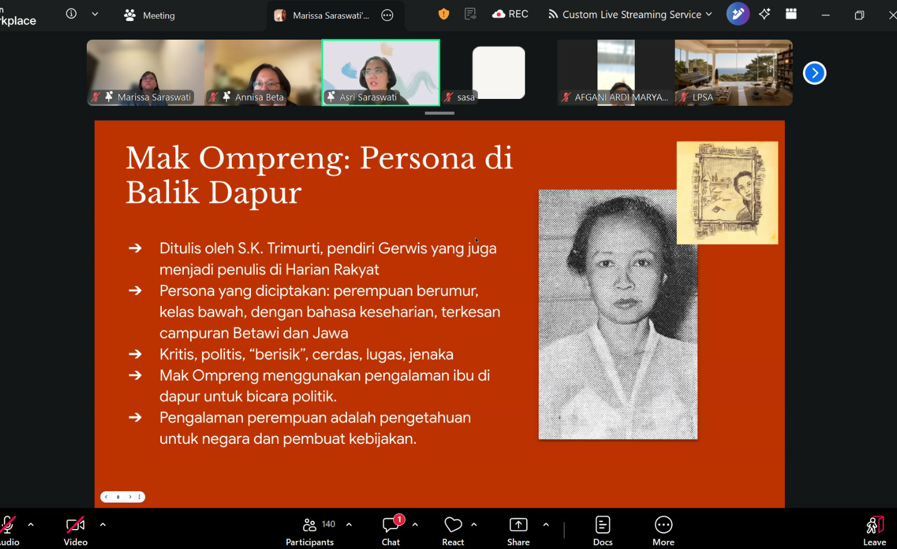
That assessment was delivered during a Press Conference evaluating two years of Prabowo-Gibran government by the Indonesian Women Alliance, via zoom meeting, on Wednesday (21/10/2026). A number of organisations within the alliance presented cases of gender-based violence, femicide, criminalisation of civil society, environmental damage, budget inequality, and weakness in migrant worker protection.
The Alliance considered these issues to be interrelated. Economic and development policies that failed to prioritise the public exacerbated women’s vulnerability because women had to bear the impacts of higher cost of living, environmental damage, loss of employment, and increasing workload of caring for the family.
Representatives of the Indonesian Women Alliance stated that the government needed to evaluate the direction of the development that had been promoted as an effort to improve people’s welfare. They questioned who actually benefited from the big projects when the communities were the ones to bear the social and ecological impacts.
In its position statement, the Alliance urged the government to halt the seizure of people’s living spaces for the interests of extractive industries, to restore budget priorities to basic services, to end the silencing of critical voices, to acknowledge and reduce women’s care work burden, and to immediately address forest and land fire.
Femicide and Gender-Based Violence
The representative of Jakarta Feminis, Yuri Muktia presented documentation of femicide in 2025. Her organisation documented 216 cases with 230 victims and 245 perpetrators. 176 of the 230 victims were women, while 31 victims were girls, and two victims were transgender.
Yuri said that the cases showed that femicide could not be separated from gender-based violence and the lack of State protection on victims. Jakarta Feminis also documented a case of a woman named Irene Sopoy from Papua who was refused by four hospitals before she died on her long journey to a fifth hospital.
The case showed that serious issues with regards to access to services, especially for women who needed medical help. Yuri indicated that death associated with failure in health system had to the one subject of concern for the evaluation of government accountability.
According to Jakarta Feminis documentation, 103 femicide cases happened within intimate relationship. That figure showed that domestic violence and dating violence remained serious issues. Cases involving sexual attack motives and unwanted pregnancy also increased compared to the previous year.
Jakarta Feminis also focused on case handling by the law enforcement agencies. Of seven cases with sexual motive being reviewed, only two used the Law on Sexual Violence to deal with the perpetrators and to protect victims.
Yuri argued that such condition highlighted the need to strengthen the understanding of investigators and prosecutors regarding the scope and implementation of Law on Sexual Violence enacted in 2022. She also urged the government to prepare a disaggregated data collection system on femicide based on sex and gender that can be publicly accessed.
In addition, the Alliance urged the government to ensure the fulfilment of victims’ rights, including restitution and recovery for victims’ families. Jakarta Feminis also demanded strengthening of health care services for high-risk pregnant and labouring women, especially those who lived in areas affected by ecological disasters.
Spaces for Democracy and Protection of Human Rights Defenders
The issue of violence against women, according to Jakarta Feminis, went hand-in-hand with shrinking democratic space. Women defenders of human rights faced threats, criminalisation, and persecution when they organised the community or assisting victims.
Yuri highlighted the lack of comprehensive protection provisions for women defenders of human rights in the revision process of human rights law. She called for the legislative discussion to genuinely guarantee the security of people who defended human rights.
Restriction on freedom of expression also happened in the digital space. Yuri highlighted that the Communication and Digital Ministry took down 486 social media contents on protests and violence after protest in Jakarta on 27 August 2026. She argued that people had to take notice of such restriction as means to muzzle citizens’ criticism.
Perempuan Mahardhika expressed a similar criticism. Its representative, Shakur argued that the government had not designated violence and murder against women as urgent issues to address systematically.
She pointed out the discriminatory policies deemed harmful to women and the provision in the new Criminal Code that expanded the criminalisation of extramarital sexual relations and cohabitation outside of marriage. She argued that the provision potentially expanded State control of citizens’ private lives, with women as the vulnerable group who had to bore the consequences.

Shakur also criticised the development policies and the expansion of land concession and the consolidation of the military roles in civilian affairs. Land confiscation, threats against citizens who rejected it, damage to water sources, and the loss of local sources of livelihood worsened women’s lives in affected areas.
The LBH APIK Association, through Khotimun added that the shrinking civil spaces was also evident in citizens’ criminalisation, disproportionate budget management, and weak protection for women defenders of human rights. She argued that citizens had the rights to question the use of State budget because the funds were coming from citizens’ tax.
Meanwhile, Dian Septi affirmed that it was not enough to measure democracy through the holding of general election. Citizens also needed to look at people’s ability to criticise the government, to organise, to conduct peaceful protests, and to defend their rights without threats or retaliation.
Dian highlighted that in the two years of Prabowo-Gibran government. Amnesty International publication documented 46 human rights defenders who experienced attacks between 20 October 2024 and 19 October 2026. The attacks included terror, physical violence, and imprisonment.
Dian argued further that such condition had direct impacts on women movement. Teachers, those supporting victims of violence, defenders of indigenous people, and citizens who rejected eviction needed safe spaces to work. Threats of criminalisation instilled fear and pushed people to censor themselves.
Minority Groups and Migrant Workers
Representative of Arus Pelangi, Echa Waode highlighted the increasing violence against lesbians, gay, bisexual, and transgender people (LGBT). She cited her organisation’s document that showed increasing number of cases from 28 in 2024 to 66 in 2025, with a total of 141 victims.
Echa also revealed that Solidaritas Tanpa Batas (Solidarity Without Border) documented 23 cases with 201 victims between 16 July and 5 August 2026. She pointed out that the situation showed that stigma and discrimination were becoming real threats to the safety of gender minority groups.
She said that the State guaranteed legal protection, access to health services and safe education, equal access to employment, and freedom of expressing identity without threats of violence and persecution.
In the employment sector, Dian Septi explored the employment termination, employment uncertainty, and the terrible work condition that worsened women’s vulnerability. She highlighted the number of employment termination in the forum that totalled 88,519 people in 2025, while reminding that contract workers and casual workers risked being underreported.
She urged the government to stop worker exploitation, strengthen freedom of association, and guarantee worker protection. She indicated that workers’ rights were not gifts from the generosity of rulers or companies, rather the result of collective struggle that had to be defended.
Meanwhile, Wiwin Warsiating from Kabar Bumi focused on Indonesian migrant worker protection. She explained that her organisation dealt with around 3,840 migrant worker cases since May 2025 on a number of issues from human trafficking, withholding of documents, fraud, forced contraception, to termination of employment=.
Wiwin also said that migrant workers faced threats of death penalty overseas. She argued that it was not enough for the government to merely encouraged the deployment of workers and to go after their remittance, rather to ensure protection since recruitment, employment, and return.
Kabar Bumi urged the government to create descent employment opportunities in Indonesia and to ensure implementation of migrant worker protection. Wiwin believed that deployment of workers overseas without adequate protection risked turning women into cheap labour who had to bear the various problems on their own.
Environmental Damage and Women’s Burden
The ecological issue was one topic of discussion in the press conference. Renie Aryandari from Trend Asia explained that two years of Prabowo-Gibran government showed a development pattern that increased risks of disasters, while citizens had to bear the impacts on their own.
She questioned the energy policy that relied on coal and expanded natural resources extraction. She explained that the energy self-, the energy sovereignty narrative had to be challenged when citizens lost their land, clean air, and sources of livelihood, while the biggest profit went to corporations.
Renie revealed that the Asian Trend detected 34,933 hotspots in Indonesia during the period between 1 January 2024 and 17 August 2026. A number of these hotspots were in mining and forestry concession areas. The data did not prove that the concession holders were deliberately cause the fire, rather the data showed the importance of reviewing the relationship between ecological damage, permit, and industrial expansion.
She also focused on the effects of haze from forest and land fire on people’s health. Renie revealed that the haze from the fire on August 2026 caused 1,700 premature deaths in Indonesia. She also cited the Ministry of Health data regarding 50,891 cases of health problems between July and August 2026, although the category description of these cases had to be clarified.
Renie argued that women and children bore multiple burdens when the environment was damaged. Women had to care for sick family members, meet the food and water needs, and protect livelihood when the land and resources were affected.
The Indonesian Women’s Alliance highlighted that protection of women could not be separated from protection of the environment, rights to descent employment, and civic liberty. They urged the government to stop extractive industrial expansion that damaged the living spaces, to take decisive actions against perpetrators responsible for environmental damage, and recover the life of the affected people.
The Alliance also asked the government to stop muzzling critical voices, to withdraw discriminatory policies, to guarantee protection for women and vulnerable groups, and to prioritise budget for education, health, social insurance, an inclusive infrastructure.
For the alliance, the evaluation of two years of the government was not merely an assessment of the growth figure or development projects. The key measure was whether the State was able to guarantee descent, safe, and dignified living for all people without discrimination. (Ast)