



Did you ever feel that your internet activities were truly transparent? Or perhaps, did you ever felt worried when you uploaded photos and shared stories in the social media? In today’s digital era, the mobile phone screen was not simply a window into the world outside, but a part of people’s identity and self-expression.
Unfortunately, the seemingly free digital space was not always a safe space. Threats such as hacking, data breach, to online gender-based violence were lurking around ready to strike anyone, especially the vulnerable groups and women.
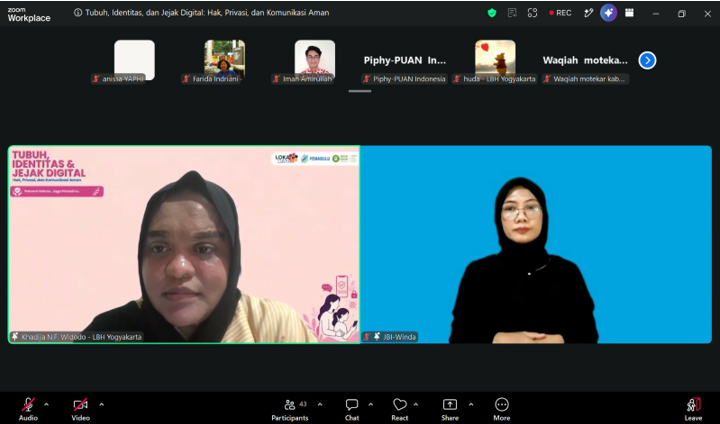
In a warm zoom discussion session on Monday (12/10) with moderator Khadija and Miftahul Huda from LBH Yogyakarta, interesting facts were presented which revealed crucial information about how the digital and physical spaces were connected, and how we could defend ourselves against the risks posed by the digital space.
When Violence in the Real World Penetrated the Digital World
Many of us thought that what happened in the digital world would stay there. Yet the fact was far from it. Miftahul Huda shared LBH Yogyakarta accompaniment experience between 2024 and 2025, where of a total of 35 cases it dealt with, around 31% were physical sexual violence and 22.9% were online-based sexual violence. The boundary between the digital and the real worlds were fairly thin.
“Violence often started in the physical world, such as rape recorded by the perpetrator(s), followed by the digital world through dissemination of the recorded video(s) without consent. Such threats looked real to women, where 38% of women globally experienced online violence,” said Miftahul Huda.
Such attacks forced many women and women journalists to limit or censor their opinions/views for personal safety. This was worsened by the bias in social media algorithm that was not fully gender-neutral, where the algorithm often sped up distribution of sexist contents that demeaned women or blamed victims.
Hidden Danger from Pieces of Personal Information
Understanding digital and personal safety/security inhered a number of facts which people needed to pay attention to. One issue was the danger of pieces of data or known as mosaic effect. Genera information such as address, vehicle numbers, postal code, or school history looked insignificant on their own. Yet, when a combination of such data was compiled, anyone with bad intention could easily map a person’s identity and day-to-day habits.
Miftahul Huda explained that it was important to become aware that photos or recording that showed a person’s face, biometric features, and other body markings were in fact private data that could be identified and were therefore vulnerable to misuse for coercion, blackmail, and harassment.
Three Privacy Dimension and the Myth of “View Once” Feature
Ata protection was closely related to three dimensions of privacy right. The first dimension was information privacy that gave right to control our own data compilation and processing. The second dimension was communication privacy which guaranteed secrecy of digital conversation, for example through the use of encryption. The third dimension was attitude privacy which was the rights that our location, habits, and activity patterns were not mapped without our consent.
On the other hand, we needed to unravel the myth of "view once" feature. Many people felt safe sending photos or videos using this feature, yet the person getting the photos or videos could always record or photographed these by using other software. In the end, safety/security had to start from culture, not simply relying on application.
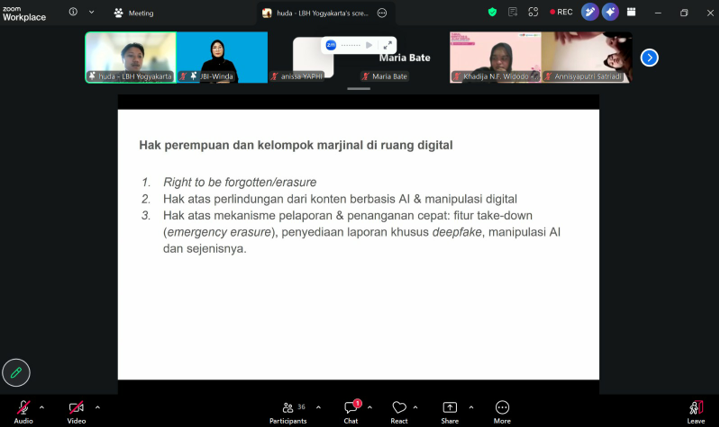
No application was 100% safe from hacking because data leak most often happened because of users’ negligence or human errors. For that reason, it was important for individuals and organisations to build a safe culture and strict Standard Operational Procedure. All these steps would be further consolidated through legal advocacy through Law on Personal Data Protection and Law on Sexual Violence Crimes which provided vital foundations to protect victims and to demand accountability of law enforcement agencies and data administrators.
Practical Steps to Safeguard Digital Security
Prevention was always better than treatment, Miftahul Huda said that there were a number of practical steps to do today to protect oneself and one’s privacy:
- Activate Dual-Factor Authentication (2FA): Apply it on all important accounts such as social media, banking, and emails.
- Use different passwords: Avoid using the one password for all accounts so that if one password was leaked, other accounts would not be threatened.
- Separate digital identity: Differentiate email address for banking/work emails from social media and online purchase.
- Manage account privacy: Check regularly tagging setting and mentions in social media to avoid random tagging in inappropriate contents.
- Pay close attention to Apps Permissions & Cookies: do not just press accept all option when downloading application or searching on the web without checking location and contact access permission.
- Limit digital access to footprint: When sharing document links such as Google Drive, make use the access setting was limited only to authorised personnel and not open publicly.
Digital footprint we left behind could stay for a long time and was beyond our control. Despite law on privacy protection, the best protection started from self-awareness and collective responsibility. Let us create safer, more friendly, and empathetic digital space— for ourselves, our family, and other users! (Anissa Ratna)