



You woke up in the morning, open your mobile screen, and you found that your social media was full of news that made you blood surge? You had not even had the change to have your morning coffee, yet your fingers were busy pressing the keypads to share the news to family contact group. But before your fingers moved further to bring further chaos, why not take a deep breath and talk.
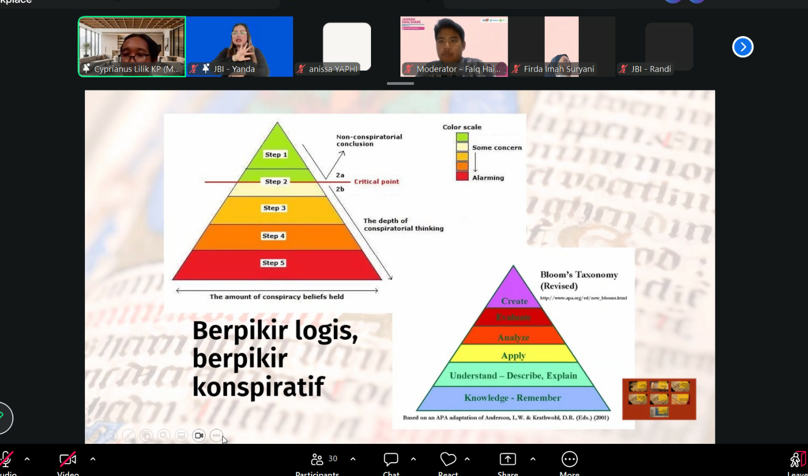
In a lively zoom discussion session on Tuesday (13/10) with Cyprianus Lilik Krismantoro from Masyarakat Anti Fitnah Indonesia (MAFINDO) and moderator Faiq Haidar from LBH Yogyakarta, participants learned that there were many interesting facts about why we were so easy to gullible in the digital world and what would be the most effective way to prevent us being victims of information manipulation.
Information Boom and Our Brain Capacity
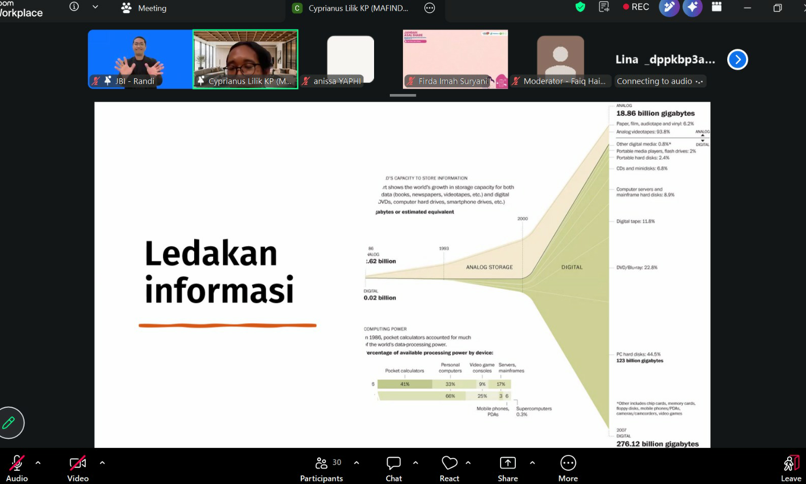
Whether we were aware or not, our way of communicating today had changed completely. In the 1990s or early 2000s, information was generally produced by official institutions that had editors and tight screening process. “Then, not just anybody could publish news to the public. Yet, after the boom of the mobile phone around 2010, everyone suddenly became content makers and had their own information channels,” said Lilik. The problem was that there was overwhelming amount of information today like floods, while our brain capacity and our time to process remained limited. This imbalance led us to take in information without time for critical thinking.
The Hoax Anatomy and Users’ Emotional Manipulation
This lack of critical thinking was not without cause, because hoax makers fully understood anatomy and how human brain worked. Our brain essentially had a fast pathway to our emotion and a slow pathway to our rational thinking, where hoax messages were designed specifically to trigger our emotional reaction.
Lilik explained that manipulative contents were usually made to incite overt emotional reaction such as anger, panic, sad, or excessive happiness. The titles were often clickbait to trigger public curiosity, in order to exploit fanaticism towards certain religions, groups, or political views. At the final part, hoax narratives almost always contained proactive call to readers to spread the messages before the they were taken down.
Three Types of Information Chaos
To understand the information dynamics more thoroughly, we also needed to distinguish three types of information chaos that often happened:
- Misinformation: A condition when a person shared the wrong information but that person was not aware of the mistake and did not have the intention to mislead.
- Disinformation: Information was blatantly wrong and the person sharing it knew exactly that it was wrong and yet deliberately sharing it to deceive/mislead the public.
- Malinformation: True/correct information but deliberately shared or leaked to the public with the intent to destroy a person’s dignity, i.e. in the case of personal data breach or dissemination of intimate photos.
The Danger of Echo Chamber and Algorithm Trap
This condition was worsened by the echo chamber phenomena and bubble filter in social media. Digital platform algorithm was designed to continually show contents which matched our preference and day-to-day habits. If we liked certain topics, the algorithm would feed us similar topics, so that without realising it, we felt that the whole world had the same view as us. This led us to isolation from other viewpoints and led us to believe that other viewpoints were weird or wrong. For that reason, we had to consciously broaden our horizon and seek comparative perspective other than ours.
The AI Era Posed New Challenge and Deep-fake Contents Leak
The Challenges in the digital space became more complex with Artificial Intelligence (AI). In the past, we could still recognise photos or videos that were being manipulated with our own naked eyes, but now AI-based voice cloning and deep-fake technology could produce high-precision engineering. Yet, AI synthetic contents still had flaws we could look out for, such as stiff lip movement and voice intonation, unnatural eye blink, to blurred and flickering skin texture or face area boundaries. WE had to remember that AI was only an aid device, hence we should not let technological sophistication to trigger atrophy in our logical thinking or to weaken our ability for critical thinking.
Practical Steps to Fact Check Independently
To guard ourselves from being scammed, there were practical steps to do independently:
- Take an emotional break: When you receive information that triggers strong emotional reaction, refrain from sharing it immediately.
- Do lateral reading: Open several new tabs in the browser to compare the information with reports from trusted media.
- Use Reverse Image Search feature: If you find suspicious photos or pictures, use Google Reverse Image Search or Yandex to trace the original context and the first time the photos or pictures were uploaded.
- Refer to Verification Database: Use official fact-checking services from organisations such as MAFINDO and Press Council of Indonesia’s verification database.
Wise Approach to Parents and Education Sharenting
When dealing with family members or parents who often shared hoaxes in group chat, the approach had to be highly tactful and did not bruise their ego. Speaking to parents in a condescending tone or blaming them would only trigger emotional self-defence and made them refuse correct information. The best approach was to talk personally and casually offline, or shared official news links in group chat that did not trigger long emotional debate. In addition, it was important to share with them the danger of sharenting – sharing children’s photos or personal data excessively that potentially endangered the safety and growth/development of the child in the future.
To be Sovereign Digital Subjects
In the end, digital footprint we left behind on the would stay for a long time. Amidst the onslaught of algorithm and sophisticated technology, the best protection was to make ourselves introspective, conscious and fully in control digital subjects with regards to the mobile phones in our hands. Technology was present to make it easy and to improve the quality of human life, not to control our mind. For that reason, before we pressed the buttons to share things, made sure that we always asked ourselves whether the information we shared was true and was beneficial to other people. (Anissa Ratna)