


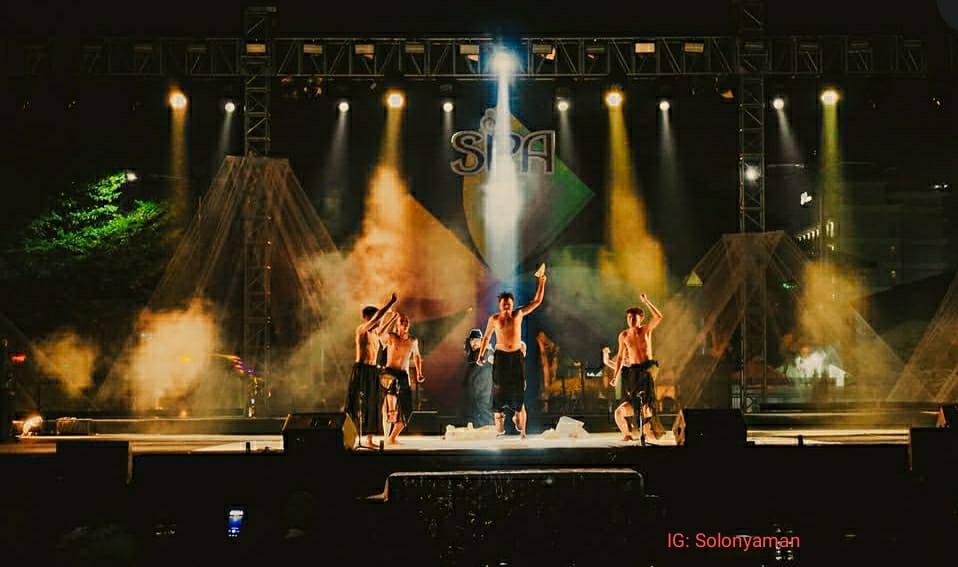

The sound of siren blared on stage. The sound was a signal that something was not right. It came in the midst of the Papuan dancer’s move, pierced trough the performance hall which was previously only filled with movement, sound and lights.
At SIPA 2026 stage, the dancers’ bodies were not just moving to show grace. In combination with Aries BM’s visual art and Ayi Dance’s dances, the dancers’ bodies showcased a story about the land, the forests and the indigenous people of Papua who faced changing living spaces. The performance was entitled Wounded Indigenous Territory (WIT). Aries BM collaborated with Ayi Dance to present the ecological emergency ad humanitarian emergency in Papua. The performance venue at Pamedan Mangkunegaran, Solo, on 11 September 2026, highlighted the expansion of oil palm plantation and monoculture, and the impacts on indigenous people’s life.
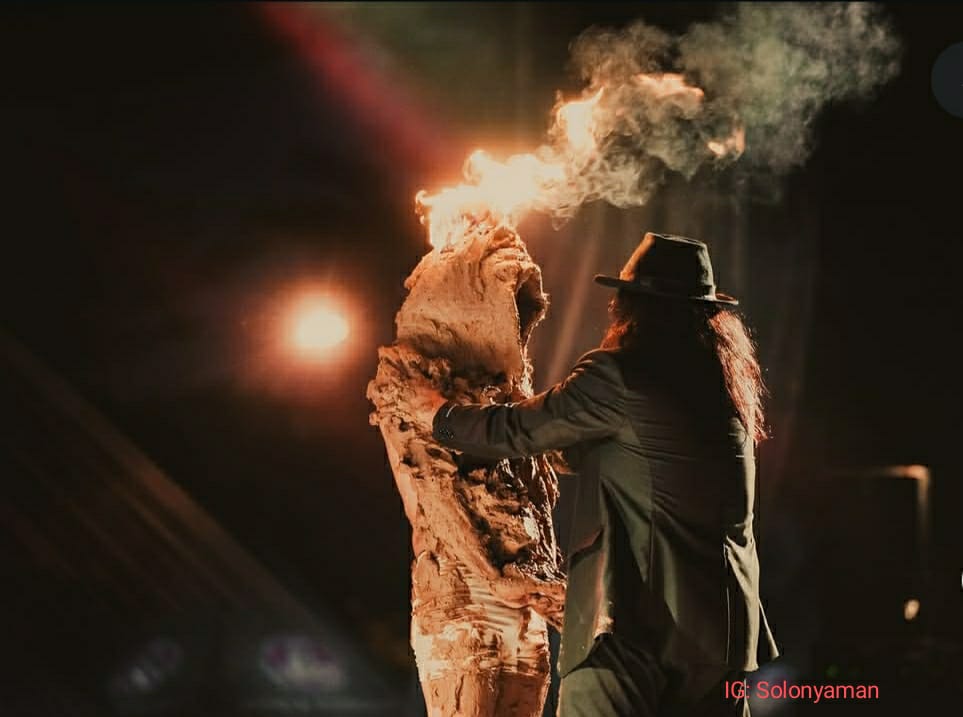
There was an image that was difficult to detach from the human memory after the performance ended. The Papuan humans were present with their heads under the fire flame. In the spectators’ image, the fire followed the bodies movement throughout the performance. Aries BM explained the fire flame as symbol of ecological destruction, suffering that burned living spaces, and spiritual decay within indigenous people who lost their sacred connection to nature. Fire became so very near because it was on people’s head.
Environmental crisis which was usually portrayed in numbers and maps suddenly had its own body. There were humans in it, burnt heads, moving bodies, sound that people heard and the siren that reminded of the emergency situation.
During the performance, there were also voices of women of Papua. That was the high points of the performance. Women’s voices, dancers’ bodies, the siren and the flame met in one room. Each carried its own language and spoke about something difficult that could be summarised in one word - crises. There were many crises there – ecological, living spaces and humanitarian.
Art had a way of making the crises felt so close. Thus far, forest destruction often appeared in numbers. The size of forest cover lost to plantation, investment value, production target and emission data. Numbers were needed to explain the scale of the issue. Art performed a different task. It brought people to those numbers.
When the body of dancers moved, the spectators saw humans. When the spectators heard women’s voices, they heard the women’s experience and cries. When the siren blared, the spectators felt the danger. And on stage, when the fire was lit on the dancers’ head, ecological threats felt so close to the human body. That was art as an alarm. It was not an alarm that gave answer, but an alarm that made people vigilant, stop and see.
From Stage to Screen
A few months prior to the performance, a documentary film “Pesta Babi”: Colonialism in our Age also brought indigenous South Papuan people to the public arena. The film by Dandhy Laksono and Cypri Dale presented the life of indigenous people in South Papua, including Marind, Yei, Awyu and Muyu, in the midst of changes in their living spaces as a result of large-scale food, plantation and industrial projects.
In the film, the Papua issue was examined up close through the lives of people who lived in those areas. In a discussion at Muhammadiyah University in Yogyakarta, Dandhy highlighted that the people only looked at the Papua issue from the economic development aspect, which in itself was not enough. The way indigenous people understood the significance of their living spaces, culture and environment was critical part of understanding the issue.
At that moment, Pesta Babi and Wounded Indigenous Territory met. It was not because the two told a similar story. It was not that the two used a similar medium either. It was because the two chose art as a medium to present the Papua issue to the public. One was using camera, the other was using the human bodies. The film record faces, sounds/voices and community life. The performance showcased human bodies, sounds/voices, symbols and movement. Both never simply treated the forests simply as a landscape.
Forests as Living Spaces
When forests were not simply forests, there was a tendency to see the forests from its economic function. Forests could be transformed into plantation areas, sources of raw materials, food production zones or parts of development projects. For indigenous communities, relation with the forests had vast multiple layers.
The forests contained food, knowledge about plants and relation with the rivers and animals. There were places of significant cultural values, and memories of ancestors. For that reason, changes in the forests also meant changes in life. This was what Pesta Babi portrayed through its story of indigenous people in South Papua. A number of reports about the film noted the issue of deforestation and changes in life spaces associated with the expansion of plantation and large-scale food and energy projects.
Meanwhile at SIPA stage, the issue was not elaborated through long interviews. Only the bodies spoke, the fire spoke, the siren spoke, and the women spoke. All those acted as pieces of the story that asked participants put together the relation between humans and their environment.
The presence of Papuan women’s voices gave a different perspective. Women were not only spectators or background of ecological issue. Their voices were part of the performance.
There was something important when women’s experience entered the story about the environment. The ecological issue finally connected to daily life. Food, water, family, work, health, and children’s future were all related to the environmental condition. For that reason, the women’s voices did not need to be presented in dramatic fashion. Their voices had significance.
Art as Space for Testimony
Art did not replace advocacy. It did not replace research, documentation, policies or indigenous people’s struggle. Art had its own way. It touched the memory, moved emotion, get people to see issues that might have looked so distant to them. A spectator who never set foot in Papua might not have known how indigenous people found meaning in the forests. But that spectator could see the dancers’ movement and heard the voices from the stage. That spectator might not have known all issues about large-scale plantation. But he/she could see the big flame on human heads. He/she might not have followed all the debates about development policies. Yet, he/she could hear the siren.
From that sensory experience, a question arose. What was happening in the human living spaces? That question was critical as ecological crisis was not simply about nature. It was also about human relations with nature. About who had relation with the land, who had the voices when an area changed, what was considered important when development was designed and about the future under discussion.
In the end, the power of the performance such as Wounded Indigenous Territory bukan lied in its message. There were images fixed in the spectators’ mind. That was also the case with the film Pesta Babi. It presented a story of indigenous people in South Papua through documentary and showed that the land, the forests and the development brought consequences that people who lived there felt in their life. The stage and the screen met at one point. Both made things that felt so far to be so near that Papua was no longer a point in a map. The forests were not simply numbers in a report and the land was not simply an expanse waiting for investment. Within them, there were people, voices, culture, memories, and future.
When the forests change, what did we actually lose?