



The Indonesian Women’s Movement or known as Gerwani was one of the largest women’s organisations in Indonesian history. Prior to its ban in 1966, the organisation had millions of members and had extensive involvement in social issues.
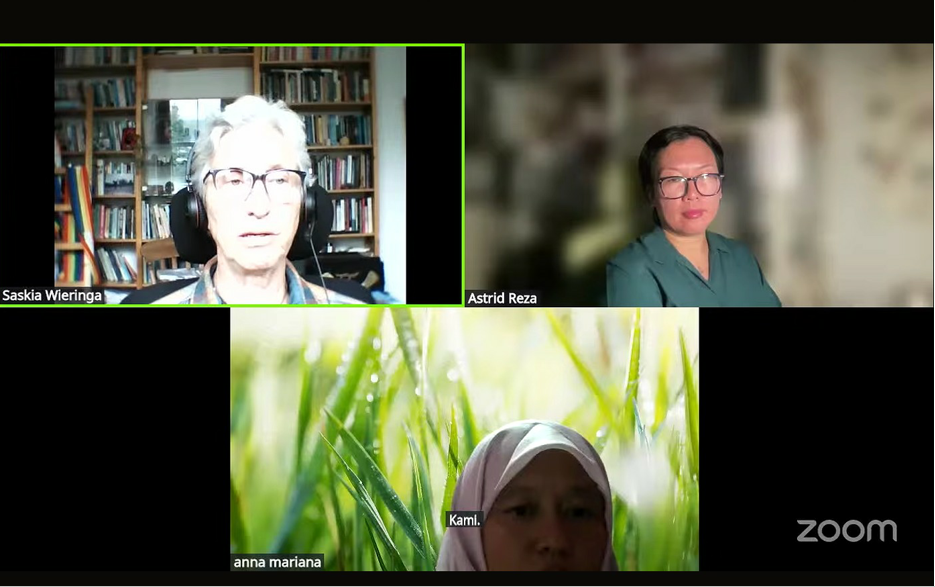
However, the public’s collective memory of Gerwani was often distorted by a single narrative constructed during the New Order era. To understand this organisation comprehensively, the presence of researchers like Saskia Wieringa and Astrid Reza in the online discussion organised by Logosid on Saturday (10/10) entitled “Witchhunting and Gender Panic in the 1965 Genocide” provided an invaluable perspective in uncovering the veil of history.
The Perspectives and Inquiries of History Researchers
In her presentation, an academic and social-feminist researcher from the Netherlands, Saskia Wieringa examined the history of Gerwani from its establishment to its eventual destruction. Based on in-depth research she had conducted since 1970s, Saskia found that Gerwani originated from a mass movement that was very active in defending the fate of ordinary people, particularly workers and women in rural areas. “However, following the 1965 events, the New Order regime deliberately created propaganda and sexual slander to destroy Gerwani;s political legitimacy,” Saskia explained. This narrative was used to marginalise independent women’s movement and to push women’s roles back to domestic sphere. Saskia’s hard work in uncovering these historical facts even led to her being threatened and prohibited from entering Indonesia until 1998.
Meanwhile, a researcher on the history of the women’s movement and an alumnus of Gadjah Mada University, Astrid Reza focused her presentation on the symbolic aspects and the development of historical research regarding Gerwani. Astrid emphasised that efforts to re-examine the history of Gerwani continued to grow through digitalised archives, art performance, and independent discussions as a way to challenge narrative restrictions in formal school curricula.
The Philosophical Meaning behind Gerwani’s Logo
Through archival research, Astrid also dissected the philosophy behind Gerwani’s logo which was rich in the meaning of women’s struggle. Citing Gita Mukherjee’s 1957 writing - re-published in the book Sekapur Sirih Gerakan Wanita Indonesia – Astrid noted that the symbolism and meaning behind the logo of Indonesian Women’s Movement or Gerakan Wanita Indonesia (Gerwani) presented a complete and highly valuable historical perspective. Reading this logo revealed how aesthetics, social vision, and the spirit of women’s emancipation were deeply woven together, while simultaneously rectifying stigmas that had overshadowed the organisation’s narrative for decades following 1965.
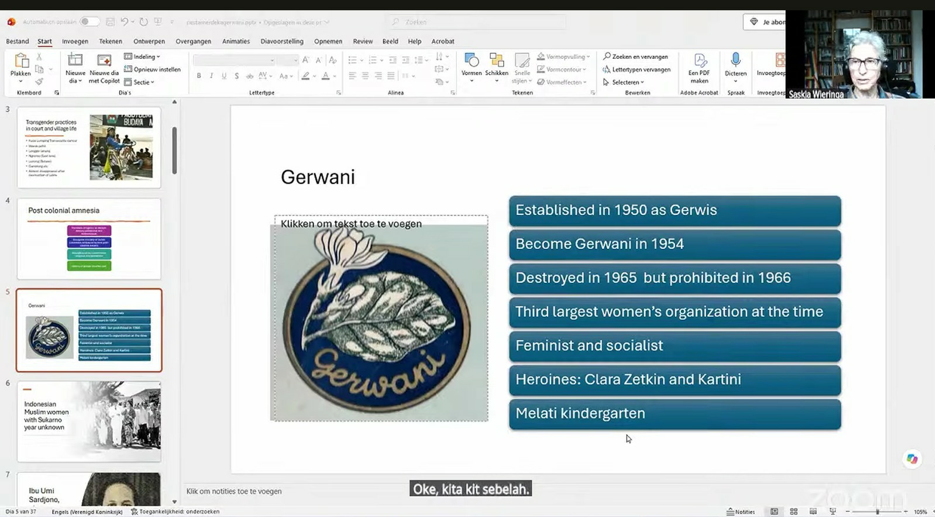
In the collective memory shaped by New Order propaganda, the logo and existence of Gerwani were often associated with the dark narrative and fear. However, when the pre-1965 archives were re-opened, the first impression emerging from the emblem instead conveyed beauty, gentleness, as well as elegant courage. The logo used a blue background, a colour that universally symbolised peace fighters. In the centre of the blue background, there was a white jasmine flower depicted with buds and blooming petals piercing through and shattering a yellow circle.
Every visual element in this logo held a social and political philosophy closely tied to the reality of Indonesian women at the time. The fragrant and delicate white jasmine – traditionally often used to adorn the silky black hair of an Indonesian woman – was elevated as a symbol to represent all women in Indonesia. Within this emblem, jasmine was no longer an ornament or visual embellishment, but transformed into a symbol of courage and source of inspiration for women to become the sole owners of their own lives.
The flower buds on the jasmine stem symbolised children and future generations that had to be protected and raised with live and peace. Meanwhile, the green leaves attached to the stem symbolised the pulse of life itself. As for the yellow circle of the jasmine flower, it symbolised the feudalism and social backwardness that confined and restricted women’s movement in Indonesia for years. The blooming and breaking through of the jasmine flower across the yellow circle illustrated the role(s) of Gerwani as a movement that helped Indonesian women to fully bloom, and to free themselves of the shackles of feudalism, and seized equality.
In addition to visual elements such as flora and colours, the writing of the name "Gerwani" in the Latin script also held a distinct place in the logo philosophy. The use of Latin letters emphasised the organisation’s connection to Indonesian language, which at the time was widely used by the general public, both in urban areas and remote villages. The inscription signified a modern and inclusive national spirit.
Gerwani’s Contribution and Positive Impacts on Society
Looking back at its historical records, Gerwani initially played a positive role in society. The organisation vigorously ran literacy programs for rural women and advocated for family rights, such as rejecting polygamy and fighting for the protection against domestic violence. It also established free child care and kindergarten to help women who worked as farm labourers, factory workers, and market vendors. At the international level, Gerwani actively voiced world peace and children’s rights through Global Women’s Federation.
Construction of Stigma and Negative Image Post-1965
However, all of those social achievements were overshadowed by a massive negative image constructed after the incident in 1965. Through social media, propaganda films, and museum dioramas, Gerwani was accused of committing cruel acts and performing erotic dances against the generals at Lubang Buaya. In addition, Gerwani’s independence was erased by fully equating it as part of PKI (the Indonesian Communist Party), even though Gerwani was an autonomous organisation that happened to collaborate with the progressive political lines. The ruling regime used the propaganda to tame critical women’s movement and restricted their roles solely to domestic affairs.
Hope of Recovery for the History of Women’s Movement
In the end, re-examining the history of Gerwani with a clear mind was not aimed at ignoring the political dynamics of the past, but rather at correcting historical facts and restoring the honour of women’s rights movement in Indonesia. By opening access to archives and broadening the academic discussion scope, communities were able to assess the value of the countries historical journey in a wiser, fairer, and objective manner. (Anissa Ratna)