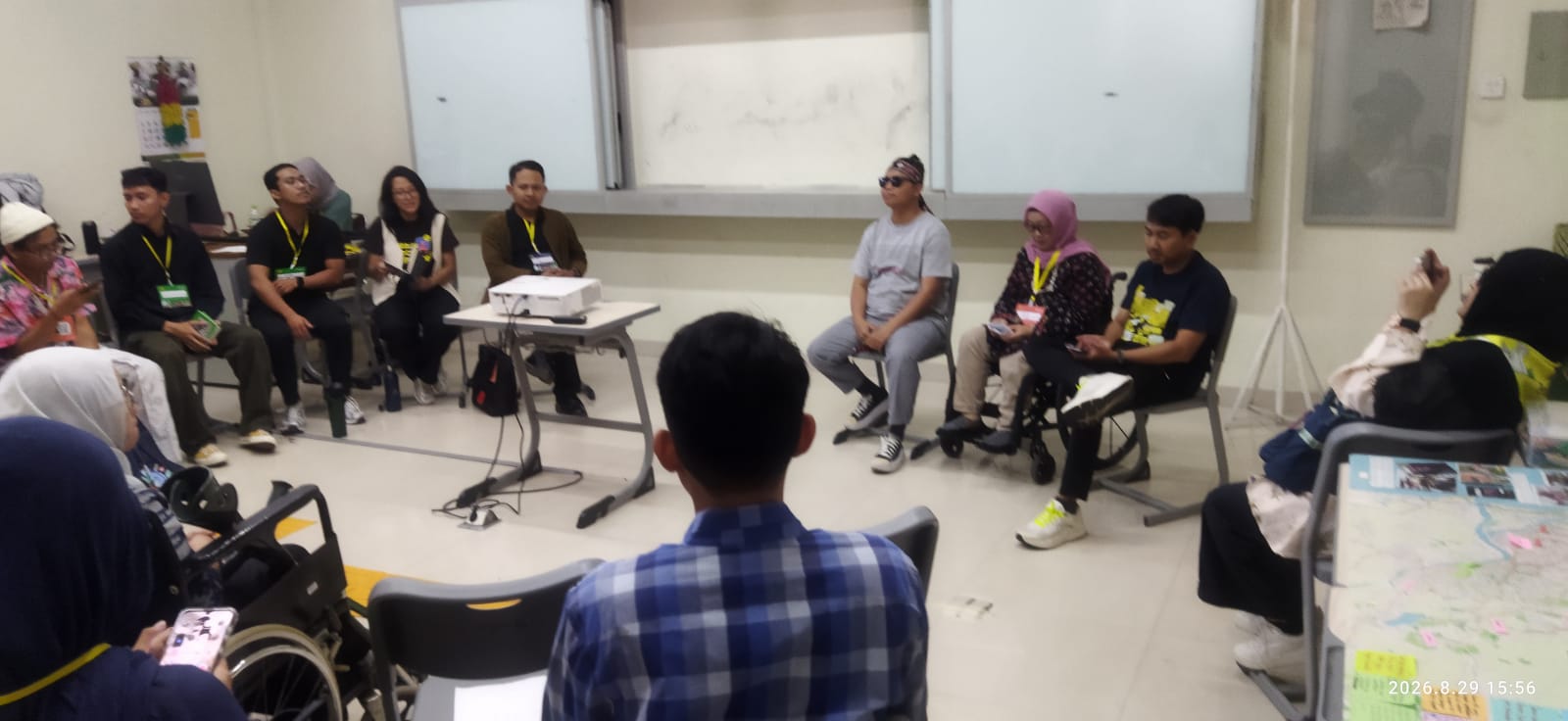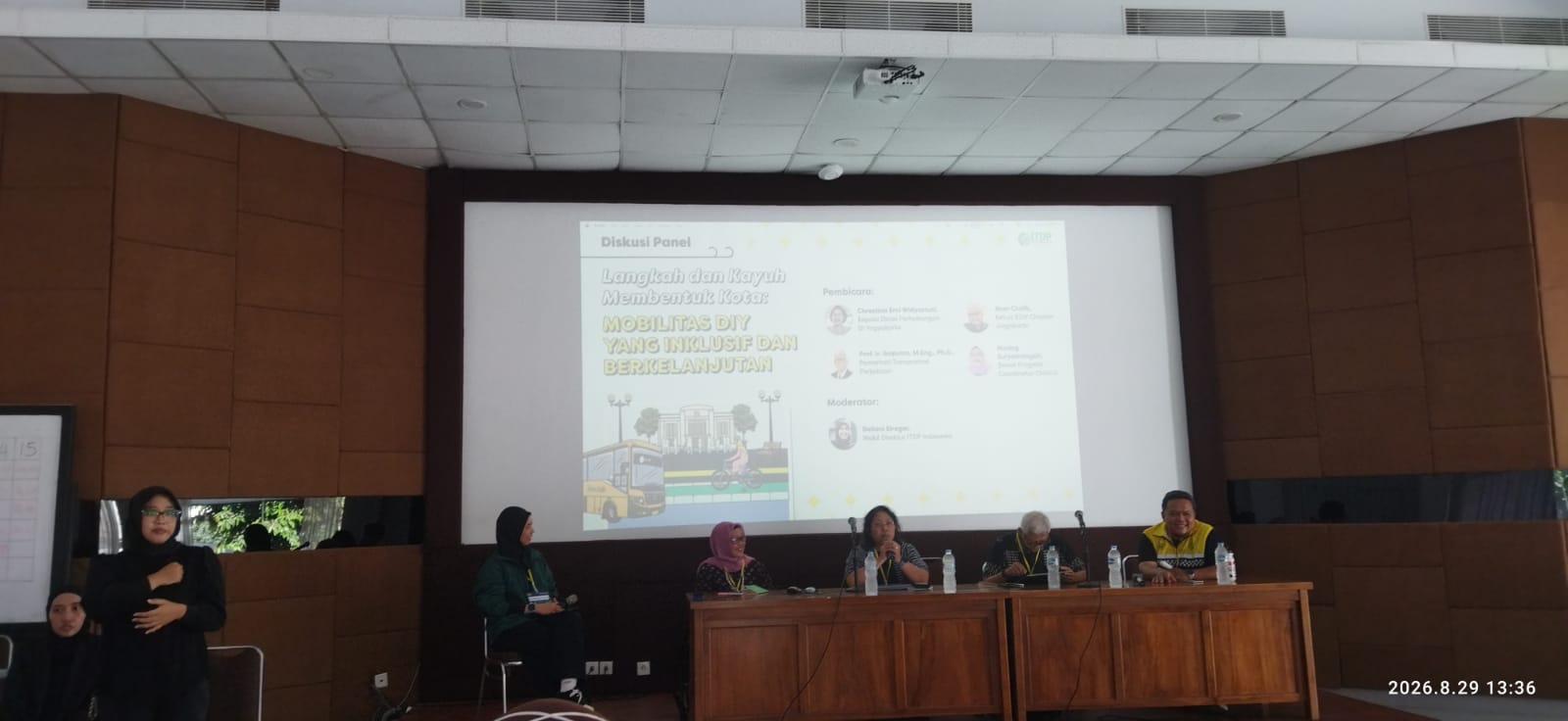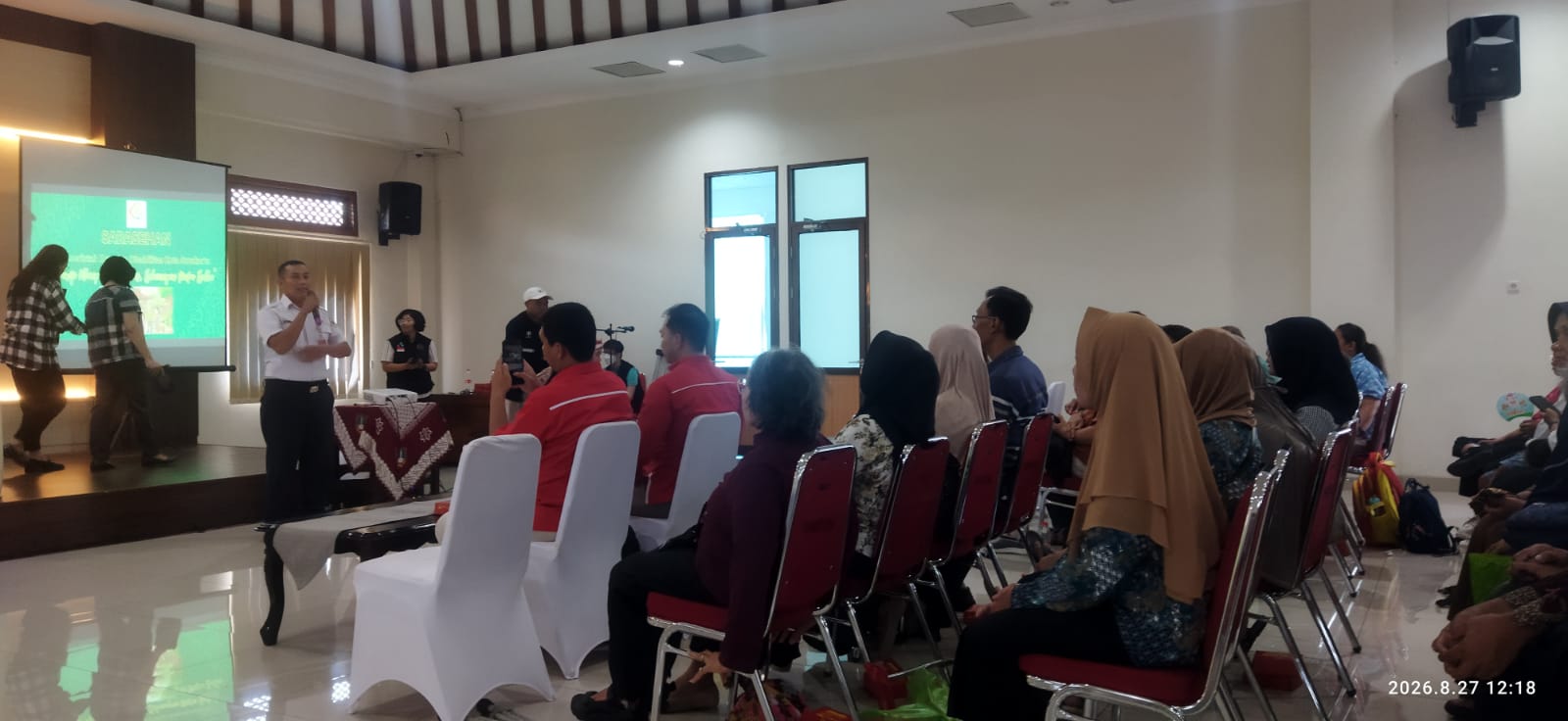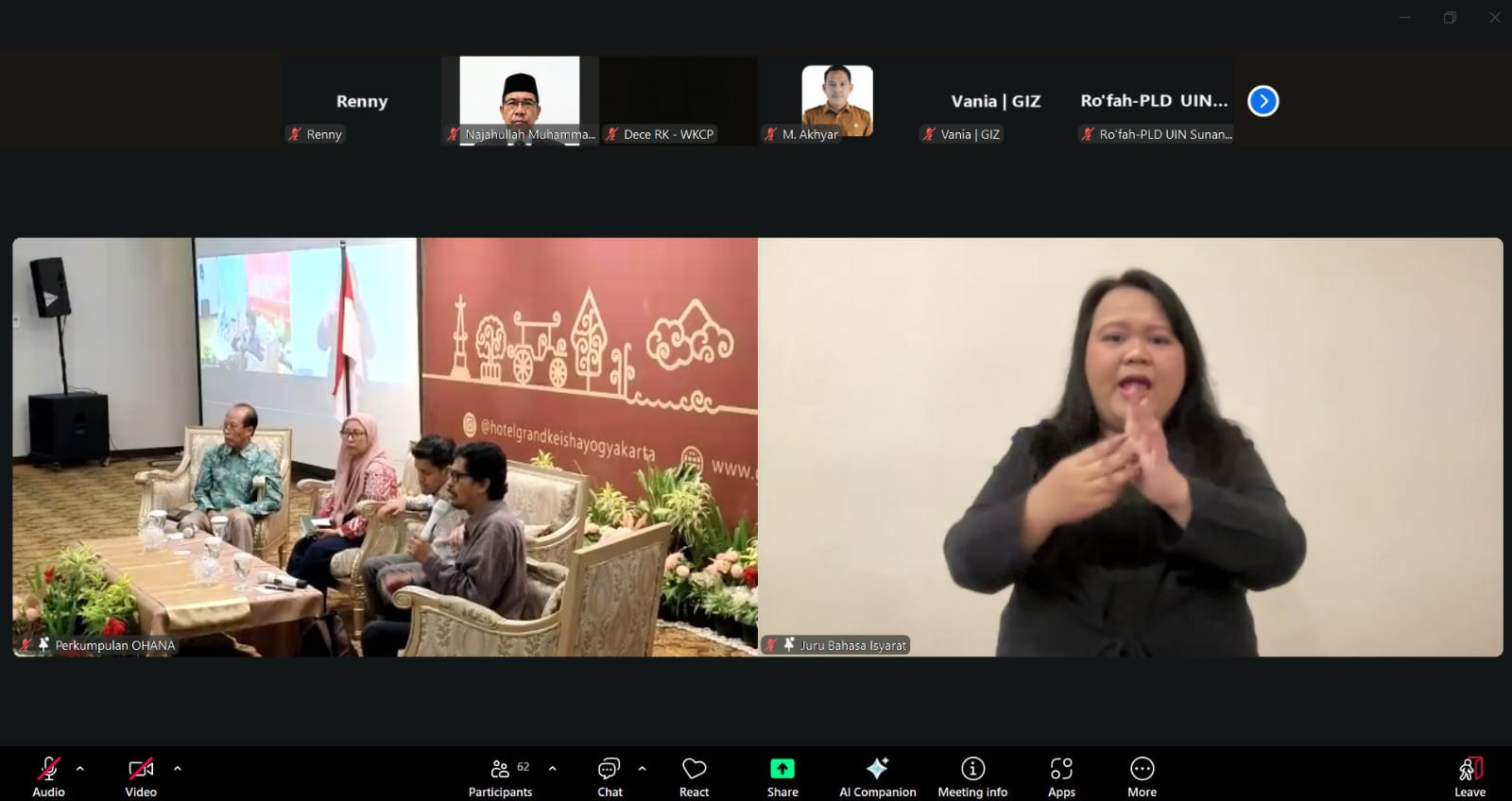



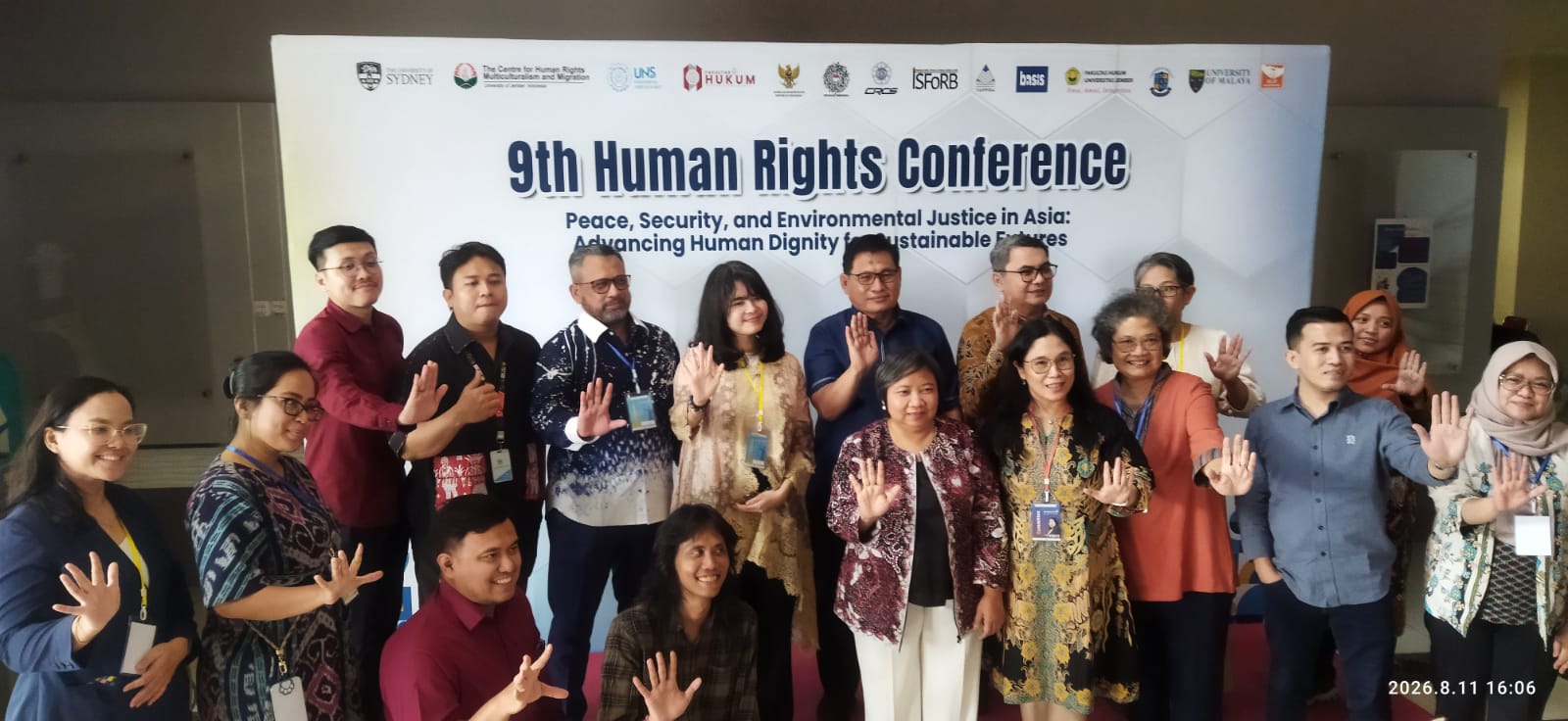

The discussion on the draft Law on Human Rights at the Pertamina Hall Building 4 Floor 1, The Law Faculty of Universitas Sebelas Maret (Sebelas Maret University), on Tuesday 11 Agustus 2026, did not stop at issues about norms. The discussion went to a more fundamental question – who would take control of human rights enforcement in Indonesia?
The forum organised by National Human Rights Commission invited academics, legal aid organisations, civil society organisations, people accompanying victims, and the chairperson and Commissioners at National Human Rights Commission - Anis Hidayah, Uli Parulian Sihombing, A.H. Semendawai, and academic from Universitas Sebelas Maret, Erna Dyah Kusumawati. They analysed the draft human rights law that remained problematic, from issues about definition of human rights, the position of National Human Rights Commission, Authority of Investigators, Protection of Human Rights Defenders, corporate responsibilities, and relationship between State security and protection of its citizens.
For the National Human Rights Commission, the law revision was important. The new law was expected to consolidate the mandate of the organisation and to adjust it to the development in national laws and international human rights standard. Yet, in the draft under discussion, there were a number of stipulations that potentially weakened the independence of the National Human Rights Commission.
The first issue was about the organisational nomenclature. In the draft version of 5th August, the National Human Rights Commission was designated as a State Agency. At the same time, the draft also stated that in doing its tasks, the National Human Rights Commission was independent. For the National Human Rights Commission, those two statements were not sufficient.
The resource person from the National Human Rights Commission reminded that the current Law articulated that the National Commission was an independent agency. The Constitutional Court Decision No. 30/PUU-XX/2022 also re-affirmed the position of the National Commission as a State Agency with a different character from other agencies. For that reason, it wanted that that independent was mentioned explicitly in the new law.
Its reservation was not unreasonable. If the National Human Rights Commission as an agency was considered part of the State structure but the monitoring mechanism was closer to the government and the parliament, then its space as independent agency became much narrower.
One major issue was about the parliament obligation to conduct monitoring on the implementation of human rights fulfilment every other year. That question looked fairly simple - Who was tasked to monitor the State when the State acted simultaneously as the main object for human rights monitoring by the National Commission.
If monitoring task was given to the ministry and the parliament, then there was the concern about conflict of interests. An agency that was part of the power structure potentially was given the mandate to monitor implementation of human rights obligation by the government.
“If it is about self-monitoring, how to ensure that the result is objective?” the anxiety read in the forum.
The Authority Potentially Overlapped
The next issue was about preliminary inquiry and investigation of serious human rights violations. The revision draft mixed a number of terms and authorities. The National Human Rights Commission had the mandate to make an investigation about serious human rights violations as articulated in Law No. 26 Year 2000 on Human Rights Court. Yet, that authority was different from an authority for inquiry.
In practice, National Human Rights Commission investigation stopped at a certain stage and the results were submitted to the Attorney General for further processing. The resource person from the National Human Rights Commission highlighted that the agency did not dream of having an authority like the one given to the Anti-Graft Commission. The National Human Rights Commission asked for clearer statement about authority.
The issue became even more complex after the criminal legal system changed. In the new Criminal Law, there was a category of new investigators. The question was whether the National Human Rights Commission would be part of that category? If so, what would be its authority? The National Human Rights Commission itself stated that it may not necessarily want the full authority for investigation.
What was needed was legal certainty about who did what. To date, the resource person from the National Human Rights Commission stated that kits organisation worked by sending notification letter with regards to investigation of serious human rights violations to the Attorney General. The National Human Rights Commission had no authority for coercive measures.
The forum even revealed that the National Human Rights Commission had asked the Attorney General to use coercive measure. Here lied the critical relationship between the National Human Rights Commission and the Attorney General. If the revision of Law on Human Rights was done without re-visiting the Law on Human rights Court, there would remain gaps in authority. “They should be one package,” was one idea that had emerged. Change in criminal law and Criminal Code also had effects on mechanism to address serious human rights violations.
Who Were the Human Rights Defenders?
Another intense debate was about human rights defenders. The new draft did not give enough definition of who were the human rights defenders. That question was not simply about definition. It was directly relevant for protection.
Were human rights defenders only lawyers? What about paralegals, academics, researchers, journalists, activists, people who accompanied victims, civil society organisations’ activists, or even State officials who implemented their mandate to protect human rights?
The resource person from the National Human Rights Commission explained that the concept of human rights defender developed internationally. Human rights defenders were not limited by profession. The key principle was that there was participation in protection and promotion of human rights through peaceful means and respect for universal human rights principles. The issue became sensitive when protection of human rights defenders was connected to State certification.
There was once the idea that human rights defenders got their certification from the Ministry of Human Rights. That idea was rejected because it potentially made the government as the party to decide who would be eligible to become human rights defenders. In practice, a person being criminalised for his/her activism for protecting human rights could asked for clarification from the National Human Rights Commission.
If the government were the party to certify the status, the independent mechanism for protection would be questioned. "When a person criticised the government, could the government decide whether that person was a human right defender or not?” was a basic question in the discussion. The National Human Rights Commission argued that the government could give its support to human rights defenders, but that support should not interfere with their independence.
Corporation and Their Human Rights Responsibility
The draft Huan Rights Law appeared in the discussion about individual and corporate responsibility. Number of participants viewed that there were a number of overlaps between State, individual, and corporate obligations with regards to human rights protection.
In the International Human Rights Principles, the State had the obligation to respect, protect and fulfil human rights. Corporation, in the meantime, had the responsibility to respect human rights. That distinction in terms was not simply semantic. It defined who had the obligation and how that mechanism was accounted for.
For that reason, when the daft human rights law mentioned that corporation had responsibility to implement human rights, the question then was, what form of responsibility? Hoe was it enforced? And which legal forum had the authority to investigate if there were infringements?
The Forum also questioned the idea of establishing or widening the human rights court mechanism. If the human rights court as set up or its authority was widened without a clear relationship with the existing court mechanism, the potential for overlaps increased.
Indigenous Communities and FPIC
The human rights issue was brought to more concrete focus: land, forests, and indigenous community living spaces. The principle of Free, Prior and Informed Consent or FPIC received a major attention. FPIC basically placed community endorsement as critical part of a project or policy that impacted their life. yet, it would be difficult to implement the principle when the indigenous communities themselves were not recognised.
One example was the case with indigenous community in Rempang as mentioned in the discussion. When a community was deemed to have no right to the land where they lived, the space for endorsement disappeared. The same thing would happen in extractive projects in Papua and Kalimantan. That was the argument proposed by Erna Dyah Kusumawati.
She said that the issue was not simply about whether a project had the legal basis. The State had to test whether the policy was truly needed, proportional, and offered benefits to the community. In that context, a balance between State interests and human rights had to be tested.
If national security reason was used to justify limitation on people’s rights, that limitation had to meet the necessary legal standard, the actual needs and the proportionality. “Was the policy truly for the State interests?” was an unavoidable question. That was key question by Erna Dyah.
When Victims met the State
Discussion about institution was relevant with the experience of the victims. Haryati Panca Putri from Yayasan YAPHI told of her experience accompanying victims of serious human rights violations. She questioned how a balance between State security interests and victim protection could be guaranteed in the new law.
She talked about an experience when a representative of the Ministry of Human Rights came to the vicinity of a victim’s house, met with local neighbourhood and hamlet chiefs, and asked whether the victim received a notification letter for non-judicial settlement or certificate of victim of serious human rights violation (SKKPHAM).
For the person accompanying the victim, that approach created a new problem. Not all neighbours knew that a person was a victim of serious human rights violation. When a state representative came and openly asked the status of assistance and the victim identity, that potentially revealed victim’s identity to the neighbours.
Another issue was the promise of assistance that may not come immediately. The National Human Rights Commission explained that the mechanism for victim recovery proceeded in two key paths – protection through LPSK (Victim and Witness Protection Office) and non-judicial recovery. Yet, the protection capacity remained limited.
The change in nomenclature within the ministry led to more complicated problem. When the ministry changed, there had to be unambiguous legal basis so that victim recovery program could continue. At this point, revision of human rights law was no longer simply about drafting articles of the law. It was about the lives of people who had waited years for legal certainty.
Six Sub-National Offices for a Vast Nation
The issue about capacity was critical in the discussion. Anis Hidayah argue that the National Human Rights Commission had limited human resources and sub-national networks. With a vast mandate and a number of laws t implement, the institutional capacity of the Commission was simply not sufficient for the task given.
The National Human Rights Commission had a number of sub-national offices. While the draft law articulated larger obligation to establish sub-national offices, the question was: where would the budget coming from? That question became increasingly important as budget efficiency policy kicked in which affected many State agencies. Establishing sub-national offices necessitated human resources, budget, infrastructure, and work system.
When obligation was expanded without resource supports, the new mandate would only become a burden for the Commission. The limited number of commissioners was a major challenge. With nine commissioners, they could not work like law enforcement agencies with a large structure and vast authority.
Revision Should Not Create New Problems
Kekhawatiran mengenai arah revisi Undang-Undang HAM disampaikan pula oleh Anis Hidayah articulated her concern with the direction of the revision of the human rights law. She argued that the draft that was in circulation contained serious problems because it mixed human rights institutional issues and human rights norms. The idea to merge a number of human rights institutions into one institutional design was dangerous because each institution had specific mandate and characters. She also criticised the idea of certifying human rights defenders.
To her, there had to be monitoring since the beginning stage of revision so that the revision did not make the law into an instrument to consolidate government control over civil society. In her view, the State had to consolidate the norms and mechanism of human rights enforcement, rather than simplifying the whole of human rights issue into one ministry.
The Forum finally showed that the key issue was not whether revision was needed for the old law. What was more important was why was the revision necessary and who gained larger space/authority after the change was in effect. Would it lead to a State’s more consolidated efforts to protect its citizens, or conversely whether it led to the State becoming stronger in controlling an agency that was supposed to monitor the State?
That question was even more relevant when the discussion shifted to past cases. In the May1998 case, for example, the National Human Rights Commission had called a number of parties through the Lower Court in Central Jakarta. Yet those calls were never heeded. On the other hand, Law No. 26 Year 2000 gave a specific mandate to the National Human Rights Commission to conduct investigation of serious human rights violations, while aw No. 39 Year 1999 became the legal basis for the National Human Rights Institution.
The tension between the two laws showed that human rights problems in Indonesia was not simply about the lack of norms, but also the design of institution and law enforcement. For that reason, a number of participants demanded that the revision did not go on its own. Law on human rights court, procedural law, mechanism for victim protection, and the position of National Human Rights Commission had to be discussed as well in one reform framework.
At the end of the discussion, one agreement was evident, there had to be continuous monitoring of the revision process. It should not only be done by the National Human Rights Commission, but also by academics, legal aid organisations, civil society organisations, people accompanying victims, indigenous communities, and groups at the frontline for defending human rights. A law on human rights did not just talk about the State. It talked about how far a State was willing to limit its power when face-to-face with people’s rights. That was the real and biggest test for the draft law. (Ast)