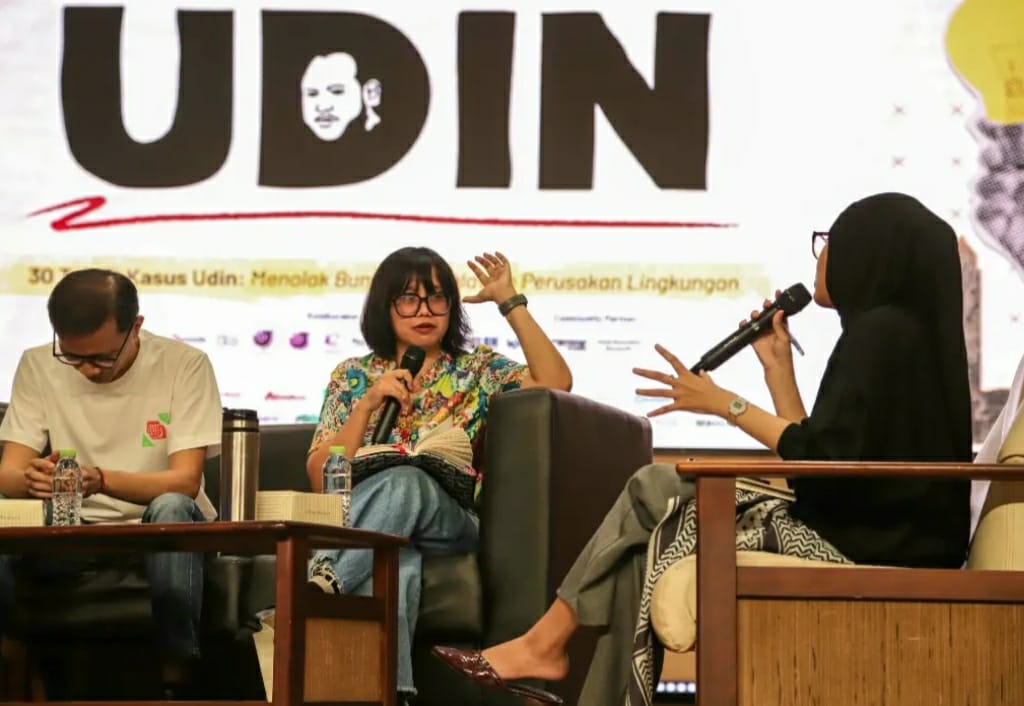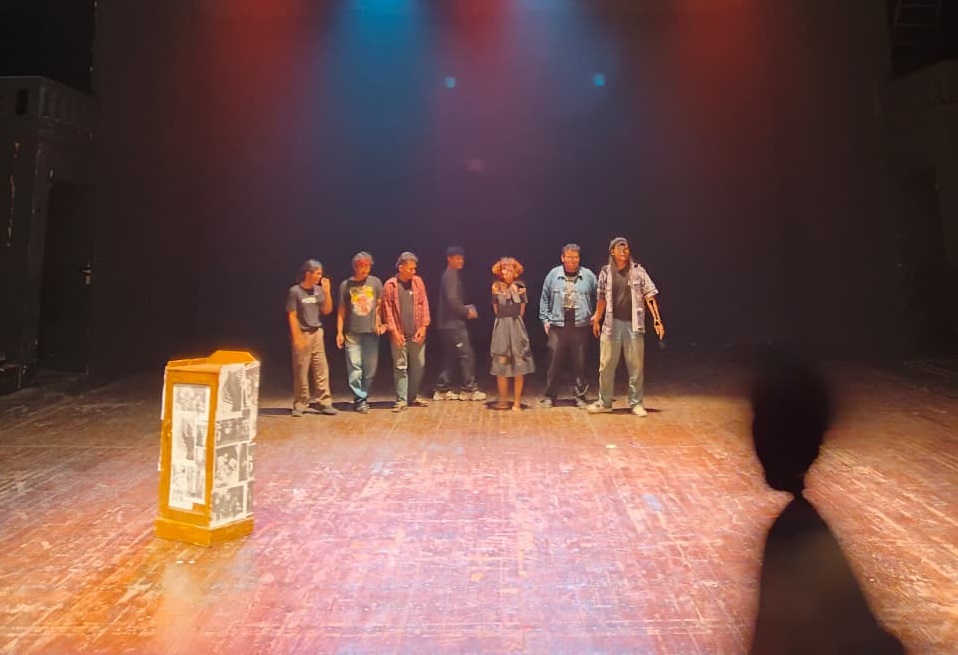



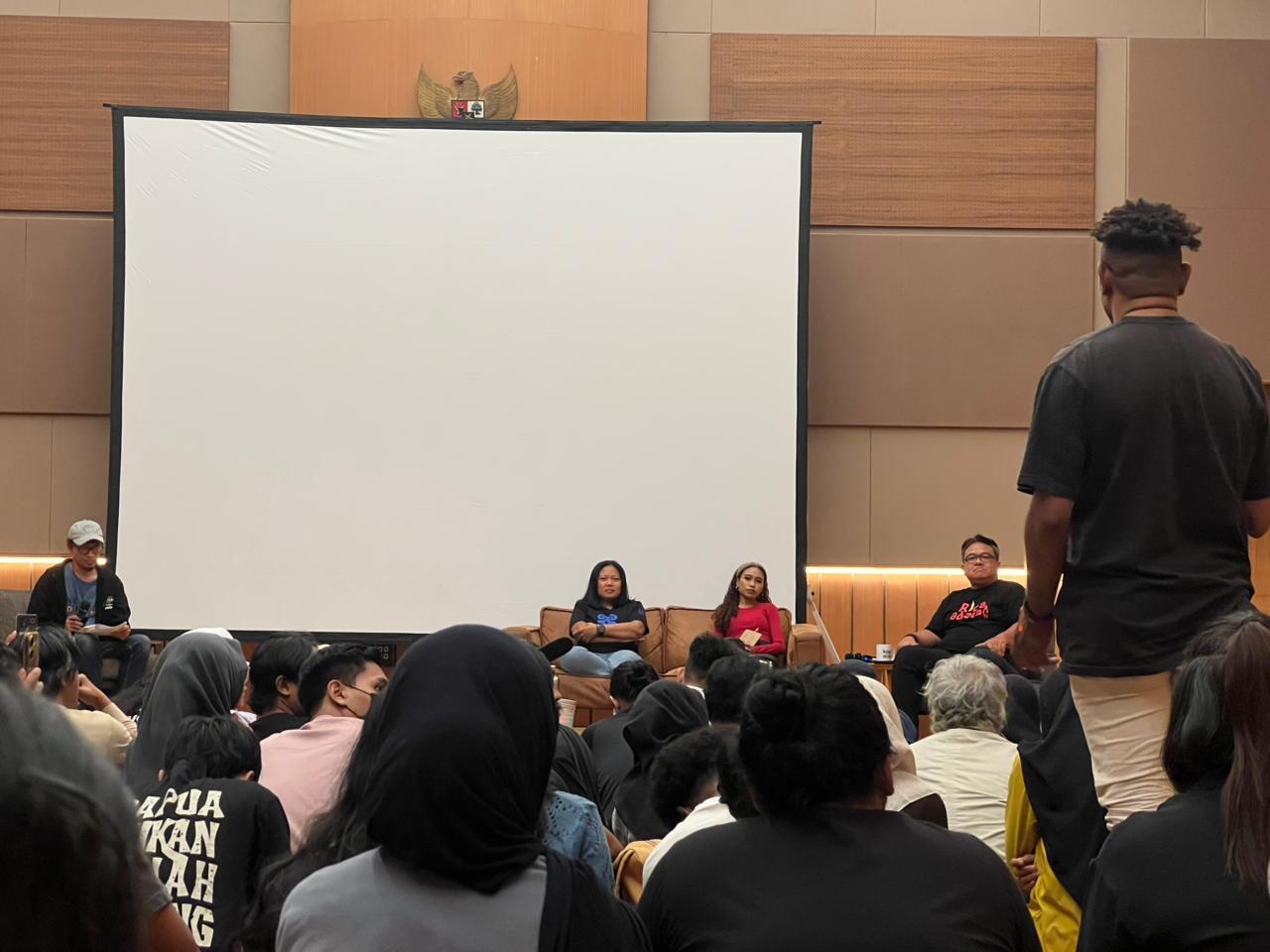

Film Pesta Babi not only presented a story about Papua on screen, but also opened past wound and memory that lived in silence. Maria Sucia worked on Papua issue since 2012 and used to live in Asmat, and found it difficult to describe her experience watching the film. She felt suffocated, angry, and bitter fact that not much had changed since many years ago. Her description served as an opening to discussion moderated by Sonsky Mardika after the film presentation at Lokananta, on Sunday (10/5).
Maria remembered how people in Asmat lived in limited circumstances, while many job opportunities were filled by newcomers from Java. Even she was called “pinjur” in 2013—a minor experience that described the social gaps and inequality there. In such situation, she also remembered a map that explain the “core happening in Asmat”: mapping natural resources, land, and riches that eventually went to big powers that took the land of the people, known as “Paman”.
A Papuan woman and a frequent speaker, Melanisia Wamafma stated that development in Papua often came from government’s and corporate’s view which placed land as resources for economic fortune. Yet, for indigenous people, land was not merely asset to make profit. Land was a living space, forest was source of food, and nature was part of identity and inheritance given by the ancestors. In the view of indigenous people, land was not a commodity, but life itself.
Melani explained that conflicts often happened because they government forced its concept of development without understanding the needs of Papuan people. The State saw big projects, plantations, or companies as symbol of progress, while indigenous people asked: development for whom? For Papuan people, or for the interests of the State and investors in Jakarta?
When Papuan people were used to live off sago, cassava, and local food system, the government brought oil palm and rice that shift the social structure, culture and local spirituality. The shift not only changed food consumption, but also destroyed community relations with the land and nature.
For this reason, development in Papua had to listen first to indigenous voices. It should not have come from heavy machineries and unilateral decision, but development based on Papuan needs, culture, and life values.
The Film Pesta Babi emerged out of concerns with regards to the lack of wholistic narrative about. In discussion with Dandhy Laksono, Sonsky suggested how Papua experienced some kind of “cultural imperialism” that continued since colonialism and structural violence. Dandhy explained that stories about Papua were often fragmented: some talked about the environment, armed conflicts, humanity, or indigenous people separately. Yet, all were connected and happened in the same location.
Dandhy believed that Papua was an unfinished mirror for Indonesia with all its problems. Ironically, in the midst of global internet and social media connection, the reality of Papua was drowned from public attention and algorithm. Many tragedies were so nearby, yet they felt so far away from people’s consciousness. The film was an attempt to present the disenfranchised voices, and reminded that the Papuan problems were not new but a continuing series of problems that kept happening to date.
In answering a question from a discussion participant, Maria suggested that development and land certification in Papua not necessarily brought goodness to indigenous people. She said that when land was certified under a personal name, indigenous people’s living spaces were easily divided and companies could easily come in. In the past land was protected by indigenous clan and ethnic groups. The result was horizontal conflicts amongst families as borders stated to appear in place of past practices of remembering border through collective memory, and people were forced to use the State administration logics.
She also questioned the “progress” often forced by outsiders in Papua. For Maria, progress was not only measured by roads, companies, or number of newcomers. Because, as access opened up, indigenous people were squeezed out in their own land. Local knowledge such as searching for sago, reading nature, and living in the forest slowly were no longer deemed important as education and development were driven by city perspective.
For that reason, Maria believed indigenous people needed to maintain their land and identity by collective actions, that fit with local knowledge and needs.
Melani answered a question that it was critical to map the indigenous territory in Papua in order to protect people’s right of their land. In changing times, the young generation no longer had the ability to remember territory boundaries as the previous generation. Hence, family conflicts often emerged because people believed they have the rights over the same land. In such situation, mapping indigenous territory became critical in order to clarify the history and border of collective ownership.
Melani believed that maps were not only about administrative issue but importantly a form of protection for indigenous people from unilateral claim by the State and companies. When one group had documents of its territory, other groups started to realise the importance of documenting their respective land to avoid confiscation by others. She believed that this process reflected a form of collective awareness to maintain living space for indigenous people.
For Melani, success was not determined by State development standard, but by community ability to maintain their land, inter-family relations, and their own identity.
With regards to the issue of health and women’s position in Papua, Maria highlighted the inequality in health services and development in Papua, particularly in relations to women living in coastal areas and in small islands. Her experience suggested that almost all women she met had lose a child while giving birth. In one village she visited in 2013–2015, no woman said that all their children were born alive. Many women lost two to three children, even when health personnel’s house was not far from their village.
Maria said that the problem was not simply about the absence of budget but about the State failure to provide basic services that catered to the community. In a number of islands near Manokwari City, the midwives only came for a few hours and then returned to the city because they did not live in the villages, although indigenous people already allocate land for such medical staff.
In such situation, Maria chose development approach based on community needs. Together with women in coastal areas, she developed coconut oil to make soap with economic value. For her, development had to rely on local potential, not forcing big projects that did not match local needs of Papuan indigenous people.
Finally, Dandhy Laksono saw that development in Papua could not be understood in simple term as sign of State success. He said that roads, schools, and infrastructure projects built by the government often had bigger political dimension than simply public services. He highlighted how development often became instrument to show the State’s presence in Papua, without addressing the real root problems experienced by indigenous Papuan people.
Dandhy reminded the public not to be easily mesmerised by the ceremonial welcome of officials or development narrative presented by the State. For him, Papua was a territory of great diversity, with many ethnic groups, indigenous territories, and different life experiences. For that reason, Papua could not be seen as a single story.
Through film Pesta Babi, he tried to show the complexity in Papua: about conflicts, inequality, identity, and experience of indigenous Papuan people that the public attention in Indonesia often missed. (Ast)