



People with Lupus (Odapus) often faced challenges not only related to health, but also stigma and the lack of understanding/knowledge in communities. Although people with Lupus looked healthy physically, many of them had to struggle with chronic pain, extreme fatigue, and issues with their bodily organs which other people may not notice at all.This situation was a reason for Lupus to be labelled as invisible disability which people often ignored.
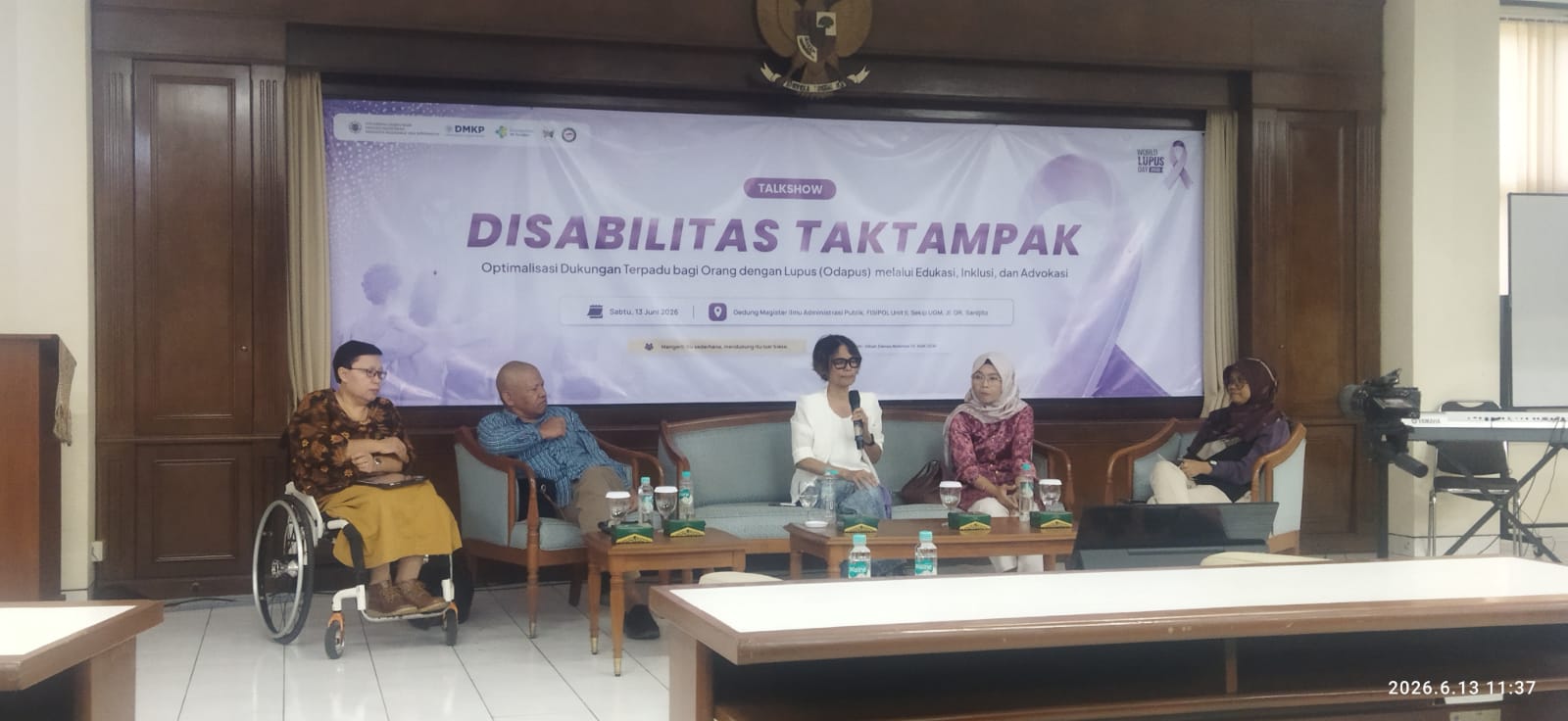
The issue came to the fore during a seminar titled “Optimising Integrated Supports for People with Lupus through Education, Inclusion, and Advocacy” (Optimalisasi Dukungan Terpadu bagi Orang dengan Lupus melalui Edukasi, Inklusi, dan Advokasi) at Social and Political Science Hall 2 (Gedung FISIPOL 2) of Gadjah Mada University (UGM), on Saturday (13/6). The activity invited academics, people with Lupus, disability activists, and other stakeholders and highlighted the importance of building more inclusive supports for people with Lupus.
In the introduction to the activity, there was firm assertion that supports for people with invisible disability were not simply a matter of health issue, but also humanitarian issues, accessibility issue, and social justice issue.
The chairperson of Disability Service Unit (Unit Layanan Disabilitas or ULD) at Gadjah Mada University (UGM), Dr. Wuri Handayani explained that many people with disability had conditions that were not physically evident, and communities failed to recognise their needs. She gave an example of the use of sun flower symbol in a number of countries as a cue for invisible disability.
“People were able to understand the symbol of sunflower – that a person had special needs that may not be physically visible,” she revealed.
Wuri suggested that recognition of invisible disability was a key step to create more inclusive environment. The reason was that many people with disability faced challenges not only as a result of their health condition, but also of the lack of knowledge and understanding in community.
Dr. dr. Ayu Paramaiswari, Sp.PD., Subsp,R. (K) also expressed a similar perspective that Lupus should not be viewed simply as a medical issue. Through community service program as part of this work, she expected that other parties could participate in supporting people with Lupus.
“We expect that supports for people with Lupus grows stronger, amongst families, communities, community organisations and government, so that there would be more comprehensive policies,” She highlighted.
In her presentation, Doctor Ayu explained that Lupus was an autoimmune disease that triggered the body immune system to attack tissues and organs. The disease was known as “a disease with a thousand faces” because the symptoms varied greatly and the disease could attack a number of organs.
“Lupus was often referred to as a disease with a thousand faces because the symptoms varied greatly and attacked a number of different organs,” she explained.
Other than the typical rash like a butterfly shape in the face, Lupus may affect the joints, kidneys, lungs, heart, and nervous system. Many symptoms were not visible from the outside, such as joint pain, difficulty concentrating, acute pain in the head, and chronic fatigue were often misinterpreted as extreme exhaustion.
Doctor Ayu suggested that one major challenge was late diagnosis. Lupus symptoms often resembled symptoms of other diseases that patients had to wait years before they received the proper treatment. This situation became even more critical as 90% of people with Lupus were women who also faced psychological impacts due to changes in their physical appearance resulting from Lupus and its treatment.
“There were many factors affecting patients’ fatigue, from disease activities, anaemia, trouble sleeping, chronic pain, to anxiety,” she explained.
The founder of Sahabat Cempluk, Ian Sofyan explained patients’ perspective. As a person with Lupus, he understood how difficult life with Lupus was which other people may not see.
“People may think we are healthy physically, although internally our body feels different,” he said.
Ian told that he had felt the Lupus symptoms since he was a child, but the diagnosis came many years later. During that time, he had many complaints that people around him could not understand. Many people with Lupus also shared similar experience which other people thought was over the top or otherwise they thought that people with Lupus were lazy.
Ian suggested that stigma was the biggest challenge that people with Lupus faced. Research showed that most patients were often deemed unproductive because they often felt tired or needed more rest time than other people.
“Breath, think, and concentrate may also be a serious challenge for people with Lupus,” He said.
Other than physical impacts, Lupus also had psychological consequences. Hair loss, change in body shape following steroid use, and limited activities often affected patients’ confidence. Sadly, people hardly understood such issues.
At the same time, Aris Sujatmiko from Employment and Transmigration Office in Yogyakarta Special Province highlighted the importance of recognition for the rights of people with Lupus in work places. He reminded that the Constitutional Court had decided to integrate certain chronic diseases into disability spectrum which all citizens had to abide through realistic actions to ensure equal access for people with disability.
“Inclusive awareness should not only grow in business environment, but also in other work environments as a whole,” he said.
Aris further iterated that people with Lupus could continue to work productively when proper accommodation was available. Flexibility of work schedule, environmental supports, and colleagues understanding were key factors for them to perform their work optimally.
“Flexibility, provision of facility, and understanding of working environment are key for people with disability in order to work optimally,” said Aris.
The seminar closed with a confirmation that Lupus was not the end of a person’s productivity. On the contrary, the condition showed the importance of building a more inclusive environment in campuses, in work places, and in social spaces. Through education, advocacy, and ongoing supports, people with Lupus were no longer viewed in terms of their limitation, but as citizens with equal rights and opportunities to participate in community life. (Ast)