



Community Service Program within the Sociology Study Program at the Faculty of Social and Political Science Sebelas Maret University (UNS) opened new spaces for people with disability to develop their capacity and their business. The activity was part of the Freedom to Study at Freedom Campus program (Merdeka Belajar Kampus Merdeka or MBKM) and was designed not only as academic activities, but also as measures to ensure real impacts in community.
The head of Sociology Study Program at the Faculty of Social and Political Science UNS, Prof. Argyo Demartoto, explained at Pendapi Gede, The City Hall of Surakarta, on Wednesday (10/6) that universities had the responsibility to provide education, research, and community services to communities in order for the latter to be able to meet their social needs. He further iterated that people with disability were integral part of the community and had the same rights and the same access to any opportunities.
Through the program, students of sociology at the faculty of Social and Political Science at UNS played roles as facilitators to bridge the needs of participants with disability and the available resources. One means was through training and accompaniment involving government offices, including city offices in Surakarta and Employment Office.
For one semester, the program was prepared and implemented with careful consideration of participants varied characteristics. They came from different backgrounds, age groups, and types of disability. This diversity prompted the use of diverse approaches to fit participants needs.
On the field, the accompanying team found that the problems faced by people with disability were not simply related to business skills. Psychological challenges, such as low self-confidence, was a major issue. Yet, many people with disability had skills and potentials that they could develop further.
In addition, limited information regarding access to start-u funds and budget supports was a major challenge. Participants hoped that they gained self-confidence in their own ability, but also knew paths they could take in order to become economically self-reliant. This way, the campus was there not only as the centre of knowledge, but also as partner to help open up opportunities for groups that faced certain challenges.
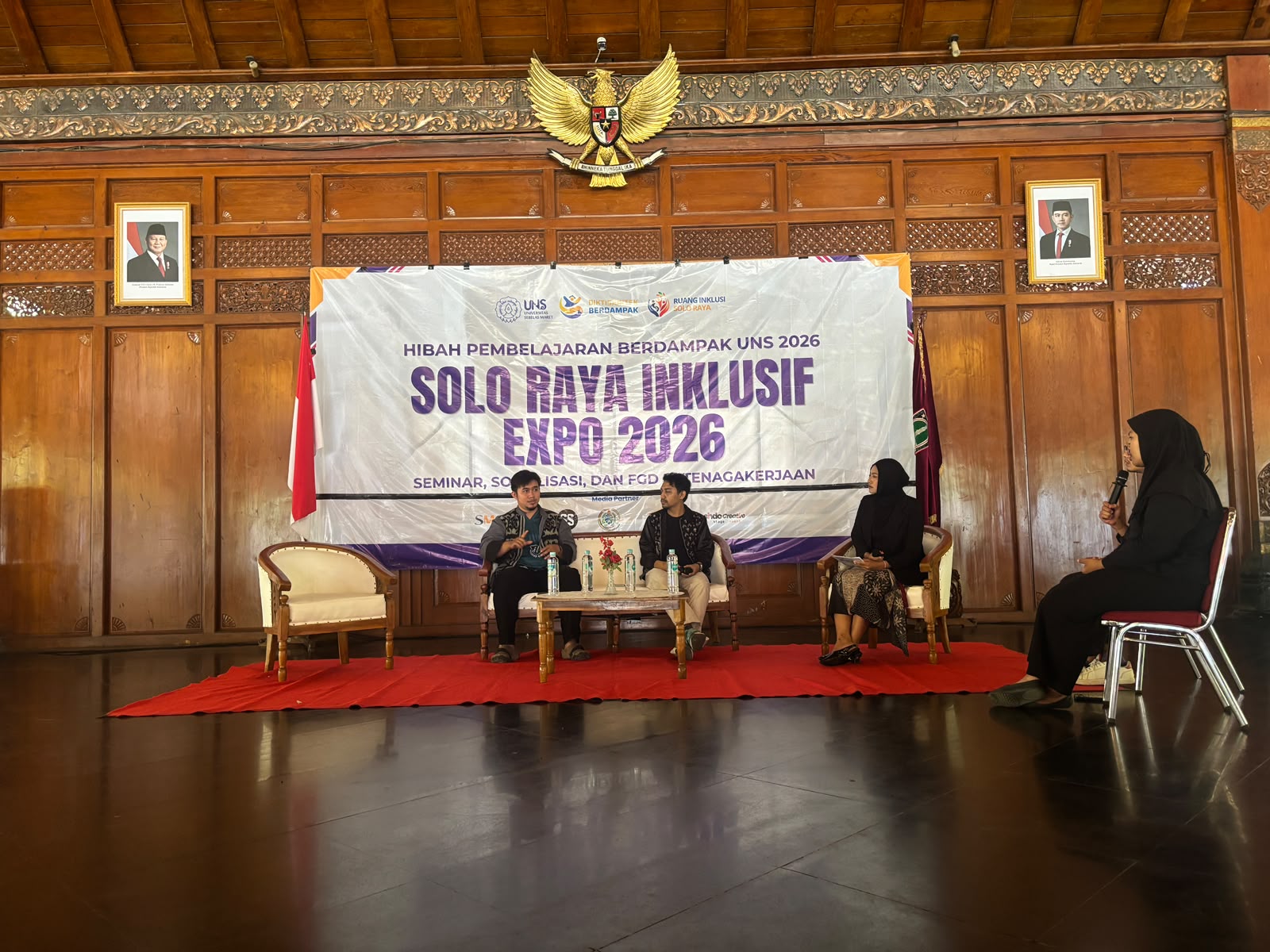
Moderator Ersi Armadani started the seminar session with a narrative that in the midst of rapidly growing coffee shop business establishment in a number of cities, Kawan Tuli Coffee and Space was set up not simply as a place to enjoy a cup of coffee. The Space was a venue for colleagues with hearing disability to learn, to grow, and to show their ability in a workplace environment that is not fully inclusive.
One of the founders of Kawan Tuli Coffee and Space, Tino explained that the idea to set up a coffee shop business was the actual needs of people. Initially, they saw that barista training for people with hearing disability was not sufficient in itself without a follow-up in the form of ongoing practices.
“By the third month we found out that the needs of colleagues with hearing disability was to apply the skills that they have learned. The standard operational procedure must be adjusted, including linguistically,” said Tino.
He argued that Kawan Tuli Coffee and Space was borne of small steps that continually being updated. In addition to being a business, the cafe also functioned as a space to introduce colleagues with hearing disability to wider communities. “We try to start from small, then we work to grow the venue. Kawan Tuli is a place to grow and develop and to introduce colleagues with hearing disability,” he said.
When asked what the initial objective of establishing Kawan Tuli Coffee and Space was, Tino explained that the initial focus was training. Then, they did not have the human resources in the coffee sector.
Government and non-government organisations provided a number of training programs and those served as bases for evaluation in order to see where the gaps were that needed to be filled.
One training participant trained as a barista was Adit, a young man from Solo. He said that the path to become a barista started with training in coffee making and direct practical experience in a coffee shop.
“In addition to learning about coffee-making, we also learn services to customers, understand the menu, and how to make customers feel comfortable,” said Adit.
For Adit, work opportunities with people with hearing disability was a pleasant experience and opened opportunities that were hard to get in the past. He also shared his experience when he attended a cooking course and then did an apprenticeship at PT Alfamart. He said that communication was not a barrier as long as others had the willingness to understand.
“People communicated with me through writing or mobile phones. From there, I could understand and learn communication,” he said.
Tino argued that the main challenge for people with disability in the workplace was not skills, accessibility, and supports from inclusive workplaces. He likened the process of self-development to plant growth that needed the right soil and the right ongoing care.
“If people want to grow like plants, then the location should fit and there should be people caring for them. Compassionate accompaniment would pave the way for such progress,” he said.
The story of Adit and Kawan Tuli Coffee and Space showed that inclusion did not always start with big programs. Often, changes were borne from simple spaces that provided everyone opportunities to learn, work, and grow without discrimination.
The disability inclusion discourse intensified, and the biggest challenge was not simply physical access, but also opportunities and ways communities understood their needs. This was a major point of discussion – re. employment opportunities for people with hearing disability – which was part of the reason why the organiser invited business operators, people accompanying people with disability, and workers with disability as speakers.
When asked about accessibility for people with physical disability in the City of Solo, speakers argued that the situation was much better than a few years ago. Yet, there were still significant number of workplaces that were unprepared to accept people with disability for a number of reasons and for lack of understanding.
The barista at Kawan Tuli Coffee and Space, Adit believed that the first step that communities had to do was to listen to the needs of people with disability. He further added that people with hearing disability had enough skills and competence, and had attended a variety of training sessions and received certification with high standing.
“Friends with hearing disability need to have the confidence to enrol into training programs or to employment opportunities. That way, our knowledge and ability increase,” said Adit.
Yet, ability alone may not be enough to open the path towards workplaces. Limited opportunities and stigma often became major challenges. Speakers saw that we had to give much appreciation to companies already opening job opportunities for people with disability so that other companies followed suit.
A motivator for Tuli Coffee and Space, Tino believed that the best solution had to begin with the needs expressed by people with disability. He reminded that government’s and non-governments’ programs often did not address fully the problems encountered on the field.
“We need to ask colleagues with disability what their needs are. Then we ask the stakeholders what they can do. From there, we may find a point of convergence,” he said.
For Tino, changes did not necessarily start with big programs. Simple discussions involving the communities, business operators, and disability communities may serve as a foundation for the emergence of strong grassroots movements.
Communication issue received much attention. As a person accompanying people with hearing disability, Budi Utami stated that there was significant misunderstanding in workplaces not because of lack of skills amongst people with disability, but because there was no means of media for communication.
“Colleagues with hearing disability can truly focus on their work. The main challenge is communication. To address that, companies need to learn communication in a simple way, for example, by writing and using sentences that are not too long,” she explained.
Budi believed that ongoing accompaniment was critical so that people with hearing disability were able to adapt to their work environment and for companies to understand their needs.
At the same time, Kawan Tuli Coffee and Space tried to serve as meeting space between general public and communities of people with hearing disability. There, visitors were not only able to buy coffee, but also to learn sign language and Deaf culture directly.
“If people never meet people with hearing disability, they are often afraid to make mistakes in communication. For that reason, we make available this joint learning space so that there is awareness and confidence in interacting,” said Tino. (Ast)