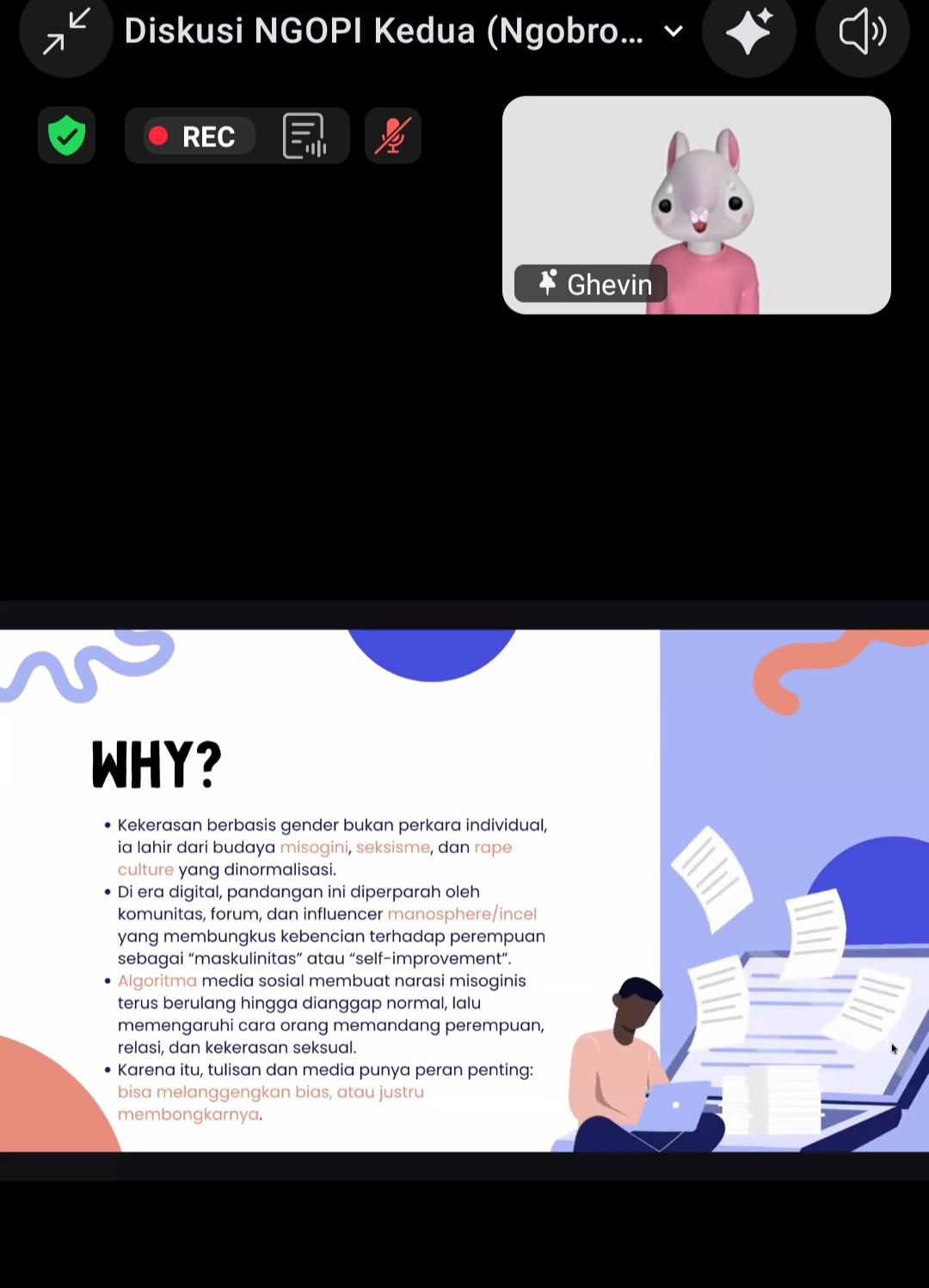



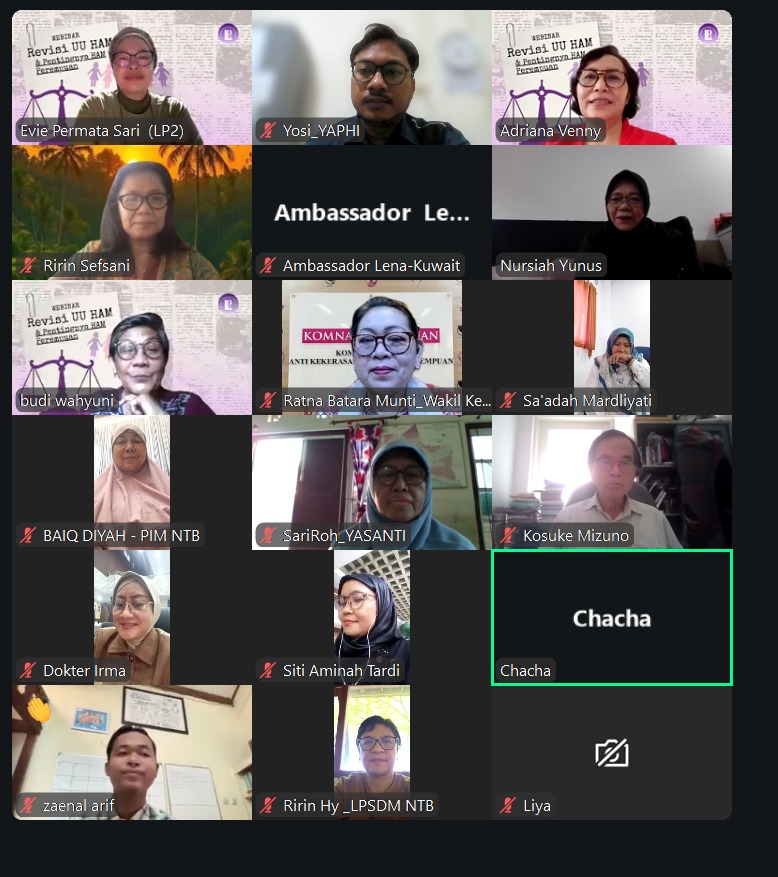

The government attempt to revise Law No. 39 Year 1999 on Human Rights invited a number of views from human rights activists, academics, and independent State institutions. In a public discussion by Lembaga Partisipasi Perempuan (LP2) or Women’s Participation Institute via zoom meeting on Monday (29/6) re. revision of human rights law, a number of speakers highlighted the importance of regulation update in order for it to respond to the current human rights challenges, yet at the same time they also reminded that revision should not weaken protection of human rights and the independence of human rights institutions.
Adriana Venny opened the discussion by highlighting that the forum aimed to answer the fundamental question about the important reason for the revision of human rights law. She said that people must understand the regulation update fully so that there would be responsive regulation that fit the ongoing development while at the same time strengthening human rights protection system in Indonesia.
Budi Wahyuni started the presentation by asking how far would the revision of human rights law be able to protect human rights defenders, particularly women. She highlighted that the Convention on the Elimination of All Forms of Discrimination against Women (CEDAW) would be the key reference point to the preparation of the new regulation.
"Will the revision of Law on Human Rights protect human rights defenders, particularly women? CEDAW must be the reference point. Do not be afraid to proceed, but be alert," she said.
One key view came from a National Women’s Rights Commissioner, Ratna Batara Munti. She opined that the reparation of the draft human rights law had not yet involved true and meaningful participation. Although the National Women’s Rights Commission was invited to public review, the Office was not involved in the preparation of the academic draft.
Ratna explained that the National Women’s Rights Commission gave particular attention to four key issues – the institution of Women’s Rights Commission, integration of women’s rights as per the CEDAW principles, protection of human rights defenders, and guarantee for vulnerable people.
She believed that one fundamental issue was the change in the National Women’s Rights Commission institutional status. In the new draft, the position of the National Human Rights Commission shifted from independent State Institution to non-structural independent State institution. This change potentially lower the institution’s status to be on par with other national human rights organisations.
In addition, Ratna criticised the regulation on women’s rights, human rights defenders, and vulnerable people in four articles – Article 54 to Article 57. She believed that there were key principles in CEDAW that had not been integrated.
"There is no robust regulation on corporate responsibility in protecting women’s rights. The definition of vulnerable groups is also not clear, likewise the tern human rights violation victims’ rehabilitation is not comprehensively put into regulation," she said.
She also suggested that the draft did not yet provide sufficient protection to indigenous people, did not yet consolidate economic, social and cultural rights, and did not yet guarantee funding mechanism for human rights institutions. She even suggested that there was potential authority overlaps between human rights ministry and national human rights commissions.
The Director General of Services and Human Rights Compliance within the Human Rights Ministry, Siti Aminah Tardi explained that the draft human rights law was in preparation. She highlighted that a number of State offices, including Women’s Rights Commission were involved in the inter-ministerial committee since the beginning.
She acknowledged the limited information available in a number of steps because a number of offices were in the middle of leadership change. Still, the government maintained open space for inputs.
Siti Aminah suggested that reform of human rights law was necessary because Law No. 39 Year 1999 was no longer able to answer the challenges in human rights right now.
"Law No. 39 Year 1999 is no longer relevant to address the challenges modern basic rights. Revision was designed to integrate new international human rights instrument, strengthen protection of vulnerable people, and propose new and more adaptive instruments for human rights enforcement," she said.
She explained that the draft human rights law also updated a number of legal terminologies. The definition of discrimination was broadened to fit with modern development, while the definition of children was aligned with the Convention for Child Rights. In addition, the design added new concepts such as ecological rights, relationship between human rights and corruption, recognition of human rights defenders, and clarify the existence of monitoring authorities such as the National Human Rights Commission, National Women’s Rights Commission, Indonesian Child Protection Commission, and National Disability Commission.
In the discussion session, a number of participants offered inputs. One input highlighted that human rights defenders did not have to be obligated to obtain specific certificate. Other participant highlighted the selection mechanism for women’s rights commissioners in front of the Parliament which could affect the independence of the Human Rights Commission.
In addition, there was inputs demanding that the definition of victims of human rights infringement be articulated more clearly in the draft law so that it could be integrated into the Law on Human Rights Court.
In closing, Ratna Batara Munti highlighted that the National Women’s Right Commission would continue to monitor the preparation of human rights draft law up to its discussion at the Parliament. Inputs would not just go to the Minister of Human Rights but also the Minister of Law.
"The draft human rights law needed revision because we believed that a number of articles potentially weakened independence of National Human Rights Commission," she said.
Meanwhile, Siti Aminah ensured that the government maintained public participation spaces. She asked communities to present their inputs through a variety of official channels made available by the human rights minister.
"The Ministry receives a variety of inputs. What we need to understand is that the National Women’s Rights Commission remains independent and not under the Ministry," she said. (Yosi Krisharyawan)