



Participants’ views were on full display in. There was no explosive debates. Yet, one common thread emerged out of all questions and answers – why it was extremely difficult for local community knowledge built upon years of local experience protecting the forests to find a place in public policies?
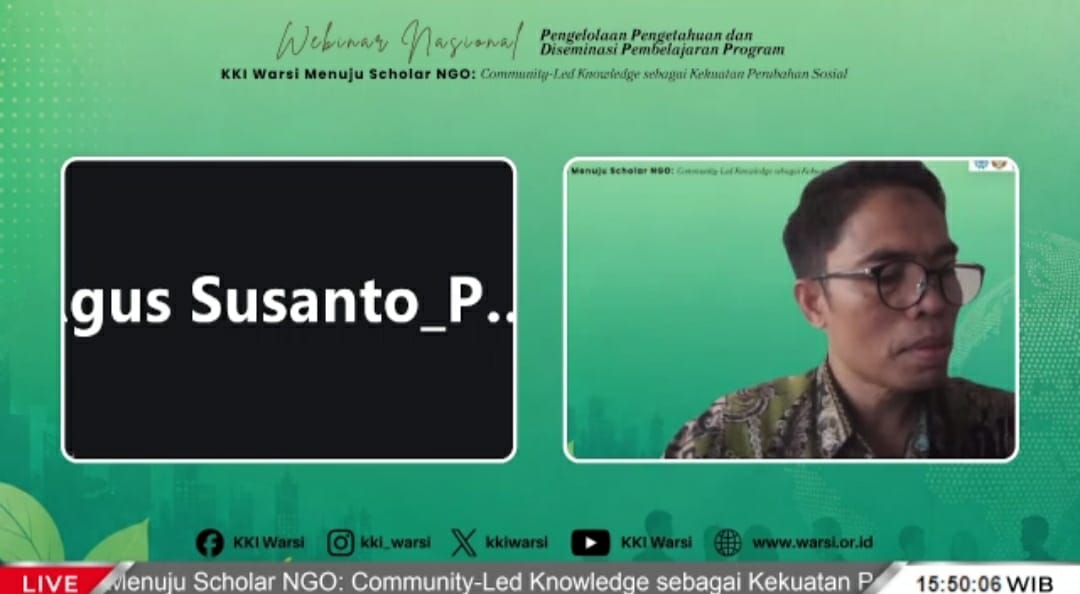
That question became the common thread of the online discussion organised by The Indonesian Conversion Community or Komunitas Konversi Indonesia (KKI) WARSI on Tuesday (14/7) when starting the presentation on the idea about NGO School (Sekolah NGO) – an attempt to promote a learning space that featured community not simply as an object of accompaniment but as producers of knowledge able to influence the direction of development.
For more than three decades of community accompaniment living in and around the Sumatran forest, KKI WARSI collected thousands of stories about successes, failures, conflicts, and the ways protected their living spaces. That experience was the key to the publication of book(s), training modules, documentary film(s), and a variety of accompaniment models. Yet, all of those did not always succeeded in influencing policy changes.
The executive director of KKI WARSI, Adi Junedi stated that people’s needs were the starting points for his organisation’s work, rather than plans conceived behind closed doors.
"Each area has its own unique context. Hence, our approaches were never the same," he insisted.
That principle led to organic evolution of accompaniment process. The variety of schemes – village forests, social forestry, and other management types evolved through dialogues with local people. Even failures were viewed as critical parts of the learning process.
Yet, the journey from the field to the policy room was far more complicated than anticipated.
It took a long time for data to be collected through participatory method, when the bureaucracy moved in a different rhythm. Often regulation(s) changed when the results of accompaniment was formulated.
"Policy revision happens when the old policy had not even been implemented," he said.
That realisation led to the idea about the NGO School. It was not meant as a formal education institution, but rather as an ecosystem to keep knowledge gained on the field, to manage it systematically, and to translate it into recommendations for policy makers.
For Mirna, the biggest WARSI asset was its vast experience in accompanying hundreds of villages. The issue was not about data collection, rather about how the vast experience could be summarised into major points which the bureaucracy could read. She reminded of the legal research history in Indonesia during the colonial time. A variety of local people’s legal practices were categorised into typologies known as the 19-Customary Law Circles. She argued that such approach could be applied to KKI WARSI experience in accompaniment.
"There is a common thread amongst the hundreds of experiences. The recommendation can be prepared more concretely to deal with certain policy situation as needed," she insisted.
Mirna even highlighted that KKI WARSI had been a school for a long time. What it needed to prepare was a way of presenting that knowledge to meet users’ needs.
Communities wanted easy-to-understand language. Academics required solid methodology. The bureaucrats demanded succinct and systematic information that they could translate into policies.
That was the key point highlighted by Ferdinan Asmin, the head of Environment and Forestry Office in West Sumatra Province. He argued that the development challenge was more complex now than a decade ago. Rural life changed as people responded to economic order, social changes, technological development, and political dynamics.
In such a situation, communities had to be the key players in development.
"Forest is not just about trees. What we need to focus is the humans," she highlighted.
She also emphasised that KKI WARSI had the know-how to become epistemic community – a knowledge community able to bridge the gap between community knowledge (wisdom) and government needs.
She even reminded of the importance of documenting failures. She insisted that often enough failures gave more valuable lessons than success.
The relation between communities an academic world was the next point in the discussion. The rector of Jambi University, Prof. Helmi learned from participatory accompaniment methods used by KKI WARSI.
The approach went to University Classrooms
Students not simply listened to lectures, but to build knowledge through discussion and experience. "There are many really good students. The task of a lecturer is to facilitate their learning process," She said. The method necessitated more time.
One material could be discussed in a number of meetings. And the results would be much thorough as students understood more deeply the key issue, not just memorising theories.
That experience made Helmi understand why people’s accompaniment often came face-to-face against the bureaucracy. The participatory approach necessitated patience. Conversely, the government often worked with a budget target that had time limit.
She remembered when oil palm plantation entered the interior of Jambi. People were promised much more prosperous life.
"If you want to sit comfortably on your recliner and earned money, then plant oil palm," she reminisced while quoting the promotional messages people received in the past.
The promise of a quick return slowly shifted people’s view about the forest. For that reason, Helmi argued that development should not simply aim for economic growth, rather development should protect the balance with the social and environmental aspects.
The discussion moved into more critical issue when researcher Marina Mardiana asked a fundamental question – who determined that a knowledge was worth recognised as knowledge?
Marina suggested that communities had produced knowledge from their own life experience for a long time. Yet, when that their knowledge entered the bureaucracy room, it lost its legitimacy because it did not meet the formal standard.
"The issue is never about the quality of data. The issue is about the language used by the community – which is different from the language used by policy makers," she insisted. She gave an example of sacred forest.
For indigenous people, sacred forest had historical, spiritual, and social values. Yet, when such values entered government documents, what often came out was the forest cover, while the values inherent in the forest were lost.
For that reason, the task of civil society organisations was not to transform local knowledge into more scientific knowledge. What was more critical was to translate that knowledge without losing its inherent values. Nur Priyanto shared that key point.
He drew people’s attention to knowledge extraction during policy making. The government collected local knowledge, change it into formal data, and used it for their own purpose.
This way, local people often lost control of their own knowledge. In response, Marina reminded that it was not enough to promote inclusiveness through inter-agency collaboration. What was needed was a change in governance towards polycentric system –a distribution of authority that truly return part of the authority to the community.
She gave an example of forest management in di Serampas, Jambi. The community there prepared their own rules, managed conservation funds, and changed distribution mechanism of the benefits as situation changed.
That experience showed that communities were able to develop their own governance independently when given the space.
Hendri Martius from Universitas Andalas shared Marina’s experience. He stated that communities were not simply beneficiaries. "They were sources of knowledge and the path to local knowledge," he highlighted.
He reminded that KKI WARSI did not need to rush knowledge production – re. books or module publication. What was more critical was developing a healthy learning ecosystem.
He offered living laboratory concept – a learning space that engaged communities, campuses, civil society organisations, and government in equal position. In such space, there was no longer disciplinary boundaries. Knowledge grew through dialogues and shared experience.
Zainuddin from The Kerinci Seblat National Park or Taman Nasional Kerinci Seblat talked about his field experience. He described changes happening in many villages around the conservation areas.
Economic pressure forced local community leaders who were forest protectors to allow rooms for illegal gold mining. So, what people lost was not simply the forest cover, but critically people’s trust in their leaders.
For that reason, it was highly critical to approach indigenous leaders, village officials, and informal leaders during people’s accompaniment. "No organisation can work on its own," he said.
By the end of the discussion, the Executive Director of KKI WARSI highlighted again that the NGO School was not simply an attempt to establish a new institution. Rather, it was about a new way of knowledge production. Slowly, WARSI trained local champions in villages.
They learned to document experience, write through people’s journalism, and spread knowledge to other communities. This way, communities went beyond research resources.
They Became the Author of Their Own History
The measure became critical in response as illegal gold mining and changes in land-use were rampant, and economic pressure put upon the forests in Sumatra intensified. What the discussion highlighted was that the future of forests was not simply determined by the myriads of government policies. It was also shaped by how far the State was willing to listen to people’s day-to-day experience living with the forests.
Perhaps that was the critical point of the NGO School pioneered by WARSI: It was not about building classroom walls and making available blackboards, rather it was an attempt to make available learning spaces where communities became teachers, where local knowledge/wisdom got the recognition in academic spaces, and where policies emerged from the voices of people who live with the forests. (Ast)