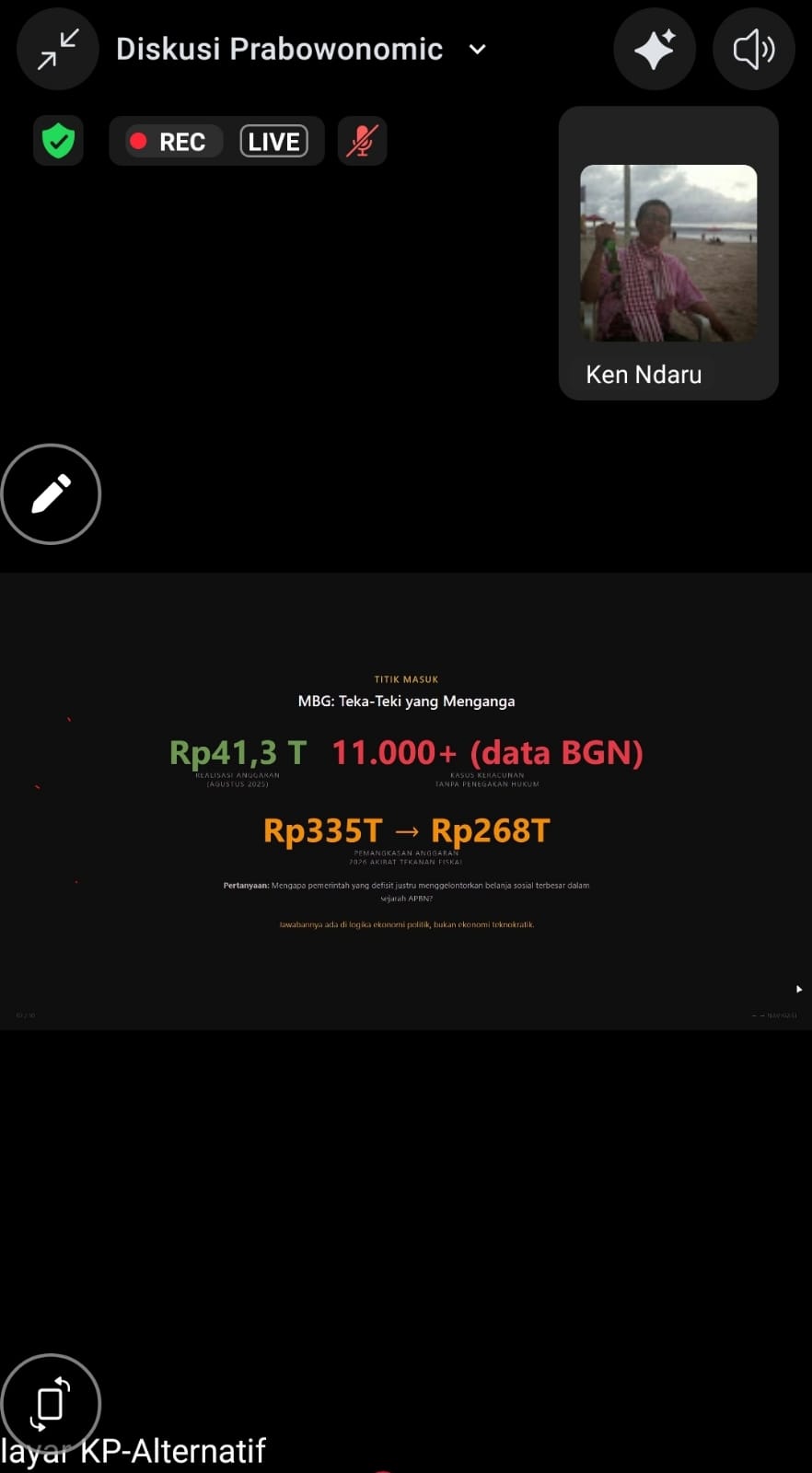





The public discussion organised by Koalisi Pergerakan (KP) Alternatif or Alternative Movement Coalition that afternoon, Tuesday (16/6/2026) was warm yet full of underlying anxiety. Amidst a number of news about the economic situation in Indonesia highlighted the weakening purchasing power, and the students protests in a number of cities, activists, academics, and discussion participants gathered to dissect one key term that kept coming - Prabowonomics.
Muchtar Habibi opened the discussion by asking participants to see the present situation in Indonesia more critically. He said that a number of emerging phenomena showed issues that needed further close attention.
“We saw the economy weakening and at the same time the State’s role kept increasing,” he said in front of the participants.
He pointed to a number of student protests in Jakarta, Surabaya, Bandung, Malang, and other cities. For him, the State’s response towards those protests needed further scrutiny.
In addition, Habibi highlighted a number of new institutions and agencies that concentrated State asset management, populist programs such as Free Nutritious Meals, and Red-White Village Cooperatives with its ongoing staff recruitment.
On the other hand, he also took issue with public perception about rupiah exchange rate which people kept watching.
“Many colleagues shared the comparison of rupiah exchange rate from the beginning of this administration to the present. At the same time, the cost of living continued to increase,” he said.
That was the background why the topic of Prabowonomics became the key theme in this discussion.
As speaker, Jaya Darmawan discussed the economic thinking associated closely to Sumitro Djojohadikusumo, the father of President Prabowo Subianto. Yet he highlighted that in order to understand today’s economic situation, data was more critical than political slogans.
“Data was more important than jargon and discussion amongst the elites,” he highlighted.
In the presentation, he showed the result of a research that compared wealth gap situation between 2024 and 2026. The result showed an increasingly worrying trend.
In the past, the wealth of 50 richest people in Indonesia was equal to those of 50 million people, now the number increased to equal to 55 million people.
“The situation became more dire. The wealth gap increased,” he said.
The data showed that wealth growth amongst the elites rose much faster than the increase in people’s welfare. He gave an example of average increase in workers’ salary which was two thousand rupiah per day, while the super-rich increased their wealth by billions of rupiah every day.
“Workers’ wage increased by two thousand rupiah on a daily basis, while super-rich people had wealth increase by up to Rp13 billion on a daily basis,” he said.
In addition to gaps, he also highlighted the economic characters in Indonesia that remained dependent on extractive sector such as coal, palm oil, gas and oil, and mining.
He believed that most of the wealth of the super-rich in Indonesia came from those sectors. This was different in developed countries which relied more on financial services and digital economic sectors, while Indonesia remained reliant on natural resource exploitation.
“The proportion of wealth in extractive sector increased from 56% to 58,” he said.
The result, he said, was that the people had to take increasing burden of social and environmental responsibility. Environmental damage, land conflicts, to gaps in development were the price to pay by the people living near exploitation areas.
The subsequent presentation showed the wealth gap between ordinary people and public officials. In a number of provinces, legislative members had wealth in excess of tens even hundred times higher than the people they represented.
Yogyakarta was one obvious example. The average legislative members in Yogyakarta had wealth 400 times larger than ordinary people.
“The wealth gap is real between officials and ordinary people,” said Jaya.
He also showed the high wealth accumulation amongst public officials in the current administration. The data showed that the total wealth of public officials reached trillions of rupiah, far larger than in previous period.
For Jaya, the phenomenon showed that gaps were not only visible between people versus rich groups, but also between people and political elites.
Furthermore, he criticised the close links between business entities and political elites which he believed was one key characteristic of Prabowonomics.
He mentioned the situation as “Oligarchy Republic” – a situation when business and political interests intersected to maintain power and economic profits.
“Business married political oligarchy. They supported each other through political investments, projects, concession, and other facilities,” he said.
He believed that the phenomenon reminded him pf the relationship between business and power in New Order regime. The political dynasty and major business groups obtained greater access to State resources than ordinary people.
Yet, the afternoon discussion did not stop by criticising. The speaker asked participants to see that the gap was not simply statistical numbers, but daily facts of life felt by people through difficulty finding jobs, low wage, high living costs, and limited access to welfare.
At the end of the session, one message that kept surfacing was the importance of reading the economic reality based on data and people’s life experience, not simply through narrative prepared by the political elites.
Behind grand term such as Prabowonomics, there lied fundamental question of whether economic growth brought welfare for the majority of people, or conversely widened the gaps between those at the top of the wealth chart and ordinary people who fought to meet daily needs on a day-to-day basis.
Prabowonomics, Young Generation Who Were Left Behind, and Increasing Gaps
For Jaya Darmawan, economic problems could not be separated from politics. So, when he talked about Prabowonomics, he did not only look at statistical numbers, but also power relations that influenced economic policies and daily life of the people.
In his presentation, He touched on an ironic phenomenon: groups that were associated with representing workers struggle were now close to those in power.
As an economic researcher, he questioned the position of labour movement in the midst of increasing economic pressures. He believed that labour unions had to be pressure groups to fights for workers’ interests, and not immersed in close political liaison with the government.
“Labour unions must negotiate with government in order to ensure descent wage, fight for incentives for workers, or policies that benefits workers,” he said.
He gave an example of how political pressures from labour groups had influence in discussion about minimum wage in the past. When the government initially proposed lower wage increase, labour unions proposed higher increase which led to a negotiation and an increase of 6.5 percent.
“Strong negotiation is vital,” he said.
Yet what was even more alarming, according to Jaya, was the increasingly volatile financial situation of the people. He mentioned the phenomenon as evident of the ever-decreasing saving amongst mid-and low-level classes of people, while the rich people increased their saving.
Small business revenue dwindled, while cost of living increased, and fiscal policies were unable to offer protection to the vulnerable groups.
“People’s saving under one hundred million rupiah tended to decrease, while saving above five billion increased,” he said.
The data showed that the gap did not only involve asset ownership, but also people’s ability to save and grow their wealth.
The young generation felt this even more. In his presentation, Jaya showed that young people were the most affected by the employment situation today.
High school and university graduates and even those completing their postgraduate had to wait longer to get a job.
“Young people on average wait for seven and a half months before they can find a job,” he said.
The situation showed that higher education did not guarantee a descend job. Many university graduates were employed in low-pay sectors or informal sectors that did not offer much protection.
He also touched on one of government programs that absorbed a lot of workers. The most job opportunities were available in the manual labour category that did not aligned with the objective of industrial drive and the improvement in the quality of workers.
“Undergraduates and master graduates had the potential to work as manual labourers as those were the only job opportunities available,” he said.
On the other hand, workers problem also included weak protection of workers. Many were engaged in daily wage and lost their rights when taking time off work because days without work were days without wage.
Young workers who just entered the work force felt the phenomena most often.
For Jaya, this fact showed that most workers in Indonesia were in informal sector and were vulnerable to all types of uncertainty.
Another issue that received much attention in discussion was the gap between minimum wage and the need for a descend living.
He gave an example of Yogyakarta which was often promoted as an education city and an ideal place to retire. Yet behind that image was a serious issue with regards to low wage and increasing cost of living.
“People feel it that food is no longer cheap and cost of life is increasing,” he said.
The same gap was also found in other areas, including areas known as industrial centres and areas rich in natural resources.
In addition, Jaya asked participants to see the gap from a gender perspective. He said that women faced more complex burden than other workers.
They were working to earn an income, and took care of domestic work that others never took into account as productive economic activities.
“Women’s world load was much bigger because they had to do domestic and economic works,” he said.
As a result, many women had the double burden that took their time, energy, and opportunities for self-development.
He also cited data that showed hundreds of thousand women were desperate to find a job. That number increased in older age groups, particularly when they were facing a divorce or other social pressures.
“More than six hundred thousand women were known to be desperate for work,” he said.
He believed that a number of those issues got the attention of government in its economic policy implementation.
At the end of his presentation, Jaya highlighted the gap in government institutions, such as the military and the police. He pointed to the big gap between highest and lowest-level officials’ salary.
That situation triggered basic issues because it encouraged most officers to seek additional income outside of their main profession.
Of all the data presented, Jaya concluded that the biggest economic challenge in Indonesia is not simply economic growth, but growing distribution of welfare.
For that reason, he offered a different approach through consolidation of progressive taxation that target the richest group of people and public officials with large assets.
“What needs to be strengthened is a wealth tax for groups with biggest economic power,” he said.
That measure could be one sources of funding to strengthen social protection, create adequate job opportunities, and reduce gaps that tended to increase.
For discussion participants, that presentation was a reminder that behind technocratic economic terms, there was a fact that people felt, such as difficulty finding a job, low income increase, high living costs, and widening gap between the rich and the poor. (Ast)