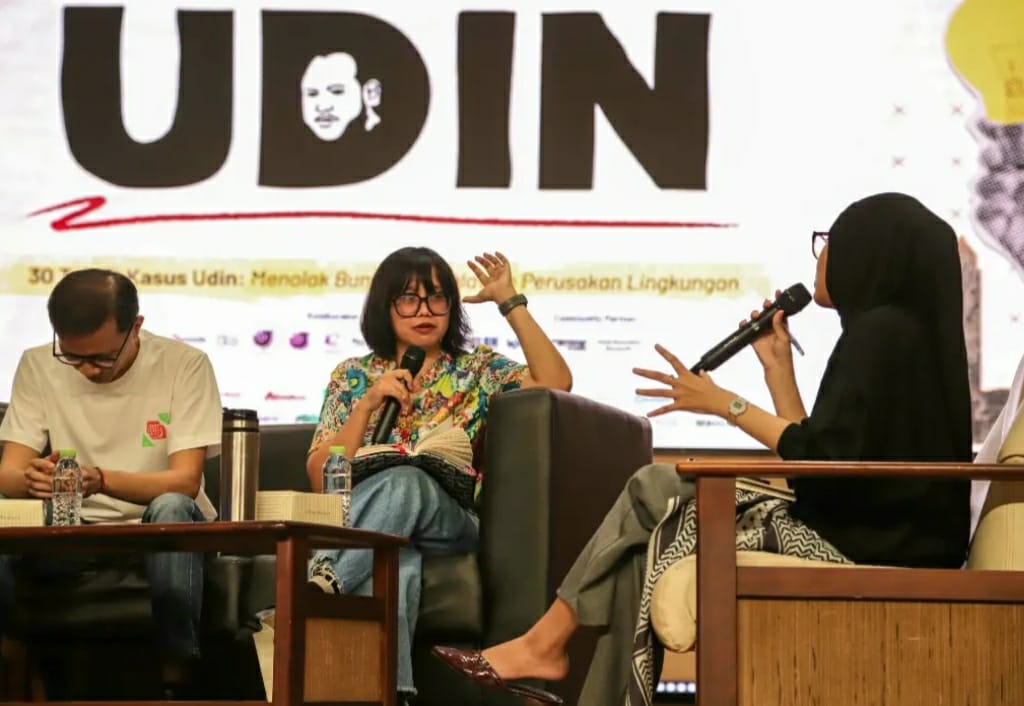



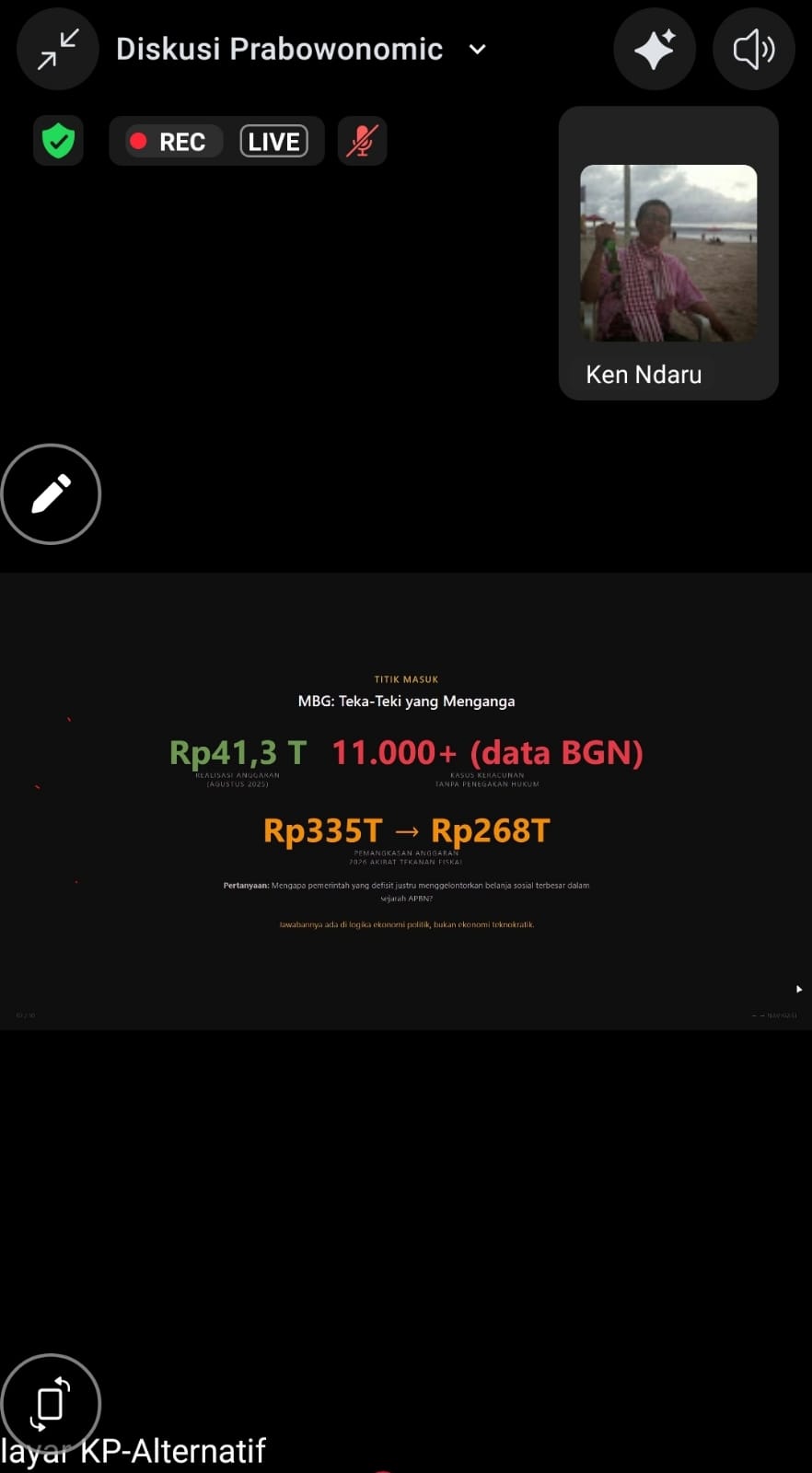

In contrast to the previous presentation during a discussion organised by the Alternative Movement Coalition or Koalisi Pergerakan (KP) Alternatif on Tuesday (16/6/2026) which focused more on gaps in data and economic situation of the people, speaker Ken Budha Kusumandaru chose to use a different point of view. For academics who review such politics and social movement, the key issue was not simply understanding Prabowonomics, but identifying weak points that could offer spaces for criticism and resistance.
In front of the participants, he highlighted that every economic analysis would eventually end up in a more practical question: What strategy did people need to use when they faced such situation.
“It is important for us to identify weak and vulnerable points that movements could exploit,” he pointed out.
To Ken, the government of Prabowo Subianto could not be understood as something totally new. He saw Prabowo as the logical continuation of the political-economic foundation laid out by the previous government.
“Prabowo is not fundamentally different from Jokowi. He is a continuation of the political-economic strategy established beforehand,” he said.
For that reason, he reminded that the public should not see Jokowi and Prabowo simply as individuals. What is more critical was to understand the social and economic groups that they represented.
In his view, a number of today’s policies were responses of the groups in power to the uncertain global situation. The world experienced economic pressure, climate change, and more complex geopolitical conflicts. Indonesia, Ken argued, was not outside of that mess.
To understand the current situation, he led participants to look at Indonesia’s economic structure more broadly. For many years, national economic growth was underpinned by household consumption, while growth in production capacity and industrialisation moved much slower.
“The Indonesian economy seems to grow, but its foundation is fragile because it depends on consumption,” Ken said.
That growth was like a house built on sand. As long as people’s consumption remained high, the economy seemed to move forward. Yet, when the purchasing power dwindled or when crisis hit, the foundation would be shaken.
Ken suggested that such condition led dominant economic groups to find a way to maintain their dominant position. One way was to shift the crisis burden onto workers.
“Al policies in the end aimed to maintain the power in the hands of those in power, while the crisis burden shifted to the workers,” he said.
He observed that the policy foundation had been established for a number of years, i.e. through employment regulations that gave greater flexibility to companies.
Ken opined that such policy allowed companies to get cheap and controllable labour when the economic situation worsened.
“The instruments have been set up for a while. So, Prabowo does not need start from the beginning,” he highlighted.
In his presentation, Ken mentioned three key objectives that he thought were the key points of economic -political policies of the current government. He called it a Power “Trident.”
The first objective was to maintain economic profits of the major players. The second objective was to build and maintain political support base. The third objective was to prevent social resistance that potentially disturbed the stability of power.
“When we see closer, many policies are driven by three objectives,” said Ken.
Social programs that looked like welfare programs, according to Ken, could also be understood as political instruments to amass community loyalty and supports.
At the same time, a number of measures to strengthen security forces, specific regulation revision, and increasing narratives that discredited critical groups were part of a strategy to weaken resistance.
He gave an example of how protests staged by student, women movement, environmental activists, and civil society groups often had to deal with accusation and labelling designed to weaken their legitimacy in public spaces.
“Organising was cut off before it became bigger mobilisation action,” Ken said.
Yet, Ken believed such strategy would not completely work. That was in fact where the weakness lied.
Yet, a variety of policies designed to keep economic and political stability often collided with each other, for example, when the government tried to keep major programs that required major budget allocation, while juggling with the country’s fiscal health.
This condition prompted a number of efficiency measures and an increase in State revenue, including through taxation policies.
The problem, to Ken, was that those measures would suppress people’s purchasing power, when the household consumption was one major factor in Indonesia’s economic development.
“When purchasing power is suppressed, the foundation for economic growth would also weaken,” the speaker said.
On the other hand, the speaker saw a possibility for friction within government coalition. In the context of increasingly limited resources, not all interest groups would get equal benefits.
“There would be some wo get bigger portions, while other get much smaller portion, and even some who would not get anything at all,” the speaker explained.
According to Ken, such situation would potentially create internal friction that would become more obvious in time.
In addition, the development model based on investment and extractive sector would also have its own problems. Environmental destruction, agrarian conflicts, and pressures to local communities would become sources of new social tensions in many areas.
Yet, in the face of such challenge, Ken saw an opportunity that appeared as more and more communities felt the impacts of economic and political policies.
For him, when workers, students, women, indigenous people, peasants, environmental groups, and civil society faced interconnected issues, there would be opportunities for broader solidarity to emerge.
“There is no longer a truly safe sector. All becomes target and all can feel the impacts,” He further elaborated.
For that reason, according to Ken, the biggest challenge in the future was not only to understand how Prabowonomics worked, but how community groups were able see the contradiction and devised a common response to address such situation. It was from those weak points, he said, that changes could find a way out.
Predator State and Path to Resistance
For speakers in the discussion, Prabowonomics was not simply an economic term. It was a way for the regime to face global economic pressure by shifting crisis burden onto workers. At the same time, a number of political and social instruments were used to ensure that the groups taking the brunt would not develop into powerful and effective resistance.
“Prabowonomics is an attempt to survive from global economic crisis by shifting the crisis cost onto workers,” one speaker said.
The speaker said that a number of contradictions in government economic policies exposed weak points that would be major focus for people to criticise. The Free Nutritious Meal Program, for example, was not seen merely as social program, but as a legitimate political foundation promoted by the government.
“If the narrative about people’s welfare attached to the free nutritious meals collapses, then its foundation would also collapse,” the speaker said.
In addition, the ecological impacts of the development model based on extractive industries could trigger social mobilisation in the future. Environmental destruction, social reproductive crisis, women’s double burden, and flexibility of workforce were expenses that the communities had to take the responsibility for.
“Workers are the ones to pay for the cost of crisis,” the speaker insisted.
In the discussion session, a participant asked about the problems that women faced. The participant focused on data that in 2024 almost 15% of women workers became sole income earners for their family. Yet in the midst of economic pressure of the day, more women felt desperate looking for jobs.
“It means the current economic condition does not only emphasise material aspect per se, but also the mental aspect for women,” the participant said.
Another view came from the subsequent speaker who tried to see Prabowonomics from a more historical perspective. The speaker said that State intervention pattern now had many similarities to the New Order practices.
“The way the State intervene today’s socioeconomic issues is not that much different from the Soeharto period,” the speaker explained.
The speaker mentioned at least three characteristics that showed the similarities. First, the State continued to promote extractive economy as major source of development. Second, development projects functioned more as means for political patronage. Third, law was often used to serve the people in power.
The speaker argued that such characters in the political science was often called predator State – a State that spent more time maintaining the interests of powerful groups than serving the community at large.
“This is not simply a mismanagement of the State. Mismanagement relied on intent to manage. The issue was that the intent itself was often invisible,” the speaker argued.
The speaker also criticised the narrow view of political elites about people’s welfare. In the imagination of the people in power, people felt satisfied when their basic needs were met.
In fact, people had grander ideas: higher education, descent houses, dignified jobs, to better life opportunities.
“People also want to be full human, not just humans that can eat as needed,” the speaker insisted.
At the end of the discussion, the speaker asked a question to encourage participants to reflect. Until when can we expected that social movement would maintain its position as permanent opposition without building capable power to change the direction of the State?
The speaker believed that other countries had shown that fundamental change did not just emerge from criticism, but from the ability of community groups to build solid political power able to influence even drive State policy direction.
“The character of a State is defined by who is in power. If the people in power remains the same group of people, then the character of the State would not change much,” argued the speaker.
The discussion ended with one conclusion that had been in the participants’ mind all along, that debate about Prabowonomics was not simply about the economy, but also about who took the brunt of the crisis, who benefited from the development, and who had the power to define the direction of Indonesia in the future.
Monitoring Free Nutritious Meals and Demanding Wealth Tax
During question and answers, the discussion shifted to more concrete direction, how alternative economic policies could be offered in the midst of criticism against Prabowonomics. One key issue was the idea for a wealth tax and tax on big profit from extraction sector.
Jaya explained that wealth tax was different from income tax. The focus was not on income, but on accumulation of assets owned by the super-rich.
“Gap in assets is far more prevalent than gaps in income. That is the reason for a wealth tax,” he said.
He believed that the scheme could be combined with tax on unforeseen profit or windfall profit tax from commodities such as coal and nickel. When prices of global commodities rose and companies gained large profit without significant increase in productivity, the State should be able to generate part of that profit for public interests.
In the discussion, there was also a question about the discourse about establishing State export body. Jaya argued that such step would not even address the root issues of export-import manipulation practices or misinvoicing that the government often talked about.
“If the problem lies in supervision, then the evaluation should be about supervision. To set up a new body would potentially add to the distortion,” he said.
He reminded that economic policies were too centralised that it could open spaces for monopoly and widen possibilities for political intervention in economic activities.
For Jaya, what was more important was to monitor programs that were relevant to people’s lives, particularly Free Nutritious Meals. Such program was directly relevant to the use of large State budget, including its impacts on the education sector and social protection.
“The Free Nutritious Meal was much closer to people’s lives. That is why we need to monitor it,” he insisted.
Beyond the criticism, he also believed that the social movement needed to also offer clear alternatives. One such alternative was to promote progressive taxation of super-rich people in order to find social protection and to reduce inequalities.
“Two percent of the wealth of the super-rich people would generate trillions of rupiah that could be used to fund people’s welfare,” he further insisted.
By the end of the discussion, Jaya reminded that Indonesia faced serious poverty issue, malnutrition, and inequality. For that reason, changes could not be deferred much longer.
“If changes do not happen quickly, what happens would be that many people would live in poverty,” he argued.
For participants, that message provided a strong point for the closing argument. Criticism of economic policies, in their view, should not stop at simple rejection. That should be followed by public education, research, organising, and alternatives able to address real issues in community’s day-to-day life. (Ast)