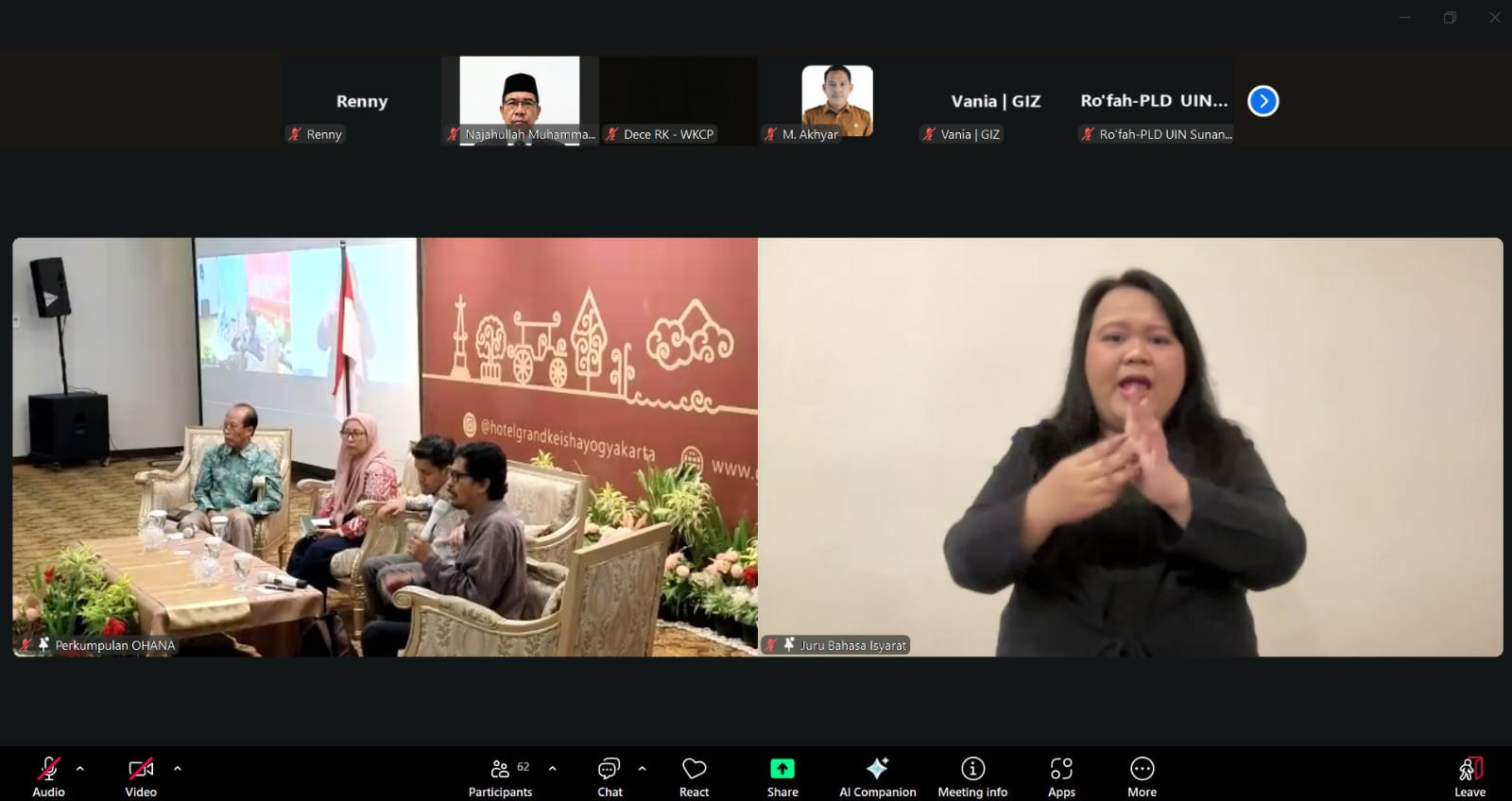



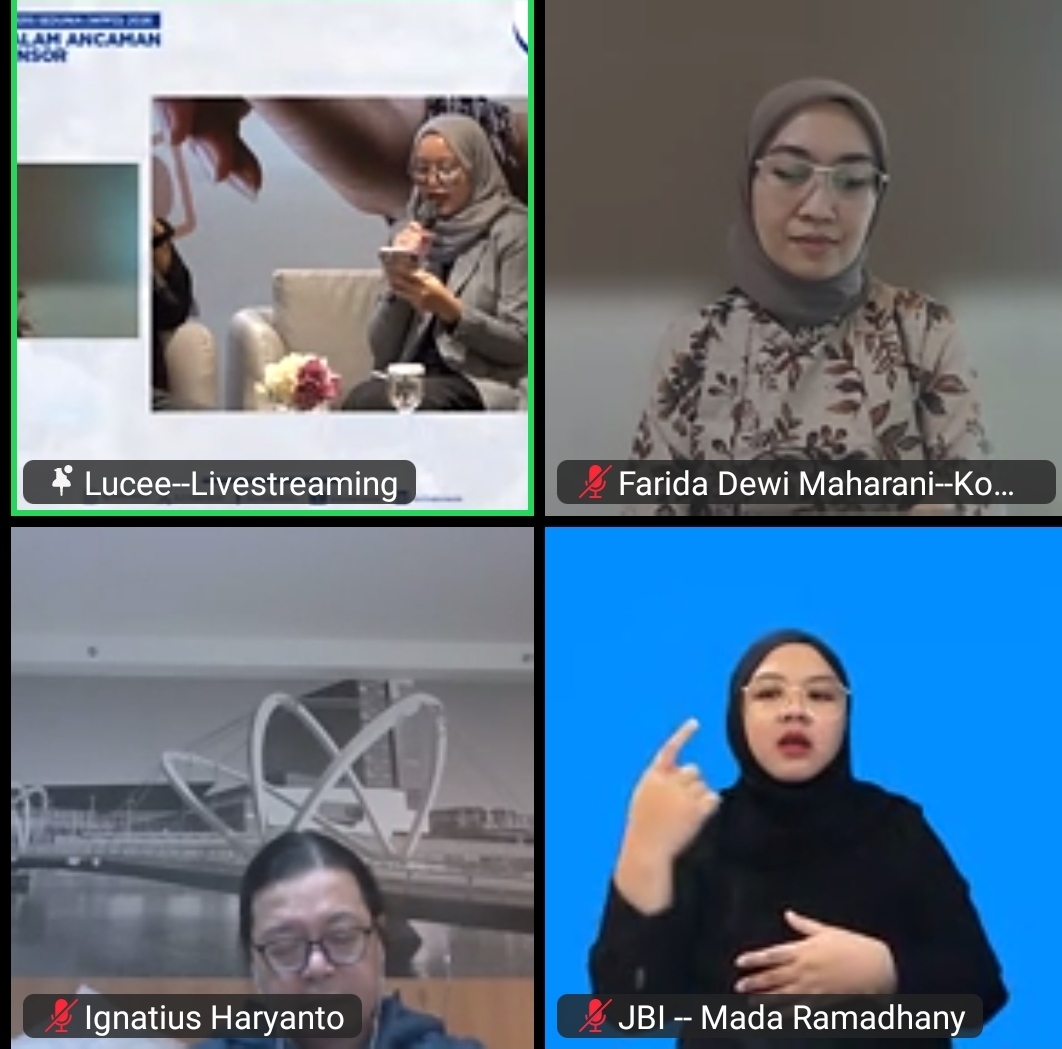

Under the shadow of Political Pressure, economic interests, and practical censors and self-censors deemed normal in the editor’s room, press freedom found itself under scrutiny. Today’s democracy situation and media landscape posed serious threats to independent journalism and public rights to obtain critical, honest, and balanced information. In response to this outlook, the Independent Journalists’ Alliance (AJI) organised public discussion for International Press Freedom Day 2026 entitled “Press Freedom un Threat from Censors and Self-Censors” with the support of the European Union.
Through the forum via zoom and YouTube, the organiser from AJI, Nurul Nur Azizah expected that the discussion not only elaborated the many threats against press freedom and media independence, but also formulated collaborative actions to consolidate protection of journalists and to maintain healthy and democratic public spaces on Wednesday (13/5). Prior to the first session, the participants watched a video about prevention of sexual violence prepared by the organiser as part of a commitment to create safe space for journalistic works.
In her opening speech, AJI chairperson, Nany Afrida stated that the celebration of World’s Press Freedom Day 2026 by AJI highlighted the seriousness of threat against press freedom, through increasing censors and self-censors in Indonesia. In addition to national public discussion, AJI also provided journalism and digital violence training in Jayapura.
AJI highlighted that self-censor became a major issue as many journalists feared covering certain issues, particularly in relations to Free Nutritious Lunch, National Strategic Project, and Social Justice issues. Safe Journalists’ Research (Riset Jurnalis Aman) where AJI was involved showed that hundreds of journalists experienced pressures during their journalistic work.
The latest case involved digital attacks against Suara Surabaya after the latter exposed alleged poisoning of students after consuming free lunch. AJI stated that journalists were only messengers of public issues and press freedom had to be maintained for a healthy democracy.
European Union representative, Stephane Mechati stated that pressures to press freedom not only happened in Asia, but also in Europe. Media and government often used political, economic, and advertisement pressures in order to muzzle criticism. Although Europe had good press freedom index, the situation decreased as internal gaps increased.
In response, European nations strengthened regulations with regards to press freedom in order to protect journalists and resource people, to maintain editing independence, and to ensure transparency of media ownership and government advertisement. The regulations also emphasised protection against elimination of news ad establishment of independent media board. The action was critical to maintain democracy and to ensure that people got accountable information.
Another resource person, the Secretary General of AJI, Bayu Wardhana presented his views by stating that the threats to press freedom in Indonesia continue to increase. Data from Journalists’ Safety Index 2025 compiled by Yayasan TIFA showed that self-censorship tended to increase. This finding was further affirmed by research of Independent Journalists’ Alliance or Aliansi Jurnalis Independen (AJI) re. environmental journalists who found that many journalists experienced pressures, intimidation, and limitation to their reporting for safety reasons. Censor took a variety of forms, from demand to not publish articles on certain issues, to change titles, to take out parts of articles, to take online news off. The issue considered sensitive included free lunch program, national strategic program, people’s school, to mining and plantation conflicts.
Pressures on media came from many sources, from media owners, advertising companies, to government. Media owners were known to be most feared in editing room as they had many political and business interests outside of the media industry. This situation triggered intervention in news reporting, particularly when the issue potentially disturb their business or political interests.
In addition, advertising companies often put pressures on media via business channel. The pressures involved changing article titles, deleting articles, or softening news content through threats of advertisement termination. Advertisement-dependent major media often found themselves in difficult position between maintaining journalistic independence and maintaining company viability and staff salary.
National and sub-national governments were known to exercise pressures on media. At sub-national level, government-media collaboration in publication often became an instrument of control on news publication. Threats of collaboration termination or publication budget made local media vulnerable to losing their independence.
This situation engendered normalising censor in editing room. Many journalists decided to be more cautious even before they received any direct threat/pressure. A survey of 655 journalists revealed that around 80 percent of respondents had committed self-censorship, particularly with regards to free lunch and national strategic program. In a number of cases, media opted to public positive aspects of government programs and avoid critical reporting.
Other phenomenon was media collaboration with mining or plantation companies that led to the disappearance of negative field facts from the news. As a result, media only made positive news about those companies and lost its social control.
For this reason, there was a recommendation for a special complaint mechanism re. censor and self-censor in order to protect reporters from employment termination. In addition, there was also suggestion to prepare regulation to forbid media owners to be directly involved in politics in order to maintain press independence and democratic quality in Indonesia.
The subsequent resource person, Prodita Sabarini highlighted the fragile financial security of digital media in Indonesia. Many small media suffered from economic difficulty as journalism production costs increased, while media business model experienced further shocks due to advertisement moving to digital platform. This situation became increasing difficult after the government of Prabowo Subianto cut budget, which reduced government spending in advertisement—a major source of income for many cyber media.
Media dependence on government advertisement prompted normalising self-censorship in editing. Media became cautious in publishing critical articles when their income were dependent on the government budget. This situation was laid bare by reports of Independent Journalists’ Alliance or Aliansi Jurnalis Independen (AJI), of Journalist Safety Index or Indeks Keselamatan Jurnalis, to investigative coverage withing the Project Multatuli that deemed political and economic pressures were instrumental in rising self-censorship amongst media in Indonesia.
Research by Asosiasi Media Siber Indonesia (AMSI) and Monash University in 2025 of 220 media members of AMSI showed that cyber media number increased as costs of establishing the media became much cheaper than in the past. Yet, the increase in media number did not automatically strengthen the industry. About 50 percent of digital media income depended on government advertisement, so when budget was cut, pressures towards independent media increased.
On the other hand, media started to adapt to changing audience bahaviour. Many media outlets now used analytic, social media, and platforms such as TikTok to reach the audience. Yet, most innovation revolved around content distribution, and not yet delved into changing the fundamentals of business model. Less than 25 percent of media being surveyed were found to start serious business innovation.
Other challenge came from progress in Artificial Intelligence (AI). In the past, the media was under the shadow of Google and Meta competition to dominate digital advertisement, now AI allowed audience to not directly access media for information. This prompted media to search for new strategies, from blocking AI from taking journalistic contents to opening access so that the media’s name remained visible in AI search.
AMSI promoted three key agendas: establishment of journalism funds to support quality media, ensuring publisher rights, and protection of copy rights of journalistic works to ensure that AI companies pay compensation to media content they used. This action was critical in order to sustain the media, ensure journalists safety, and guarantee press freedom in Indonesia.
The discussion also featured academic and media observer, Ignatius Haryanto who reminded audience that censor against media was nothing new in Indonesia. He pointed to experience during the New Order era and the important lessons people could draw from it as there were many old patterns that re-emerged in different forms.
He explained that during New Order regime, the government used a variety of instruments to control the press. One such instrument was permit – printing permit, publication permit, to Press Business Licence or SIUPP which dictated who were allowed to publish media. Journalists’ organisations and press companies then became instruments of State control. In addition, there was a practice known as “telephone culture” where government officials, military or Police officials contacted media editors in order to tell them not to publish certain news.
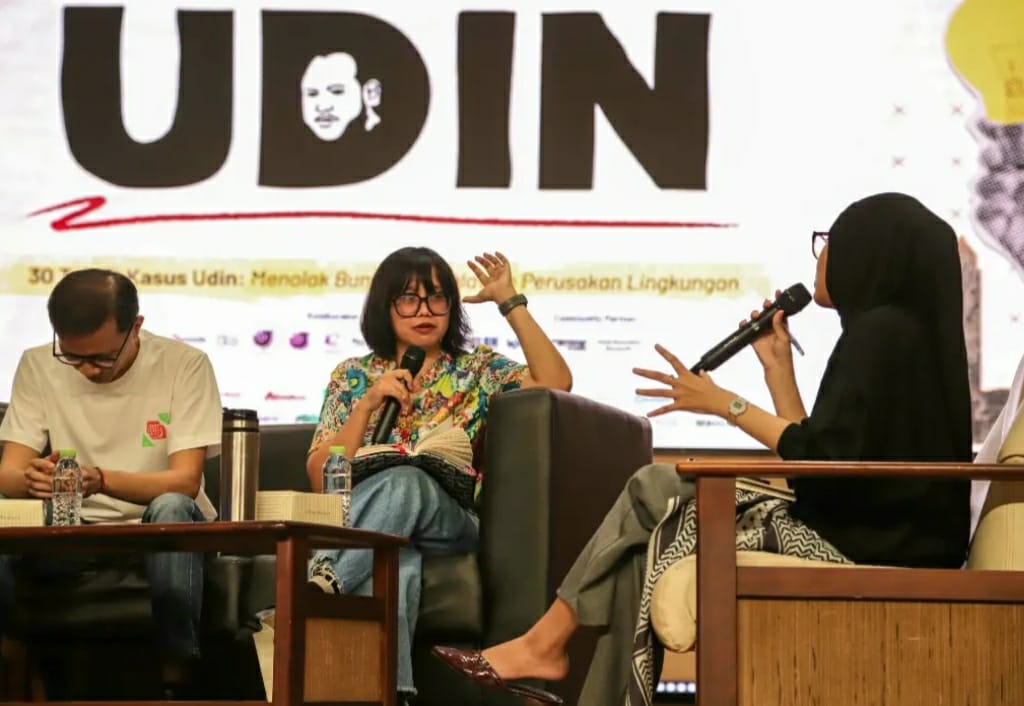
Other types of censor were letters of reminders to media, censor against foreign media by redacting articles in black ink, to articulating taboo on certain topics and people. Student protests, land conflicts, criticism of government, to interviews with opposition such as Pramoedya Ananta Toer and Mochtar Lubis became sensitive issue at the time. Even physical violence against journalists happened, including murder of journalist Udin in 1996 after his article on alleged corruption.
Ignatius suggested that the pattern of pressures were more modern, but nonetheless carried similar substance. The government could ask digital platforms to take off contents that disrupt public order, pressure media owners to change news, stop government ads, to conduct intimidation against journalists and their family, both physically and digitally.
He highlighted a number of issues, such as Free Nutritious Lunch program, Red-White Cooperative, and National Strategic Program that became sensitive themes in media. Based on research by Yayasan TIFA and Populix, many journalists opted to conduct self-censor in order to avoid conflicts or to protect resources.
Ignatius thought that the Press Freedom situation was worse than in the past as a result of systematic and covert pressures. He cited decrease in Indonesian press freedom rating re. Reporters Without Borders (RSF), which stood at 129 position out of 180 countries. He opined that collaboration between journalists’ organisations, media, academics, and civil society was critical to maintain press freedom and to promote regulation that protected media independence in Indonesia.
Meanwhile the Press Board chairperson, Komaruddin Hidayat stated that development of digital technology, social media, and liberal politics created more crowded and disruptive social space. The change affected many sectors, from business, education, to mass media. Digital technology dramatically changed the communication pattern; people were now free to express opinions through social media, while political stage was filled with controversies that drew comments, criticism, and public anger.
Difficult economic situation, employment termination, limited job opportunities, and disappointment with political pledges increased people’s restlessness. Social media became venue for emotional release. Negative news spread far quicker than positive information because they offered more interesting sensation to the public interest.
In such situation, the mainstream media lost its dominance as information controlled. Many people felt closer to content creators, YouTube, and social media which they felt were more familiar in that they used day-to-day language and met their emotional needs. As a result, information flow became uncontrolled.
Komarudin Hidayat viewed that every crowd, including “digital crowd” needed regulation in order to avoid chaos. Yet, regulation had to maintain balance between freedom of expression and community protection of hoaxes, slander, and information manipulation.
In the Press world, economic pressure forced many media outlets and journalists to become more cautious. Survey showed that many journalists conducted self-censors in order to ensure their work’s safety and the economic viability of their media. Government and corporate interventions were often tacit by issuing threats of limiting access or stopping advertisement.
For that reason, press freedom necessitated collective courage, strong data, and public solidarity. Critical voices by collective forces, based on facts, gave strong chances of being heard than individual voices.
The discussion concluded that media’s resilience was critical to the functioning of the press in delivering its mission – quality journalistic products. For that reason, the media had to innovate methods in order to deliver more effectively, from research, investigation, to product contents. Technology may help media in consolidating its efficiency and strength, yet on the other hand it could also pose threats to current media business model and income.
Hence, the media had to fight for a fairer digital ecosystem in order that journalistic works received its proper merit. Otherwise, media industry could become weaker, thus damaging its key function as the fourth pillar of democracy.
It was critical that the government protected the national media industry. Its role was not to demand media platforms to suppress its government-bashing contents, but to become negotiator that fought for the media’s interest vis-a-vis global digital platform in order to ensure fairer system.
The discussion and collaboration involving media, governments, and civil societies had to continue so that journalism and press freedom continued to exists in the midst of rapid digital technology changes. (Ast)