


Mobile phone screens might be a few inches in size. Yet inside those screens, someone’s story could move faster than anyone’s footstep. A video moved from one hand to another hand, an upload could get people to meet who otherwise had never met before, and well-hidden daily life experience could become a source of knowledge for many people.
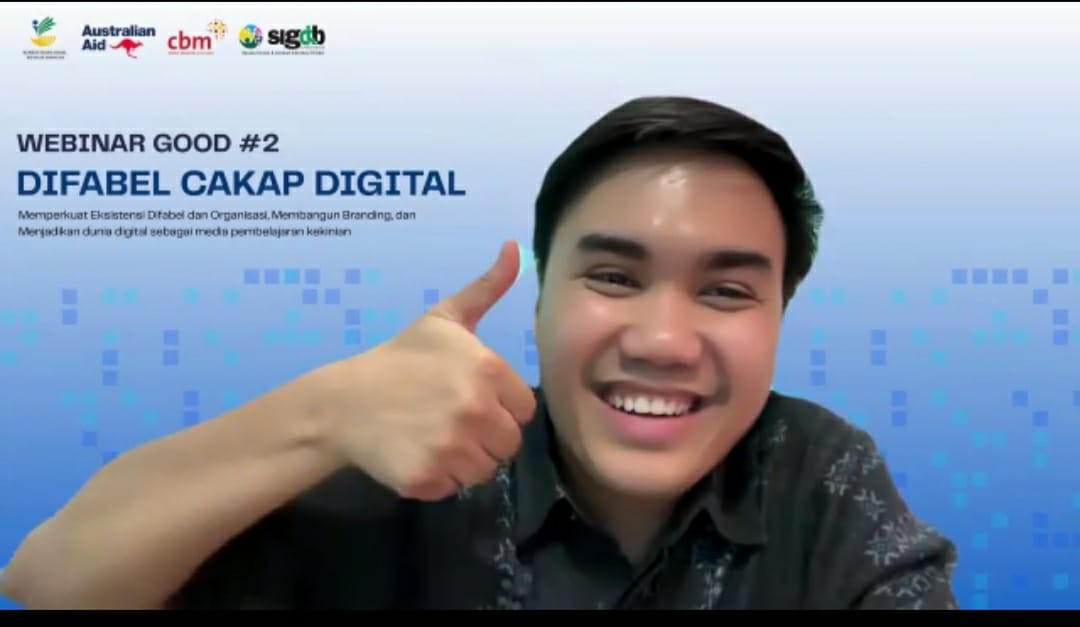
That was the kind of digital space discussed during a webinar entitled “Digitally Literate People with Disability, Strengthening the Existence of People and Organisations of People with Disability, Building Branding, and Converting the Digital World into Contemporary Learning Media” or “Difabel Cakap Digital, Memperkuat Eksistensi Difabel dan Organisasi, Membangun Branding dan Menjadikan Dunia Digital sebagai Media Pembelajaran Kekinian.” For people and organisations of people with disability, the digital space was no longer simply a space to upload activity documents. It could become a space to introduce identity, build networks, develop businesses, learn, and regain control over stories about disability.
That idea was key theme in the presentation by Muhammad Rezki Achyana during the webinar organised by Sigab Indonesia on Wednesday (7/10). Rezki was not new in social media. His Instagram account had around 175 thousand followers, TikTok with 655 thousand followers, and Threads with 28 thousand followers. He was also the founder of Parakerja, an organisation for training and workplace access for people with disability, and TamTam Terapi Center that provided therapy services for children with special needs.
His experience with the digital world led Rezki to see the social media not simply about followers. There was more fundamental issue – who had the right to tell a story. “Now is the time we regain the control to tell our own story,” said Rezki. Thus far, stories about people with disability were often written by people without disability. They talked about how it felt to use a wheelchair, to have hearing difficulty, to have metal disability, or to face challenges to accessibility.
Yet, people had direct experience that other people might not be able to translate easily. For that reason, people with disability had to present themselves as subjects. They had the right to determine how they would be known, heard and seen in public. When stories were told by people who had direct experience, the representation of people with disability did not stop at pity or inspirational stories. The stories became life experience.
From Object to Subject
Rezki gave an example of working people’s experience when they initiated sign language classes. The call to learn a sign language had different meaning when expressed by people with hearing difficulty. Those attending the classes not only learned about theory. They looked into real life experience and needs in communication.
There, the social media could play its role. People with disability did not need to wait for the media to come to them to tell their stories. They could write their own stories.
The experience of using public transport while using a wheelchair, the difficulty of finding descent access, the experience of people with hearing difficulty when driving or riding, the experience of people with visual impairment when dreaming, to the life of people with disability with family could be sources of stories. “Many questions about us that could become contents,” he highlighted.
Such everyday stories could open the doors for communities to understand the life of people with disability which they had no prior access.
The issue then was not about how to make content, but how to make contents that reached the right people. Rezki explained about the importance of knowing the audience. Who would be targeted, what age group(s), where they lived, what were their interests, what were their habits with regards to social media use and what issues they faced?
Each platform had different character. The right contents for Facebook might not have the same approach as those for Instagram or TikTok. Organisations needed to understand the differences. If the target was community in general, for example, disability issue could be related to experiences which anyone could encounter.
Gentle slopes were not only necessary for people with wheelchairs. They were also preferred by women with strollers, the elderly, pregnant women, or people with injuries. This way, accessibility issue was not simply an issue of certain group(s) of people.
The First Three Seconds
In creating contents, Rezki also reminded of the importance of three first seconds."Focus on the first three seconds,” he said. Those three seconds determined whether people would continue to watch or move to other contents.
For that reason, content creators could open a video with questions or issues close to the audience. They did not have to go straight to a long explanation, but rather to make people feel that there was something they needed to know.
Good contents encouraged people to make comments, save and share the contents. For organisations of people with disability, that helped expand networks. Social media could become an entry point for volunteers, community members, subscribers and people in general who wanted to know more about an organisation’s activities. The digital existence would not stop at the number of followers. It became a relationship.
Learning from the Screen
While Rezki talked about how people with disability and their organisation(s) established their presence, Bramono Adi took participants to another discussion – how digital world could become a learning space. Digital technology and business practitioner with 11 years of experience, Bramono asked participants to see technology in a simple way
Every day, people opened their WhatsApp, looked for information through Google, watched YouTube, used social media, and interacted with artificial intelligence. The question was whether all the technologies were only used to search for information, or were also used for self-development? “today’s technology could help people learn more easily,” said Bramono.
Digital learning did not need to happen in a classroom. People could learn from videos, podcasts, articles, PDFs, webinars, and online communication. Learning could also happen in a short time.
Ten minutes or fifteen minutes daily could be time for learning a new skill. Bramono simplified the digital learning process in three steps - access, manage, and share. It was not enough for knowledge gained to be read or watched. The person had to understand the information, summarise it, compare it and verify it. Afterwards, the knowledge could be shared with others.
He gave an example in organisations. If a member had learned to prepare a proposal for certain activities, that knowledge did not need to stop within that person itself. That person could prepare a guideline so that other members could use it. “The quality of digital learning was not dependent on the tools, but on how people used it,” said Bramono.
Technology and Accessibility
Bramono also touched on artificial intelligence which became increasingly easy to use. AI could help explain difficult materials, summarise documents, prepare training, develop proposal framework, and help make lesson plan.
For organisations of people with disability, such technology could become assistive tool to speed up work. Yet, technology still needed humans who were able to examine the outcome. Information produced had to be verified. Sources had to be scrutinised. Users could not rely entirely on engine to do all the thinking process. On the other hand, technology development opened up opportunities for accessibility.
Subtitles, transcription, screen readers, voice orders, contrast management, and text size allowed more people to access digital information. For people with disability, these features were not simply add-ons. They determined whether an information was accessible or not.
Bramono reminded participants to not ignore security. Private data such as passwords, emails, ID photos, and other sensitive information should not be shared with anyone. The digital space could be a broad learning space, but there were risks when not used with caution.
In the question and answer session, Marcel from Forum Belarasa Difabel NTT shared his story as a person with disability and journalist in Sikka District. He had an online media with 12 thousand followers on Facebook. After making contents with a variety of topics, he found a focus on news and events. The growth was extraordinary when his contents were more tailored.
There was one question – how to attract Instagram followers, particularly as the participant’s Instagram account was connected to Facebook. Rezki explained that although the two platforms were in one ecosystem, the characters of the audience were different. The contents had to be adjusted to where they would be published.
Another question was from a participant from Wiradan Magetan Foundation or Yayasan Wiradan Magetan. The participant was active in uploading organisational activities, such as development planning meetings, bazaar, and joint activities with people with disability. The objective was simple – to show to the people that the people with disability were not a burden.
Yet, the responses came primarily from people with disability. Rezki explained that the issue had to do with the way algorithm worked. If disability contents were using a language only people with disability could understand, then people who felt easily connected to the issue were those with similar experiences. For that reason, disability issue had to use a bridge to connect to people’s life in general. Again, he used an example of a gentle slope route. (Ast)