


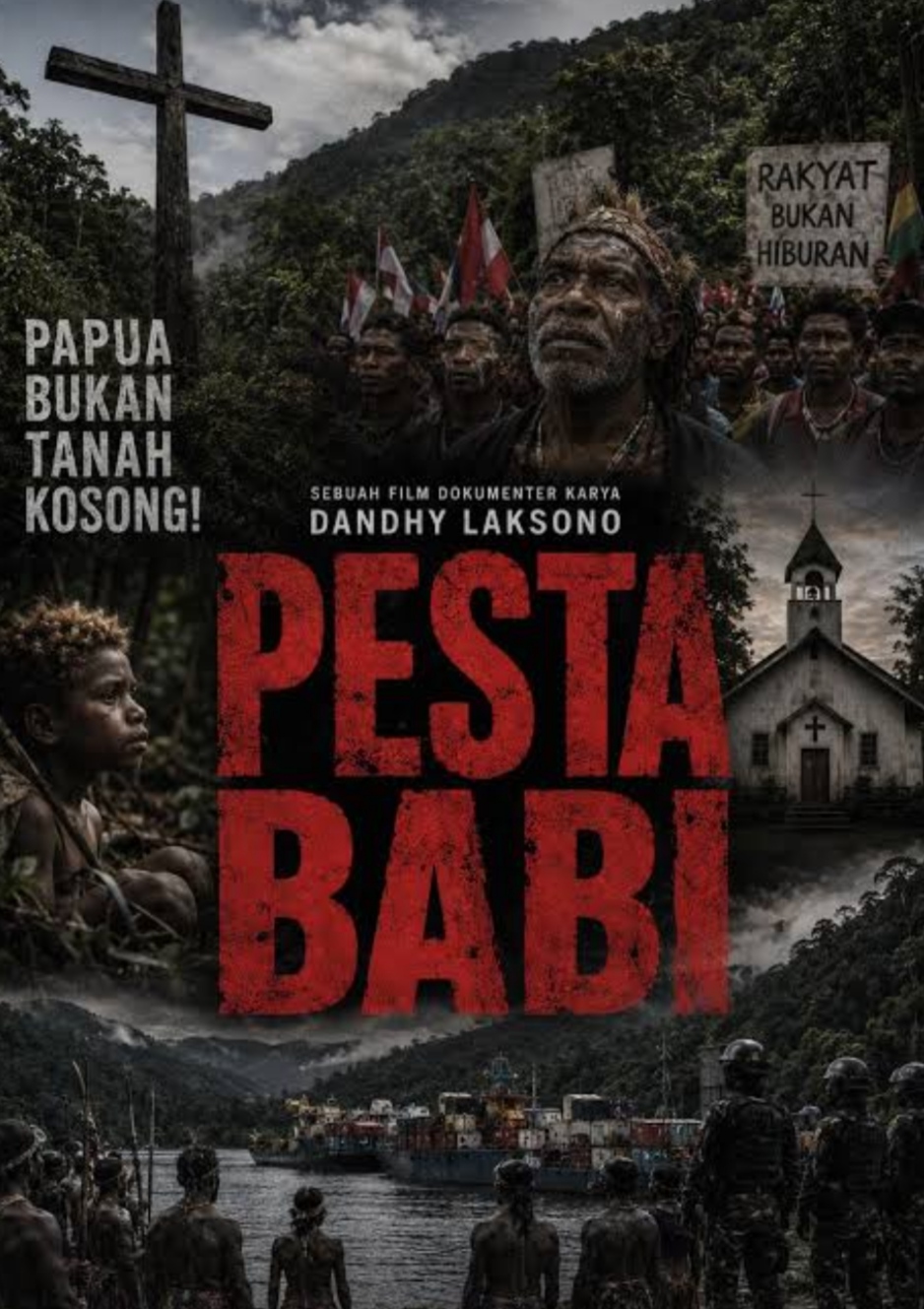

The Film “Pesta Babi” (Pig Party) lasted for 95 minutes and was directed by Dandhy Laksono and Cypri Dale with collaboration of Watchdoc, Jubi Media, Greenpeace Indonesia, and a number of other civil society organisations. Through investigative approach, “Pesta Babi” tried t present Papuan voices who were at the fore front against change in their ancestral land.
An indigenous leader and initiator of indigenous Red Cross Movement, Willem Kimko understood the threat as being bigger than the loss of trees. For him, the stake was the existence of indigenous population against major State ad corporation power.
“This land was created by God and inherited to us,” he said.
That sentence was simple, but in Papua, it had a long history about confiscation of living spaces, military operations, transmigration, mining, and now giant industrial-food project.
The government planned around 1.3 million hectares of new rice fields, hundreds of thousands of sugar cane plantation for bio-ethanol, oil palm plantation for bio-diesel, and industrial livestock. The argument was for food security and national energy. The President and his officials stated that the project was a path towards the country’s self-reliance.
But the indigenous people of Papua asked: Self-reliance for whom? Yasinta Moiwend from Marind Tribe remembered the day when heavy machineries arrived at the port in her village. There was no indigenous people’s deliberation. No free consent. No full explanation.
“We were surprised. We suddenly saw heavy machineries,” he said.
For indigenous people, forests were not simply production land. There were ancestral burials, places to hunt, water sources, traditional medicines, and stories about their origin. Yet, the State project treated forests as empty land ready to be transformed into food and energy production numbers.
In human rights perspective, this situation touches on the basic principle of indigenous people’s rights and the right for self determination. The UN Declaration in the rights of indigenous people stated that States had the obligation to obtain free consent first, and then informed the project before execution in indigenous people’s areas. But in many villages in Papua, people felt that they only became spectators in their own land.
Moving pictures in the film “Pesta Babi” (Pig Party) with sophisticated drones taking pictures of rivers in the forests and plantation areas. In the District of Ilwayab, a road stretching 135 kilometers was being built that split the forest and marshes. The road was straight, unlike indigenous people’s road which followed the contour of the river and local forests.
With the arrival of heavy machineries, security officers came. Vincent Kwipalo from Jagebob District, Merauke saw the change with unexplained fear. For him, the noise of excavators reminded him of the long history of military operation in Papua.
“The place where we looked for food is gone,” he said. Papua lived with a long trauma. Since its integration into Indonesia in the 1960s, military operations happened many times. Thousands of civilians became casualties of violence, refugees, or living in fears. Papuan churches noted tens of thousands of internal refugees in the lats few years resulting from armed conflicts.
In human rights perspective, development that drew the military into the civilian space always created serious problems. The presence of armed officers potentially created conflicts through intimidation and the indigenous people lost their freedom to refuse.
People saw company poles being installed. Forests, which used to be hunting grounds, became concession areas.
One indigenous land owner, Victor once painted trees in red paint as indigenous sign that the area should not be touched at all. But the sign was ignored.
“Land was valued so cheaply. When money ran out, where would we live?” he said. For indigenous people, loss of land mean loss of future. They not only lost economic resources, but also collective identity.
In the midst of State’s and Companies’ dominant voices, Papuan women emerged as firm guardians of their living spaces. A Papuan woman said unambiguously that she rejected the companies’ presence in their land. “When the land is lost, where would our children live?”
That sentence came out of everyday experience. Papuan women lived close to the forests. They harvested sago, searched for vegetables, caught fish, and care for their family life through nature. When the forest was gone, women would be the first to feel the impacts. For them, sago was not simply food. Sago was family.
For that reason, food project which forced changes from sago to rice cultivation was a form of cultural coercion. The State came with a modern agricultural concept, while the indigenous people already had their own food system for hundreds of years.
Another Papuan, Natalis tried to follow the government rice cultivation program. But the aid given was not sufficient to cover production costs. Many times, he experienced a loss. Finally, with a disappointed face, he realized that if the project was not meant to empower indigenous Papuans, but to serve the interests of large industries.
Indigenous people’s criticism was in fact simple: Why would the State not strengthen local food system? Why opened millions of hectares of forest instead?
Many Papuans saw the project as a form of new colonialism. Past colonialism arrived in ships and guns. Now, it arrived in concession, heavy machinery, and green investment terminology.
Sugarcane for bio-ethanol and palm oil for bio-diesel were parts of global energy transition. Countries aimed to reduce dependence on fossil fuels. Yet in Papua, the transition sacrificed the forests and humans. Ironically, the so-called environmentally-friendly project was set up by destroying one of the largest tropical forests in the world.
Papuans saw a similar pattern in forced cultivation during the Dutch colonial period. Land was opened up to meet global industrial needs, while local communities became cheap labour in their own land.
As Priska Beni said, to be fishermen in Fofi River was better than to work nine years in a palm oil plantation of Korindo Palm Oil group. For nine years he only got food, sleep and he only received a total of one million as the other million was cut to pay for food.
In such pressure, indigenous community social movements grew on their own. They combined indigenous symbols and religions through the red cross movement. Crosses were installed in indigenous areas as signs of resistance to companies. There were already 1,800 crosses installed.
This movement had long root in the 19th century in Melanesia. It was born out of the inherent faith that their ancestors had to be called back when people were no longer able to face injustices. Yet, today’s generation brought the fight to new spaces.
“In the era of TikTok, we wanted to tell all through films,” said a young Papuan activist. Social media became a new space to address silence. Documentation, independent films, and civil society organisations’ reports tried to tell stories about Papua coming out of their geographical border. LBH (Legal Aid) Papua, local media, environmental activists, and churches became part of network consolidating community voices to make sure they were heard.
A number of churches in Papua even openly stated their supports for rejecting the strategic national project. They believed the project was not merely dealing with the environmental issue, but also with human dignity.
Pig Party as a Form of Resistance
The highlight of all was the pig party which was prepared for years. The pigs were not purchased in the market. They were raised when they were young, and let loose in the forest. When the time came, hunters would locate them.
This tradition urged people to maintain the forest. Without the forest, there would be no more pigs. Without pigs, there would be no more party. Without party, social bond would collapse. For those reasons, pig party was not simply a cultural ritual, it was an economic, solidarity, and ecological system.
Willem Kimko understood that when the forest disappeared, not only did trees disappear, but the whole civilisation also disappeared. He saw how indigenous peoples of the world experienced slow annihilation: The Aboriginal people in Australia, the native people of America, to indigenous people in many former European colonies.
He feared that history would repeat in Papua. “We came to our native land, and we saw many heavy machineries,” he said.
The Human Rights perspective indicated that development should not be done by sacrificing vulnerable people. This development principle was based on human rights and demanded people’s participation, environmental protection, and respect for cultural identity. Yet what people in Papua felt was the reverse: militarisation, intimidation, and disappearance of living spaces.
People did not reject better life. They did not reject schools, health, or economic access. What they rejected was development that eliminated their existence. (ast)