



One basic question was often ignored amidst the country’s big ambition to pursue food security. The legal framework was in fact strong enough. The 1945 Constitution, Articles 28C and 28H stated that it was the rights of every person to live a prosperous life physically and spiritually and to meet their basic needs, including food. This guarantee was further elaborated in Law No. 39 Year 1999 on Human Rights which placed rights above welfare as part of human rights. In specific detail, Law No. 18 Year 2012 on Food stated that meeting food was a State’s responsibility by ensuring availability, accessibility, and safe, quality and nutritious consumption.
At global level, Indonesia ratified the International Covenant on Economic, Social and Cultural Rights through Law No. 11 Year 2005, with Article 11 recognised the rights of every individual to descent standard of living, including enough food. Hence, the State not only had the moral obligation, but also the legal obligation— which applied nationally and internationally.
Yet, the reality showed the big gap between norms and practice. Indonesia had around 23 million poor people in 2025, with stunting figure at 19.8%. This fact showed that food availability did not automatically mean fulfilment of rights to food. The main issue was inequality in access and weak protection for vulnerable groups.
It was a pity, the dominant policy approach remained charity-oriented. Food aid program and subsidy were often promoted as key solution. This approach was important in emergency situation, but dangerous when it became long-term strategy. When food was viewed as “aid”, and not “rights”, the State indirectly shifted its responsibility to provide charity, not to meet its constitutional obligation.
The issue became clearer when we looked at the most recent case in Merauke. The National Strategic Program for the large-scale food zone development in this area triggered agrarian conflict with indigenous communities. National Human Rights Commission report showed that there was land opening without free consent, information dissemination prior to project implementation, and minimum dialogue with affected communities.
The result was indigenous communities losing access to forest and land – their source of food. This was not just a land conflict, but multi-level infringements: rights to land, rights to living environment, rights to culture, and rights to food. When living space was confiscated, communities’ ability to feed themselves disappeared.
The Merauke case was not the only incident. It reflected wider pattern in agrarian conflict in development project in Indonesia, where project expansion, whether for food, energy, or industry, often sacrificed groups most reliant n natural resources. In such situation, the State not only failed to protect, it was also a part of the problem.
In addition to agrarian issue, national food policy often ignored the cultural dimension. The State tended to assume general consumption pattern based on rice as primary standard. Yet, in areas such as Papua, sago and other local food items played important roles in people’s life. Imposing one type of food was not only ineffective, but also contrary to the principle of non-discrimination and respect to cultural diversities.
On the other hand, the issue of nutrition showed another irony. Measures to reduce stunting through food aid, in many cases, only triggered increasing obesity. This showed that food policy remained focused on quantity, not quality. Children may have been full, but unhealthy. The State was not entirely present in ensuring safe, nutritious, and sustainable food system.
This situation showed that the issue of food could not be addressed in a sectoral manner. It was not just about agriculture or trade, it was also about law, health, education, to governance. Without integrated inter-sectoral approach, food policy would continue to be fragmented and ineffective.
In this context, the launch of the Standard Norm and Regulation over Rights to Food by National Human Rights Commission would be critically important. The document attempted to translate human rights principles into more operational guidelines, covering availability, accessibility, quality, to cultural acceptance.
Yet, the biggest challenge was not in the formulation, but in the implementation. Indonesia had planet of regulations, yet it was often weak in implementation. Without integrating regulations into development planning and without the courage for true agrarian reform, the standard risked becoming a normative document.
In the end, food was a most concrete measure of State’s presence. The latter was not there just present statistical figures, but also to deal with day-to-day reality: whether each citizen was able to eat descent, healthy and dignified meals.
If there remained hungry citizens or citizens who lost their food sources due to agrarian conflicts in this rich nation, the issue was not about lack of resources, but about the direction of State policies. Food was not just about filling the stomach. It was a guaranteed constitutional right. And this was where the State was being tested.
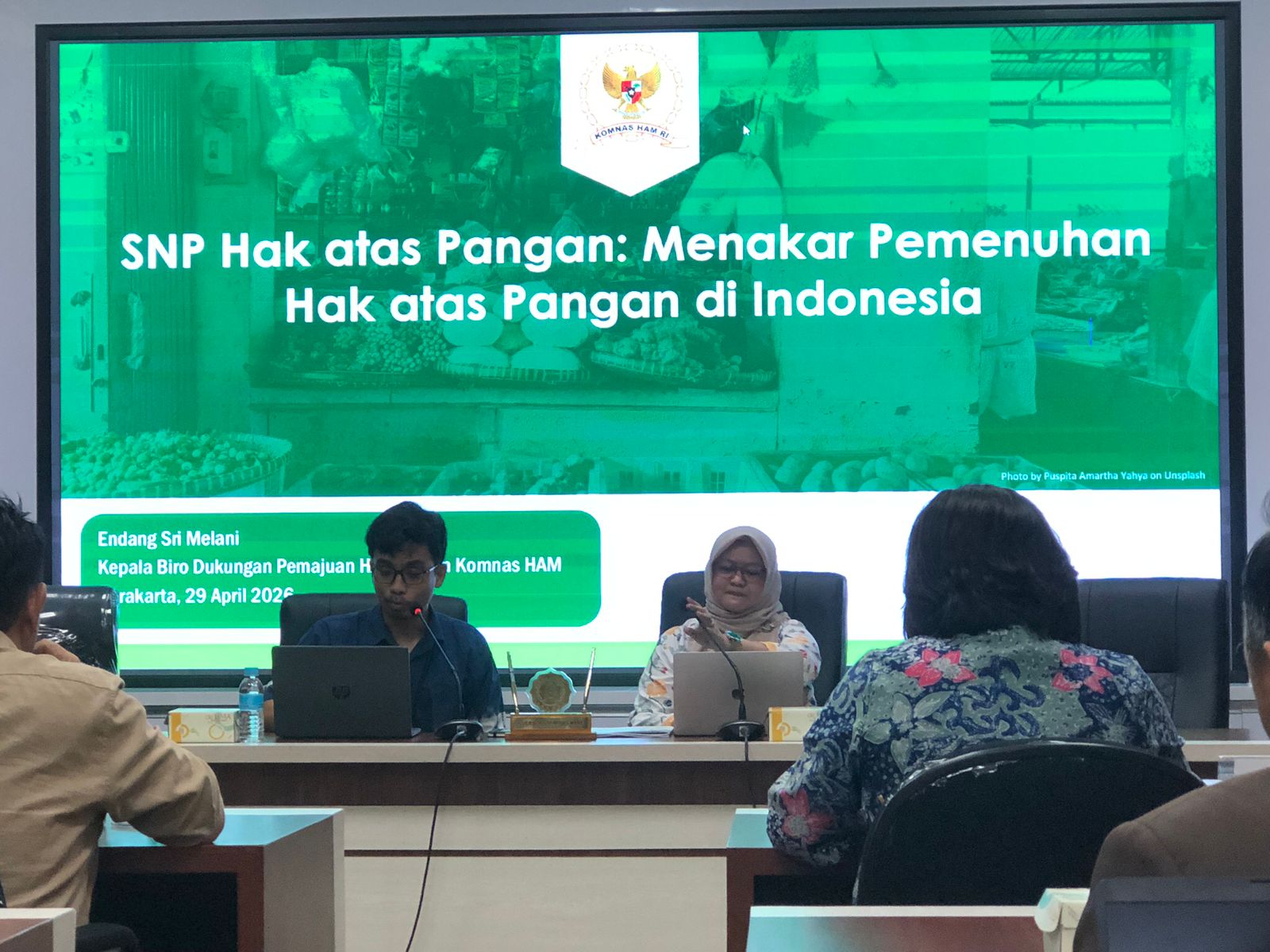
This was the key note of the discussion session on measuring the reality of meeting food rights in Indonesia after the signing of Collaboration between National Human Rights Commission and the Law Faculty of the University of Sebelas Maret or UNS, which continued a long relationship built since 2018. This Collaboration reflected the seriousness in integrating human rights values into education, research, and community service, at Pasca Sarjana Hall, Law Faculty of UNS on Wednesday, 29/5.
This collaboration was a long-term investment: to promote graduates who not only knew law in normative term, but who were also able to connect the issue with the social reality, including issues about inequality and injustices in accessing food and the weakness of protection for vulnerable groups. (Ast)