


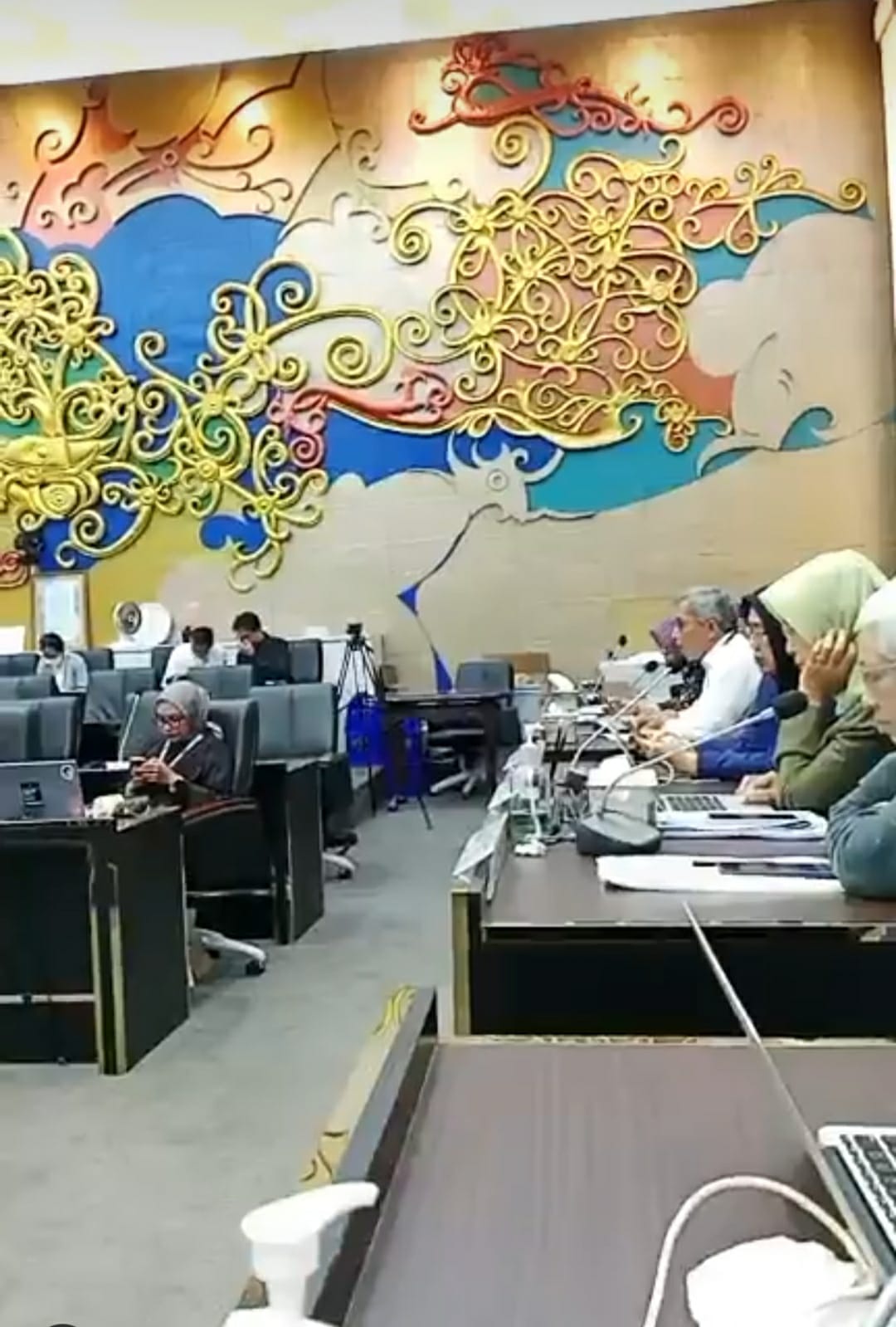

Civil Society Coalition for Ratification of Law on the Protection of Domestic Worker attended hearing meeting at Parliament House on Thursday, 5 March 2026. The hearing questioned Parliament’s commitment after 22 years of non-decision regarding the Law ratification.
“What really happened, after 22 years and no ratification?,” Said Lita Anggraini, Coordinator of JALA PRT when asking a question at the hearing.
Since 1 May 2025, President stated in front og Parliament leaders - Puan Maharani and Sufmi Dasco – that the Law would be finished in three months, which would be that it should have been ratified in August 2025. Yet after almost one year, the Legislative body of the Parliament had conducted so many hearings, and nothing final came out.
“Was there other underlying reason for the hearings? How many more hearings should there be? We really hope that this would be the last,” said Lita Anggraini.
Th Parliament had conducted hearings after hearings, since President Prabowo made his speech on 1 May 2026, in other words ten months of hearing and no progress whatsoever.
“Hearings continue, and Civil Society Coalition knows exactly what comes out if these hearings?,” said Lita Anggraini.
The draft law had been on the table for 22 years. Before this, a number of hearings, research, learning visits were done. Should such situation cotinued, the Coalition was not optimistic that the law would be ratified this year, because the Parliament tended to drag on and on and did things that were not really necessary. What was truly needed was commitment to finalize the draft law and brought it to the Parliament leader’s meeting which would then allow for a plenary meeting to consider.
The chairperson of National Women’s Human Rights Commission, Maria Ulfah Anshor stated that the Commission had urged for the ratification of the law immediately, because it would promote a humane working relations between employers and employees, and at the same time strengthened relations amongst women.
Chairperosn of YLBHI, Muhammad Isnur stated that it was urgent to ratify the law because treatments of domestic workers were not visible because they worked in the domestic sector, hence it is crucial that the Parliament reflected seriously what happened when these domestic workers had problems?
“When there is problem, the panic button should work to solve the problem.”
The panic button was a security measure designed to solve dangerous problem, so the only would be to ratify the draft law in order to solve hidden domestic worker issue, those who were in the kitchen, in the laundry room who were not visible.
Data from Serikat Pekerja Rumah Tangga (SPRT) Sapu Lidi indicated that to date, there were 1,103 domestic workers becoming victims in 2025.
“We work in the invisible domestic domain. We receive terrible treatment such as not being allowed to sit, but only allowed to stand when fetching my employer’s child(ren), not allowed to use the human escalator, but only allowed to use goods escalators. We are not being respected,” said one domestic worker, Wiwik Kartiwi.
Another domestic workerfrom Jakarta Feminist, Dita Nirmala Sari said that domestic workers have vulnerabilities and they are treated differently.
“The salary of domestic worker is small, sir, many are not able to return home because they are not allowed by the employer(s), they rarely receive bonuses, sir, other than biscuits,” said Dita Nirmala Sari.
Representative from Workers’Union (Serikat Pekerja), Rieke Diah Pitaloka from Konfederasi Rakyat Pekerja Indonesia and Ramidi from Konfederasi Serikat Pekerja Indonesia (KSPI) said that the law must be ratified, after 22 years of wait.
Eva Kusuma Sundari and Ninik Rahayu from Ibu Bangsa Institut Sarinah argued that the Parliament and the government had to consider women’s vulnerabilities today. There was economic vulnerability and women were trapped in poverty. Vulnerable households could be discerned through high-level of domestic violence, stress, mental health issues, and high-rate of suicide. The way to save these households was by caring for the economy thus saving women and households where domestic workers became a part of.
“It is important to ensure economic investment – i.e. domestic workers who help household managed mostly by women,” said Eva Kusuma Sundari.
A number of Parliament members stated that saving domestic workers meant saving women, which Parliament members from PKB, Gerindra, Nasdem, and Golkar agreed.
“The draft law is almost as old as I am, having been fought for 22 years, and I am 26 years old. There is no other way but to ratify it,” said Cindy Monica Salsabila Setiawan, a Parliament member from Nasdem.
Member of PKB Party, Habib Syarief Muhammad stated that discussion about the articles in the law had been completed, and that there was no other way but to ratify the law.
“There had been so much discrimination, that is why it is critical to ratify this law. Data shows that there is significant discrimination against women, and that discrimination must stop and there should be social security and protection of workers.”
From Gerindra Party, Sugiat Santoso questioned why was the Parliament dragging its feet when President Prabowo already endorsed.
“I also questioned, where exactly is the problem? Is it at the Legislative Body or elsewhere? The President has given his endorsement, why is it not ratified yet?”
Other Parliament members alspstated that one domestic worker in a house would be able to solve so many issues in the house – which would help anyone living in the house.
From PDIP Party, Nyoman Arta also lent his support. From Gerindra, Melly Goeslaw read a poem to support the law.
The Vice chairperson of the Parliament, Martin Manurung from Nasdem Party indicated that all parties had been ok with the draft, so there should not be any more issue at National Legislative Program. The only thing to be done was to ensure progress.
“On 10 March 2026, we would discuss again during a working committee meeting, so that it would be ready for ratification.”
The chief of Legislative Body, Bob Hasan stated that the working committee would then have only one article with two points to discuss.
Lita Anggraini stated that it was time for the Parliament to fight for social justice for workers and domestic workers.
"Urge the Parliament that the Draft Law became the Parliament legislative Initiative for ratification, President’s Letter and Issue Inventory in May, Level-1 Discussion and Ratification in July 2026."
Civil Society Coalition for Ratification of Law on Domestic Workers’ Protection
Contact: 0856-1612-485