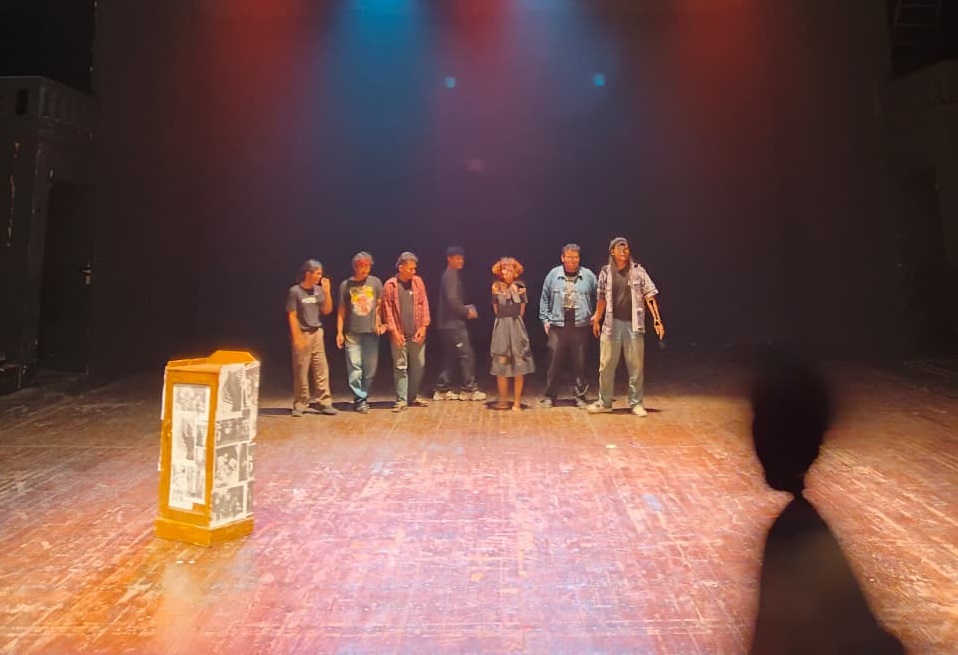



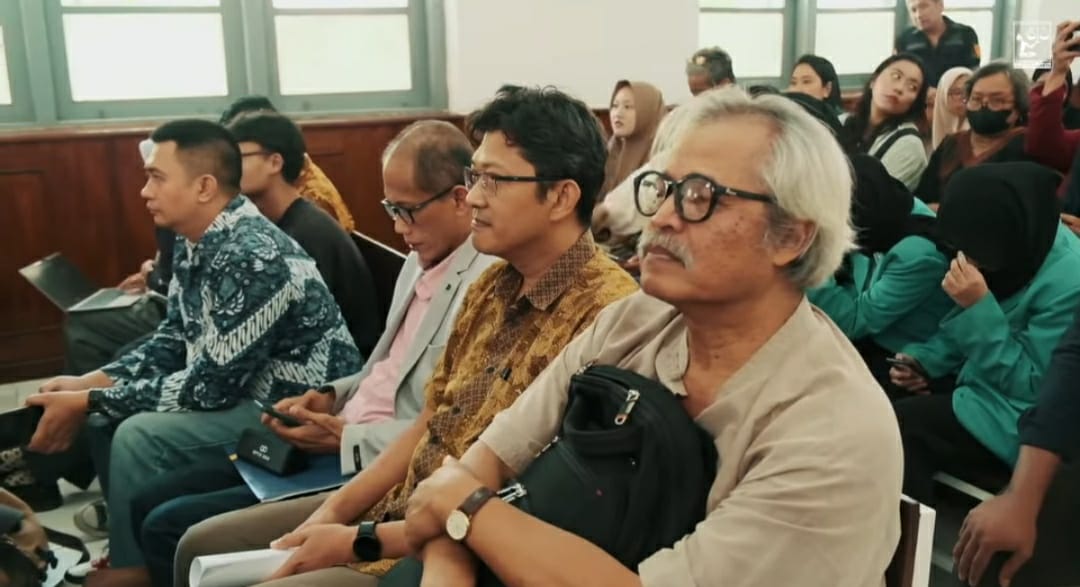

The proceeding against political prisoner Hanif Bagas Utama (Hanif), Bogi Setyo Bumo (Bogi), and Daffa Labidullah Darmaji (Labid) proceeded on 4 March 2026, with deliberate limitation of public presence at the court. That was the right to listen and observe the proceeding fully, not simply technical comfort within the court, and the court had committed infringement to the regulation of the Supreme Court. There was no sound system during the proceeding. That infringement was with regards to Standard Facility (SK KMA No. 026/KMA/SK/II/2012) with regards to Standard Services at the Court, the court had the obligation to provide descent facility including sound system so that all people involved could listen to the proceeding.
The judges’ rejection of the legal counsel initiative to provide independent sound system showed the court’s reluctance to fulfill public interests for information, which was not consistent with the Law No. 25 Year 2009 on Public Services.
In the court proceeding at PN Surakarta (Courthouse) there was attempt to limit attendance, which was not based on the principle of open justice. Despite the large room, the judge prohibited people to stand, declaring that there were only four rows of seats. This was clearly against the principle of open justice as articulated in Article 13 Law No. 48 Year 2009.
Although the Supreme Court Regulation No. 5 Year 2009 provided stipulation for limitation for security purpose, but in the context of this court, such limitation was deemed arbitrary because the physical space was available and there was no tangible threats.
During court proceeding, where the voices of both the judge and the prosecutor were almost inaudible while the legal counsel spoke loudly creating imbalance in the court room. This was not consistent with Article 28 D point (1) of the Indonesian Constitution regarding the rights to legal certainty. It also ignored international ICCPR Article 14 (telah ratified via Law No. 12/2005) that guaranteed fair and open cross-examination.
After the court proceeding, the Koalisi Advokat Anti Kriminalisasi Solo Raya (the Solo Raya Anti-Criminalization Lawyers) submitted its demand urging the Supervisory Body of the Supreme Court to conduct on-the-spot inspection at Surakarta Court, and asked the Judicial Commission to examine the judge who deliberately rejected transparency in the court proceeding and repaired the air conditioning system and sound system at the court within 1x 24 hours in order to protect the court dignity.
The Court Proceeding
The semiotic expert and lecturer at Universitas Sanata Dharma, Yogyakarta Dr. Stanislaus Sunardi or known as St. Sunardi answered the question raised by the legal counsel for the defendants - Hanif, Bogi and Labib – who were indicted for incitement based on stipulation of the criminal code, in relations to the writing and the poster which used the word "killer police." In semiotics, there was connotation that "killer police" was not word, but a form of rhetoric, hyperbole, and in this text it was meant to draw people’s attention that the situation was dire. This was not just simply about the fact about the death of Affan Kurniawan (online driver) but had broader association. It related to the murder of the driver but also to the drivers’ protest at the Parliament House. ST Sunardi articulated that as an expert in semiotics, he only read intension of interest. "As a lecture, I only looked at the text, the written stuff in order to prevent/avoid arbitrariness," he insited.
Then the legal counsel asked whether the hashtag can be interpreted as call to do something or call to commit crimes?
- Sunardi answered no. This referred to the critical condition in the community and the injustices happening in Solo where people might witness. There were two meanings, first hyperbole and second semiotics – a call to do something. "the flyers are forms of political education for young people, not for criminal activities and there was no race that went that way, " he insisted.
The previous expert presented by the Soloraya Civil Society was Prof. Dr. rer. soc. Masduki, SAg., M.Si., senior lecture for Communication Science at Universitas Islam Indonesia. Prof. Masduki’s statement with regards to how communication science saw the evidence (flyers). He stated that from communication science, one needed to see where the content was distributed, taking into consideration that the audience may not have necessarily taken actions after reading the flyers.
This happened because there was an ecosystem affecting it such as readers accepted but did nothing, or readers accepted and did something that was not in line with the message of the flyers, or people distributed the flyers through social media, but did nothing else. Prof. Masduki also explained that research was needed on the people engaged in the riot, whether the riots were acts of incitements or not. Human essentially had a sense of autonomy to choose whether they wanted to act or not.
Flyers were more of forms of campaign and voicing solidarity works. Prof. Masduki also explained that distributed flyers were forms of campaign, to voice facts not accusation, written in hashtag #killer police. The riot that ensued had many factors not related to content and flyers. The flyers featured critical issue that happened. He also suggested that the flyers had digital rights, to express and conduct campaign. It shold not have become a problem worthy of indictment, but had to be appreciated because they provide critical education that verbal and digital theories could be combined.
Even when the prosecutor asked what could happen after the flyers were made then triggering chaos, Prof. Masduki explained that the responsibility of those making the flyers stopped at that (making flyers).Evidence and research were needed, if the flyers triggered people to move and prompted chaos. The bottom line was that the flyers were made for positive activities in order to maintain democracy.
The judge also asked whether it was possible for the flyers to cause riots. Prof. Masduki answered that the written message was in general encouraging people to the active and the authority of those making the flyers only stopped at making the flyers with positive activities.
There was interesting response from Prof. Dr. rer. soc. Masduki, SAg., M.Si, that should there riots, then the State authority had to take the responsibility to find structural solution and to re-gain community trust to State authority.
Third Expert Witness
With regards to expert view on human rights principle(s), guarantee of protection for freedom DR. Herlambang P. Wiratraman, S.H., M.A., Ph.D, dosen UGM, opined that the human rights principle(s), particularly from the standpoint of human rights acknowledgement from the viewpoint of the Indonesian 1945 Constitution and Article 28. He said that there were not many human rights article at the time. That articles was proposed to prevent the authority from indiscriminate acts. During amendment, human rights remained inserted int Article 28 E. This was a political contract between people and the authority in the constitution and as basic principle of the State of Law. The constitution had to be the standard. Legal practices had to be based on constitutional principles. Article on human rights had to be integrated into laws. It just happened that Indonesia ratified the treaty, including the economic and social rights, Law No. 11 Year 2005.
The question was did the economic and social rights had their limitation? Herlambang suggested that Article 19 point 3 contained some limitation, for example based on health – i.e. COVID-19. With regards to morality, with regards to certain standards or with the objective of protection, and this was "For Others".
Then there was the phrase “Digital Right is Human Right”. The United Nations also issued a general comment that included digital right. Digital right was similar to expression in public space – meaning that it was protected.
Then the question from the legal counsel to the expert witness was whether the flyer was legitimate? The answer was that based on the poster depicting a call to join, that was legitimate expression – meaning that it expressed ideas, feelings, or opinion considered official, natural, and acceptable socially, legally and ethically in certain contexts. That was to say the poster was a call for solidarity.
Herlambang said that he was present in similar case regarding accusation of incitement, including in digital space. He believed the August phenomenon was critical and may be regarded as the hunt for activists as witnessed in the court room. Yet that incident was triggered by the death of Affan Kurniawan. The death of Affan Kurniawan was the initial context where an Indonesian citizen was killed by the Police constitution. That meant that the incident was the trigger to the massive movement which may not necessarily related to the poster, because the public simply was enraged and disappointed. "The incident with Affan was not the first. In the August incident, 13 people were killed. What I mean was the context was key when we read a case. And first of all, the number was high in the Indonesian legal system. Every one had to be detained if they were not in accordance with the context," he said.
Look at the example in the United States in 2020, white police officers kneeled on the neck of a black man, George Floyd that led to the latter’s death. What were the consequences? Thousands and millions of people in a number for countries staged protests of his death, which triggered massive protests worldwide, and that was not just about one poster.
One more case from Iran, in 2020 Mahsa Amini wearing unusual hijab was arrested by morality police. The following morning after her arrest, Mahsa was found dead, and there was solidarity and protest. That incident led to public anger. And the August incident was not independent of the death of Affan Kurniawan.
The Hastag "Killer Police" appeared in a number of countries. They used killer police. This was not limited to Indonesia. This was a fact, not provision on incitement.
Human Rights expert meeting in Morocco in 2012 specifically discussed incitement. 1. Incitement for violence. 2. Incitement for discrimination. 3. Incitement for hatred, with regards to hashtag. There was no problem with the fact just not use #kill the police.
“We need to understand whether the hashtag was part of freedom of expression to be protected? Hashtag for activism to find allies, solidarity, resistance and the goal was to draw public attention, awareness that this was the problem. That was the hashtag activism. The question was should it be protected? Yes, it should be protected,” said Herlambang.
Herlambang added that the legal processes had to be tested, whoever acted during the legal processes should not have conflict of interests. The problem in Indonesia was that the legal construction itself was not totally coherent with the advanced human rights system. Often rules/regulations were developed haphazardly, such as in fascist countries.
In Indonesia, there were already many examples and Indonesia returned to authoritarianism. Foreigners gave that labelled observing the legal processes and the court’s legal decision. (Renny Talitha Candra/Astuti)