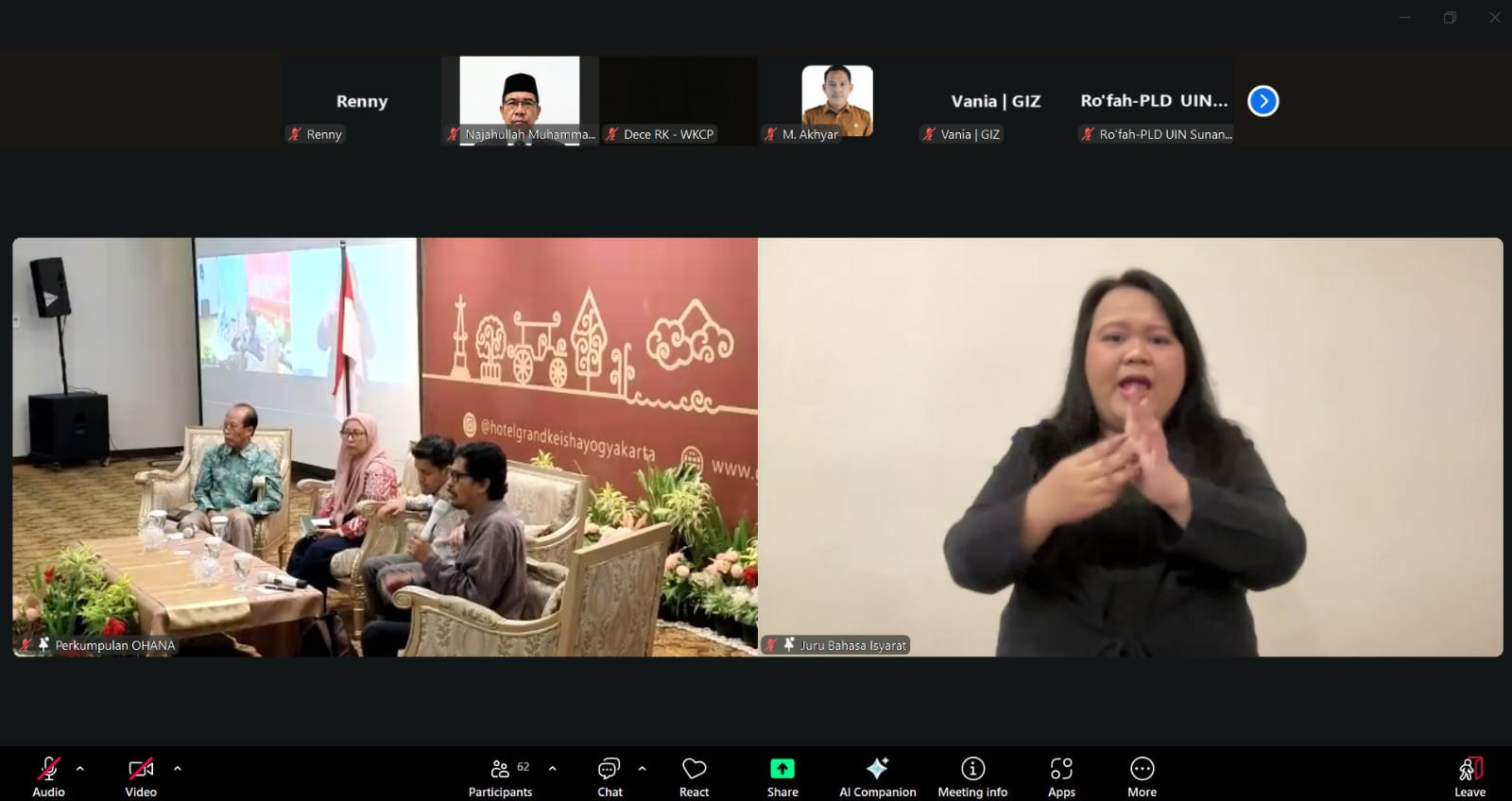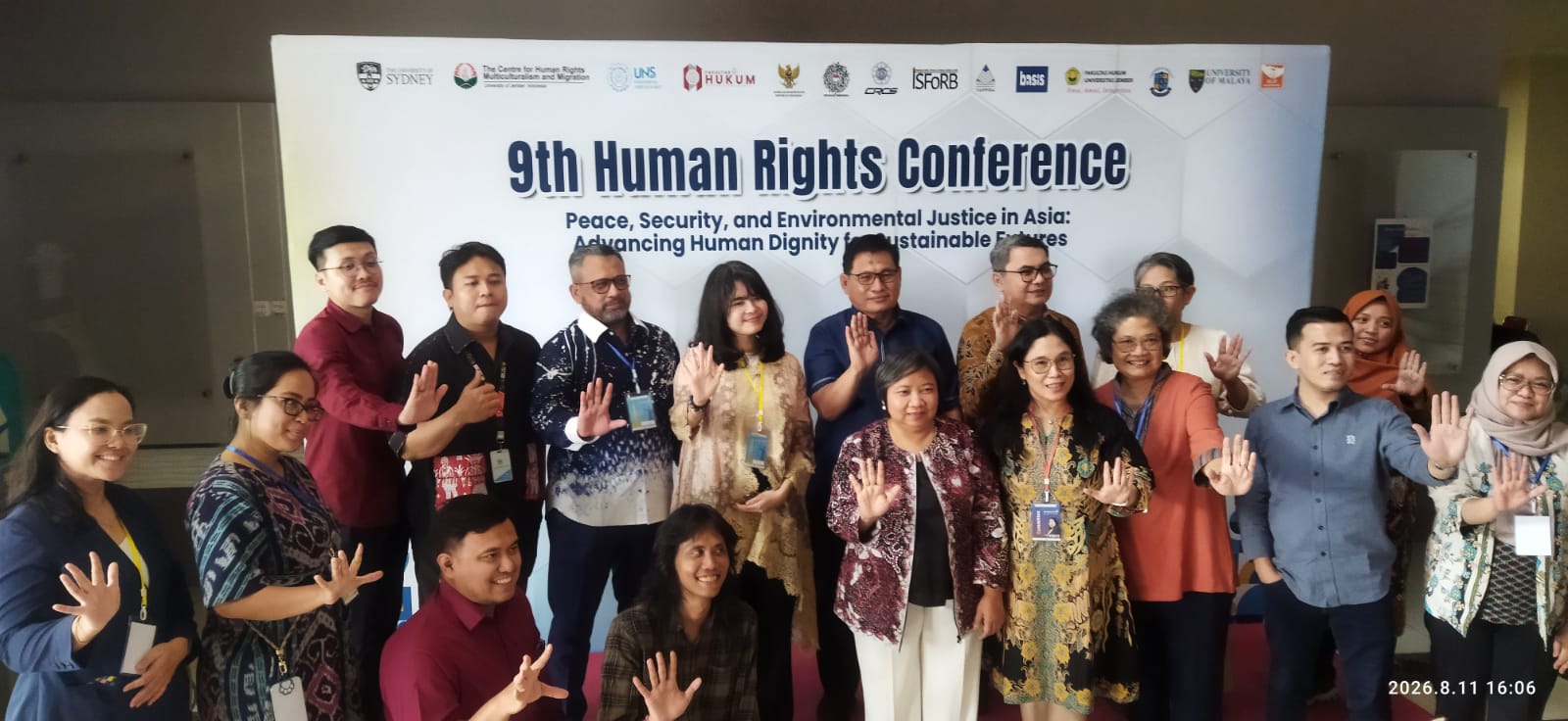



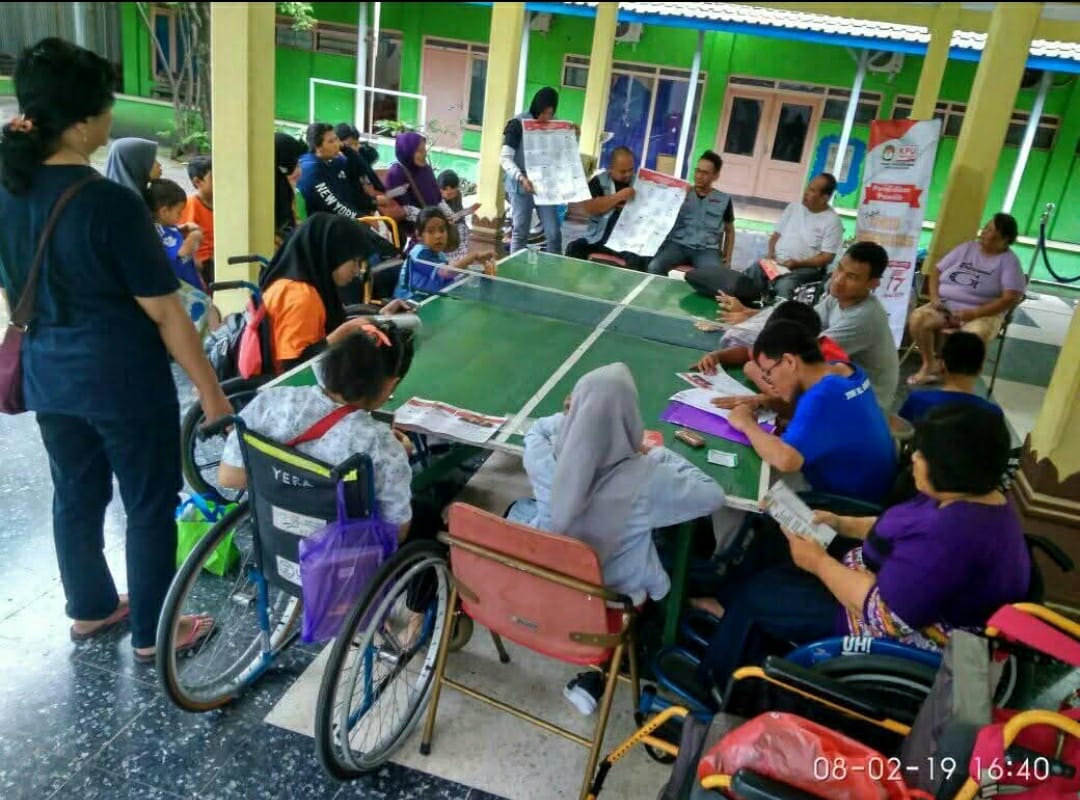

There are polling venues that are not accessible, or biased election monitoring authority, lack of information dissemination, lack of technical supervision, as well as “black holes” in election from start to end, not to mention the still below 50% of involvement of people with disability – which are key issues for inclusive election. This is what Ahmad Shidqi from the election office in Yogyakarta emphasizes during the book launch “Ignored Voices and Dissemination of Roadmap,” on Wednesday (18/2) via zoom meeting done by Sigab Indonesia.
Muhammad Syamsudin, Director of Sigab Indonesia also finds a similar case that people with disability are being used during election. There is not even attempts to address the basic issue of disability such as data, when many people with disability are not registered in voter rolls. Data of people with disability remain hidden and unpublished, and when individuals try to check, the data cannot be accessed.
Syamsudin also suggested that the book answers the 2024 election with regards to participation of people with disability and the election office in Yogyakarta Special Province prepared a roadmap to involve people with disability. He expects that the 2029 election would no longer be about accessibility and more inclusive law(s).
The resource person Slamet Thohari has the first opportunity to present and he says that the significance of election for people with disability, as per findings that election becomes a toolbox, is that it serves as an instrument to express day-to-day policies because the voices of people with disability are not heard. He takes examples of cases such as Law on the Ombudsman Law, whose impact is evident even today with the use of such words as “disabled”, a case involving the refusal of a dentist civil servant who eventually becomes a person with disability, and the requirement to be physically and spiritually healthy.
Slamet Thohari says that there should be political advocacy on the above issue, yet so far that advocacy is entrusted to people without disability, which pose significant gaps (holes) as the interests of people with disability are set aside or not deemed important. The main case he believes involves: Ombudsman Law, and today in the context of the health insurance, there are abundant cases where people with disability no longer have access and therefore unable to use the insurance, the same with social security and other social aid such as direct cash aid, Family Hope Program that do not integrate the interests of people with disability, for example people with disability only get so much money when their needs are much higher that what they receive. This is also happening with scholarship and other assistance.
Slamet Thohari also suggests the facts that almost all candidates – whether for district administrator or governor – are not familiar with nor classify people with disability as vulnerable groups, hence the issue is forever hidden. “In election, people with disability serves only symbolically, with no understanding of vision and mission. Disability is forced into the election, yet there is no access, no findings with regards to representation,” he says.
“If we look back at past election in 2019 or even further back, there were people with disability who could break through, that election serves as toolbox, because people with disability were the true people who had the experience of disability, so they had to promote themselves such as the case of Saras from Rembang and Nasdem in Jogja, but they were not successful,” says Slamet Thohari.
The book being launched describes people with disability experiencing challenges such as inaccessible buildings, and inaccessible means of transport. There is also a lack of consolidation to make sure people with disability are elected and that is a major challenge. This proves that the structure and infrastructure are not supportive, which is also evident in election structure, and an incident where the capacity of a candidate with disability is questioned when during a show in Sumatera. That person is deemed not ready to lead, and the person eventually report this to the party, which in itself constitutes another major challenge.
In addition, there is also challenges associated with regulation such as the requirement to be healthy physically and spiritually. In a number of areas, there are incidences involving people with psycho-social disability, being deemed ‘crazy’. In 2019 election, the government put in place measures, yet not all sub-national areas are implementing those measures, the minimum quota or affirmation for people with disability within their own parties. People with disability face discrimination, where the State and political parties should have given them quota. Yet they did not do it. The lack of funding and the brutal nature of money politic, made it difficult for people with disability to break through into legislative and executive elections. People with disability only relies on disability networks, Non-Government Organizations (NGO) and private connection. At the same time, there is little disability movement whose voice remains insignificant.
One can conclude that people with disability are incorporated into political parties and government offices in symbolical terms only. Disability issue only serves as lip service to the government. It is portrayed as inclusive, yet the substance is missing, particularly with regards to instruments, political parties are obviously reluctant, lacking in awareness, and short on involving people with disability. “This begs the question of whether people with disability need to enter politics and become truly competitive in order to ensure inclusion. In Australia, the United States, and Egypt, they have quote for people with disability in parliament. We should be able to adopt that significantly and substantively by setting quota or other instruments,” says Thohari.
Suharto from Sigab Indonesia opens his presentation by suggesting that no voice is useless. That is to say each voice counts. There were not many candidates with disability in past election and today not one person with disability is elected, as they do not have enough funds to succeed as candidates in election, there remains stigma of powerlessness and un-represented.
The challenges to accessibility and inclusiveness are significant within regulation, while there is no stipulation in laws. Things like election logistics are never articulated, and the election law does not mention what criteria is used and what kind of inclusion specifically, for example in braille template which people with vision disability fights hard to get, and only in presidential election and sub-national election where there are relatively few candidates. The design of voting paper is such that caters to the crowded candidacy. In 2019, a number of sub-national election offices printed braille at Sigab, and Sigab could not oblige. The other shortcoming has to do with the vision and mission of candidates that are never printed by the media, while accessible information is not available either, which leads to 50% or less participation rate of people with disability. “If election is done liberally, while the process is full of stigma and discrimination, it would be difficult to vote, not in terms of the voting but in terms of the quota,” he says.
Suharto believes that advocacy targeting the government is critical in order to: strengthen policy and legislation to revise discriminatory regulations: logistical accessibility, and requirements for candidates and administrators, as well as information, protection of the rights of people with disability. 2. Clear sanctions for infringement of rights. Effective monitoring of implementation may be exercised through transparent monitoring mechanism, clear sanctions for infringement of rights and capacity improvement of election administrators. 3. Budget allocation for accessibility: special funds for inclusiveness facility, prioritizing election office planning, fulfilment of a variety of needs amongst people with disability. 4. Standardized inclusive facility: disability-friendly election booths (flat, spacious), availability of assistive devices (braille, and so on), and accurate and easily accessible voter data.
Suharto then explained what needs to be done – that is advocacy to a number of stakeholders, including the election office: 1. By preparing and implementing clear guideline to ensure full accessibility in all stages. 2. By training to all people involved in the administration of election. And 3. By providing information. The second would be advocacy to political parties: 1. Representation of people with disability. 2. Education in internal parties, 3. Inclusive program, vision, and mission, 4. Accessibility campaign: 1. Organizing and mobilization, 2. Direct monitoring and advocacy, 3. Education and information dissemination regarding voting rights, and 4. Partnership with other stakeholders. The third advocacy targets disability community. He also offers example that networking is critical so that advocacy becomes stronger vis-à-vis the government, political parties, communities, as well as strong candidates.
What the Panel Say
A member of election Commission in Yogyakarta Special Province, Surani responded with regards to the book launch (the roadmap, particularly the re-commitment), her office cannot work by itself. As election administrator, her office may encourage people with disability to have meaningful participation. The process towards the publication of the roadmap, according to Surani, is that YAKKUM and 11 other organisations, were ready to discuss and prepare a roadmap towards more inclusive election in 2029.
She also revealed facts that election is not yet inclusive due to low participation of people with disability in all stages of election. She also points out that the election administrator does not yet have the necessary perspective, nor guideline or roadmap to involve people with disability in all stages of election. There is a dire need therefore for good collaboration amongst election stakeholders with voters with disability and with disability activists in order to ensure fulfilment of the rights of people with disability in inclusive election.
Surani expresses that the objective of the roadmap is to identify gaps, priority issues, and stakeholders in promoting inclusiveness in national and sub-national election in 2029 in Yogyakarta Special province. This necessitates defining vision, mission and strategic targets for every priority issues. She also initiates good practices such as collaboration amongst election administrators and disability organisations/civil society organisations in order to promote inclusive election at national and sub-national levels.
The roadmap approach to election administrator is through mainstreaming of disability issue in all regulations, policies, budgeting, and programs that are specifically targeted towards people with disability.
The approach to civil society is through coordination with election administrators at all levels in order to ensure integration of disability issue into all processes and stages, and coordination with other election activists in order to move towards inclusive election in all stages.
The strategic issue/target: Data collection with disability perspective, increase in access to knowledge for people with disability through voter information dissemination and education, ensuring barrier-free environment in election venues, and logistical management for voters with disability, improvement in services for people with disability during election process, and supervision and responsive complaint mechanism regarding people with disability.
Yusti Erlina, from the Election Supervisory Body (Bawaslu RI) responds to the real actions by Bawaslu by saying there is already regulation about inclusion, but it is not being implemented. Bawaslu data shows that it conducts monitoring and law enforcement based on applicable law. “The issue is that there is minimal discussion about people with disability in the law. It is only used to ignore our duties. It is a fact that equality in constitutional rights is not the same as accessibility rights,” she insisted.
Titi Anggriani from Perludem explains her response to the roadmap at the Election Office in Yogyakarta Province. The key contribution of the book is to shift focus from procedure to substantive democratic justice, by placing inclusiveness of people with disability at the centre of democratic issue, not merely about welfare, which showcases the paradox between progressive law versus weak implementation, strengthening discourses about electoral inclusion in democracy in Indonesia.
The fact is that there remains systemic exclusion in election data collection, in accessibility within the polling venues, representation in politics, and recruitment of election officials and political parties.
In reality, political parties as “gatekeeper” has not shown their commitment to inclusiveness obligation in promoting candidates, the lack of electoral incentives for inclusion, the absence of party reform, inclusion stopped at polling booths, and political representation in public policy decisions.
From there, Titi then shows the direction of the reform – by integrating inclusion into the election integrity indicator, serious infringement with regards to accessibility, and affirmative design for representation of people with disability: as integral part of national electoral districts (women, people with disability, youth, and party ideology).
As inclusion standard in evaluation of election implementation, there is an urgent need for institutional reform, not merely technical, in order to develop effective capacity and paradigm. (ast)