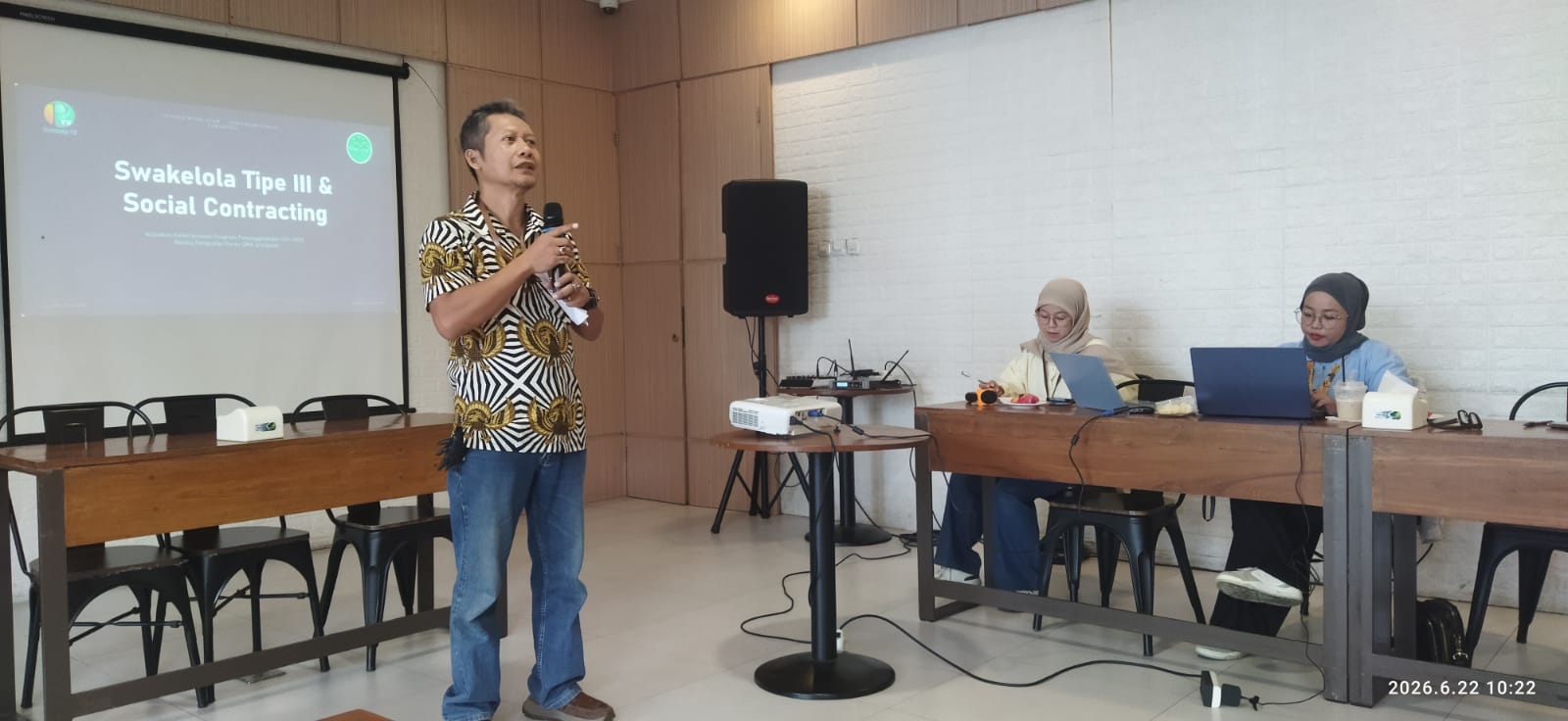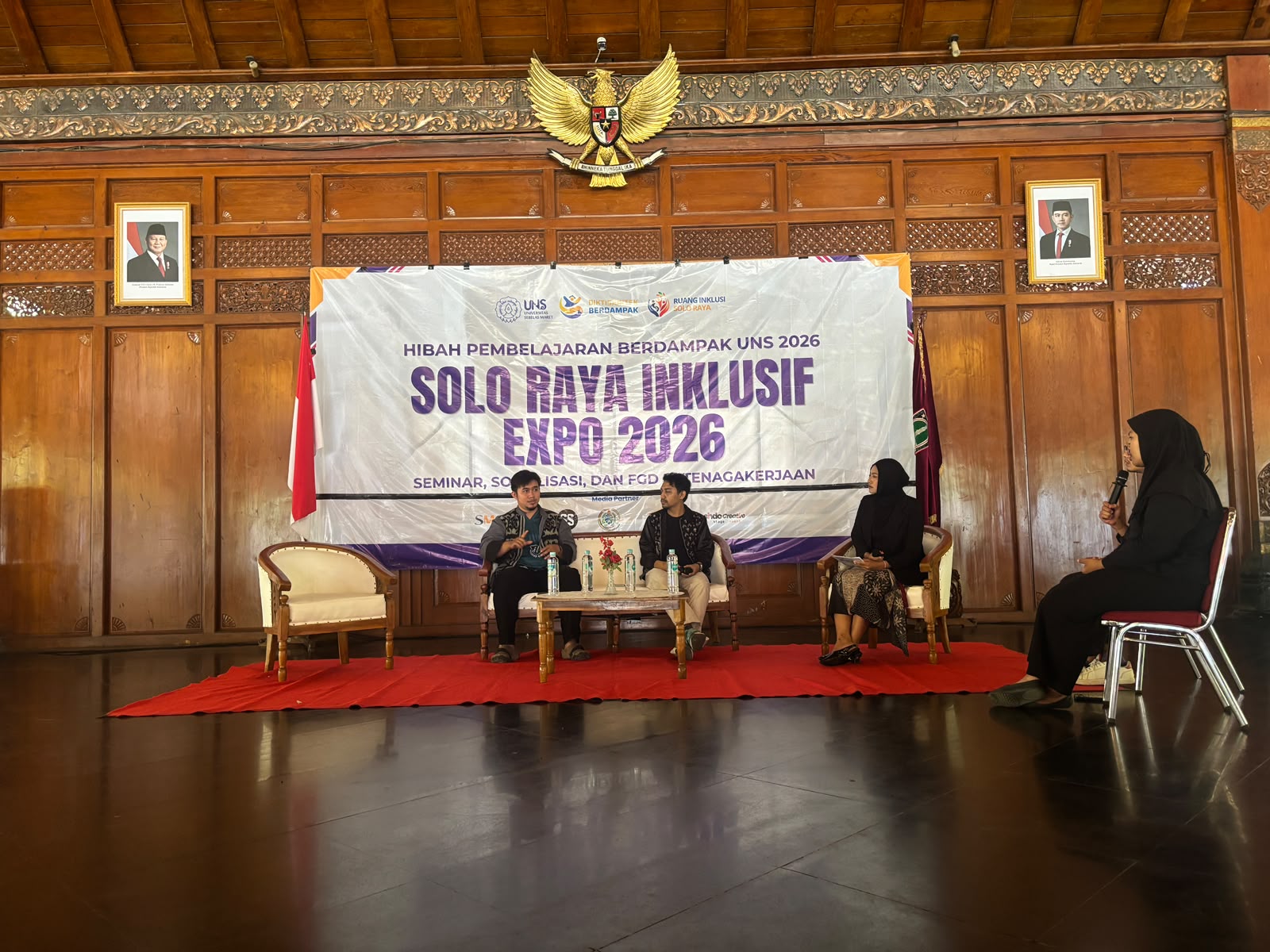



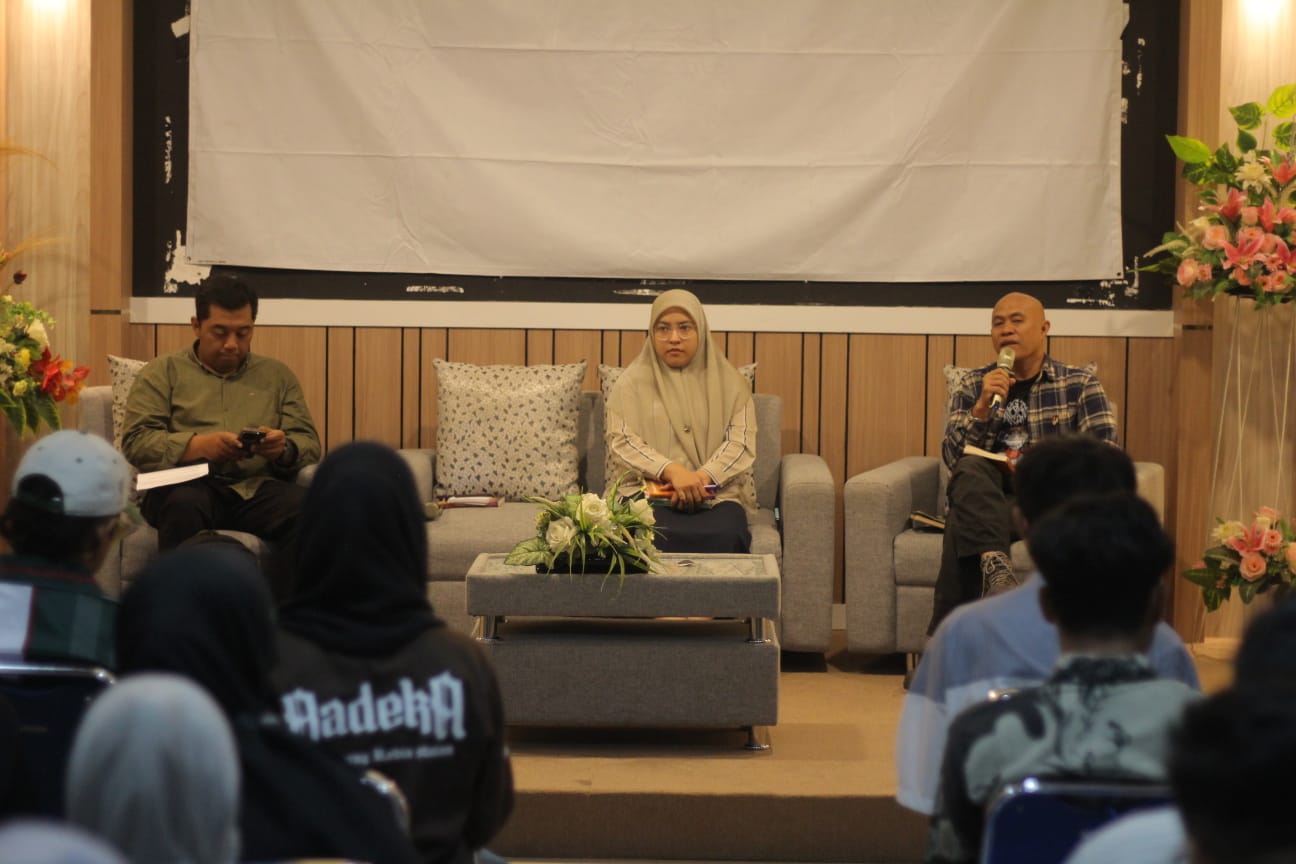

A book discussion proceeded at the hall of Fakultas Ushuluddin dan Dakwah UIN Raden Mas Said on Wednesday (3/6). The discussion was warm and reflective and many students, activists, and literary people were enthusiastic participating.
The book was not a fiction. To Fall and Keep Fighting (Tersungkur dan Tetap Melawan) was a collection of journalistic reports under Project Multatuli published in collaboration with Marjin Kiri. The book recorded a number of real incidents about injustices, loss, and people’s struggle in the face of intense pressures.
One of the authors, Bambang Muryanto started his explanation with a story from Wadas Village. He explained how andesite stone in the area was mined for development project for national Interest. Yet for him, the development was never simply about concrete, roads, dams, or airports. Behind massive projects, there were always humans who had to pay high price.
He reminded again the experience of people in Kulon Progo when Yogyakarta International Airport (YIA) was constructed. Prior to the project, the coastal area was deemed poor for years yet it helped local peasants to thrive. They worked on the sandy soil and made it productive. Water melons, chilli peppers, and a number of agricultural produces were abundant. People income increased. Houses were renovated. Life slowly got better.
Yet that life suddenly stopped when the airport project was established as Strategic National Project. Agricultural land that used to support people’s lives had to be abandoned. Some peasants got compensation in significant amount of money. Billions of rupiah went into their bank account in an instant. Many built new homes, bought new vehicles, or paid day-to-day expenses.
For Bambang, the issue was not about the size of compensation. The problem was the loss of livelihood which people inherited for generations. Money would run out one day, while loss of land would never be recovered easily. When cost of life continued to soar, when prices of key products increased, compensation money would slowly dwindle. Meanwhile, peasants who lost their land also lost their ability to support sustainable life.
For Bambang, what happened in Kulon Progo was also starting to happen elsewhere. Development deemed to bring progress often left people in more vulnerable situation. He saw a recurring pattern – people were asked to part with their living space for large projects whose benefits they might not feel directly.
Another speaker, a communication and Islamic Broadcast lecturer at UIN Raden Mas Said, Abraham Zakky Zspoke about his impression after reading the fourteen reports in the book. He said that after reading the first six reports people could pause for a while to reflect. Stories in the book presented real-life ordeals, not simply statistics or short reports that people could soon forget.
What made the book so special was the way authors presented facts. The articles did not give the impression of dry writing as news reports in general. The authors wrote using strong techniques, presented key people, situations, and emotions that placed readers right at the locations of the incidents.
He gave an example of a report about people in Serang, Banten, who rejected large-scale chicken farm. People experienced a variety of environmental and health impacts. When their protests were ignored, conflicts reached a tipping point that led to the burning of chicken coops. Police arrested a number of people. The story did not start with data or chronology, but with midnight arrests. The Police came, broke the door, and a father was taken away in front of his family. The incident was like a movie scene, yet every bit was real.
Another example appeared in a report on Kanjuruhan Tragedy. The report did not imply repeat the number of dead victims, but the author chose to write the piece by drawing readers closer to a family who lost two children in the same incident. From an intimate view, readers were led to understand the pain that would not be captured by numbers.
The same happened with a story of a family who lost two parents from Covid-19 in the space of less than 24 hours. Three children had to face the reality as orphans simultaneously. One child was deaf. That tragedy that often appeared on television screen became much more humane and touching.
For speakers, the power of journalism lied in its ability to dive deep. If daily news often only touched the surface, in-depth reporting tried to see the hidden parts – the hurt or pain, the fear, the hopes, and the unseen struggle.
One speaker, a communication at University of Sebelas Maret, lecturer Hanifah Islamiyahexplained that the book showed a number of methods used in writing the reports which went beyond the basic prescribed method 5W+1H. To that point, many people understood news as answers to the questions of what, who, when, where, why, and how. Good reporting did not stop within that frame. It delved into human lives beyond and behind an event.
This was evident in an article about people’s resistance to palm oil corporations. The author did not choose to describe conflict simply through numbers or data semata, but through a woman named Mama Yani. From her personal experience, readers got to know that land was not simply economic asset. For Mama Yani, land was part of life itself, where she had her hopes for the future of her children.
This kind of approach made agrarian issue, which was often deemed complicated, closer to people and more humane. Conflict was no longer understood as a struggle between companies and people, but as stories of people working hard to protect their living spaces.
In another report, the author used investigative method to see the impacts of dam construction. The article was not merely repeating official narrative about the benefits of development, but dug deeper into people’s experience living around the project. This way, readers gained a more holistic picture of how a policy affected people’s lives.
Another unique feature was the use of comparative method. One author compared looting incident in 1998 with more recent but similar incident, at the end of August 2025. The two incidents were placed side-by-side, not to lead to one conclusion, but to ask readers to reflect. How did similar incident happen again? What changed and what remained the same? The question was open so that readers could participate in the analysis.
Readers should not read reports in a passive manner. They had to ask questions. Why the author(s) chose certain resource people? How did they get their data? Why a particular view was chosen while others were ignored? Such critical stance was important so that readers not simply received information, even when the information was from media deemed credible.
When asked about criteria of success of a nation, Bambang offered a different view from mere physical indicator of development. For him, development had to start from bottom-up or people’s needs, not forced from the top. A successful nation listened to its people, understood local needs, and involved people in decision-making.
The speaker Hanifah Islamiyah asked participants to see that journalism was not necessarily written in a rigid format. Behind every incident, there were humans, experiences, and emotions that were often more important than a series of facts.
She recounted her experience on independent media that chose to continue without advertisement from businesses/companies. Such media survived from supports and donation of readers and the public. Such model allowed the editors to work more freely in covering issues that mainstream media missed, particularly issues about communities face-to-face with state and corporate power/authority.
The discussion became more intense as students started asking questions about the roles of young people in dealing with social issues. They wanted to know how to present injustices experienced by people in Wadas, Papua, Halmahera, and other areas.
In response, Bambang Muryanto emphasised the importance of public awareness and involvement. He said that young generation could make use of social media to disseminate information, build solidarity, and broaden community awareness. Yet, it was critically important to have the courage to always question policies that affected their life.
For him, the measure of a nation’s success was not simply in the number of infrastructures being developed. Success could be measured by how far a nation listened to people’s needs. Good development emerged from people’s aspiration, not forced from above. When people’s voices became the foundation of policies, development not only brought physical construction, but also social justice for those most affected.
Bambang Muryanto asked participants to see problems from the point of view of communities who lived directly in areas affected by development. He said that success of a nation could not be measured solely by the number of projects or the size of investment coming in. More important issue was whether a nation truly listened to its people.
He gave an example of a number of areas that became sites of massive extractive projects and development projects. In Halmahera, for example, many communities used to live with nature and land. When nickel industries came, their living spaces changed dramatically. For local communities, progress did not always mean the presence of large industries or roads. Many people wanted to maintain their relationship with nature as their sources of life.
Hanifah suggested a similar view. Based on her experience living in South Halmahera, she witnessed how restricted access to information made it difficult for local people to get information about a variety of policies and political processes happening in their own land. In such situation, young people had important roles to be information bridges.
He urged for citizen journalism practices. In the era of social media, each person had the opportunity to be news/story provider from their own milieu. They did not have to wait for major media to come from Jakarta or other cities to report on their village condition. Local communities would be the ones to understand fully their own day-to-day problems.
For Hanifah, a major step always started from simple things. Young people could start by documenting damaged roads that were never repaired, bridges were left crumbling, or social issues people faced on daily life. From there, sensitivity grew to see problems more broadly.
Meanwhile, Zaki highlighted the importance of creating discussion spaces in campuses. He believed that social awareness did not come by in an instance. It grew through reading habit, discussion, and asking questions about things that people thought were normal. Book communities, discussion groups, and alternative learning spaces were critical venues to build critical reasoning in the midst of such massive and rapid information flows.
The discussion also touched on question about the meaning of progress. Hanifah reminded that progress standard was often built from a narrow perspective. A region was deemed developed when the asphalt roads were constructed, buildings were permanent, and shopping centres were everywhere. Yet for indigenous people, progress had different meaning. They saw land, forests, rivers, and houses as one inseparable units.
For that reason, there was no singular measure to identify success of a nation. Good nation was not a nation that forced people to follow the same definition of progress, but that was able to respect diversity of people’s lives.
Towards the end of the discussion, Bambang explained that good reporting came from a process of in-depth understanding community’s life. It was not enough for a journalist to come, interview a number of people, and then went home. He/She had to understand the context, got to know the environment, read documents, and lived with the community he/she was covering. Bambang believed that such reporting did not change the world on its own. New change might happen when people reading the report had the realisation, developed empathy, and chose to act. From there, journalism found its significance, not simply presenting facts, but helped community looked at reality more clearly and humanly. (Ast)