


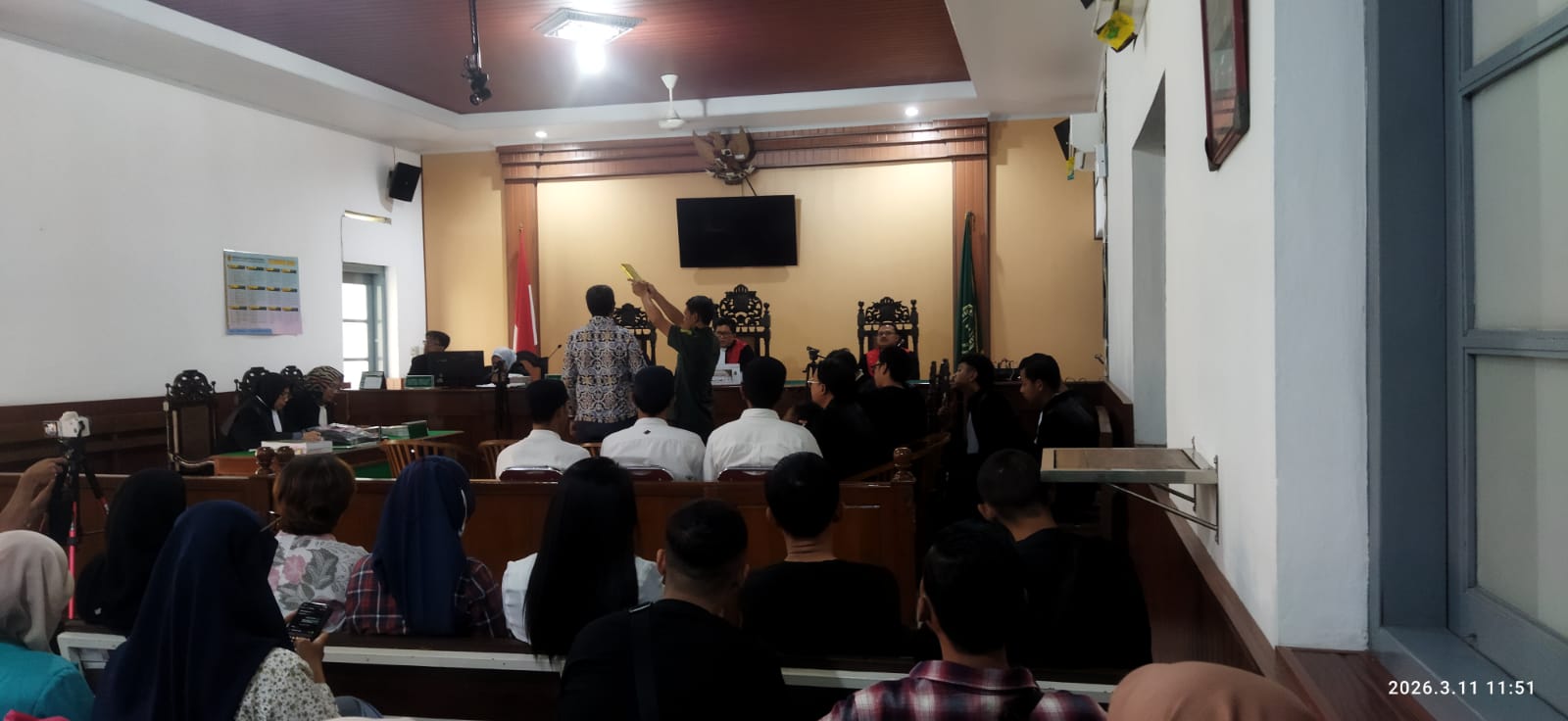

BINUS lecturer in Ciputat, DR. Ahmad Sofyan S.H, M.A. had been teaching criminal law for 13 years, business ad corporation law, and focused on publication as seventh expert witness for the political prisoners’ trial - Hanif Bagas Utama (Hanif) , Bogi Setyo Bimo (Bogi), and Daffa Labidullah Darmaji (Labid), on Wednesday (11/3). The relevance to this case was charges against Article 246 and the 247 Criminal Code.
With education background of S1 from Universitas Sumatera Utara, S2 from Universitas Kebangsaan with a major in criminology TPPO, S3 from Universitas Indonesia, and two other education backgrounds, double master in Malaysia and Melbourne for political crimes. S3 beasiswa di Belanda dan Indonesia, penelitian di Belanda Perancis dan Indonesia dan tinggal satu tahun di Belanda. He was an expert witness in 125 cases at lower court and four cases in the appeal court. With regards to the old Article 160 of the old Criminal Code, present 11 times at the lower court and once at the constitutional court. Darmaji (Labid), Wednesday (11/3).
For the third case the three defendants - Hanif, Bogi, and Labid answered the lawyer’s question, the indictment from the prosecutor when charging defendants with Articles 246 and 247, what was the key charge and how to apply this article, Ahmad Sofyan answered that one had to look at the title in the second part and the explanation to Article 246. There was definitions of incitement and in public. Based on the definitions: formulated materially. From the history of the Article 160 of the old Criminal Code. Incitement for unlawful act. "Incitement for Unlawful ... and so on)
"Because it was a material indictment, then it should have happened: unlawful act involving violence. It was to be ascertained that the act was prohibited. Because the acts were multiple, then we related those with causality. We had to find the incitement that prompted people to omit unlawful act(s)," said Ahmad Sofyan. He added that there had to be prove that the unlawful act to incite happened and the incitement led to resistance.
Then the lawyer asked that in this case there was protest that ended in unrest in Surakarta on 29 August. There were already factual witnesses to be examined. There was flyers/posters (submitted as evidence), they already saw that in social media posts. They had traumatic experience with the police. They saw a driver being overrun by the police. Then three young men posted a pamphlet. The question was in this context, there were multiple causes, so what connected them all?
The expert answered that in the contest of causal theory, one statement said "There were multiple factors," and the expert provided an example, "Victim of a crime be taken to hospital, the ambulance wt into a ditch when the person was transported to the hospital, and the patient was not immediately treated. The doctor asked the nurse to give the patient anti-pain medicine and the nurse gave the patient a high dosage, and then the equipment was detached and the patient died," then the perpetrator could not be indicted for the patient’s death.
"Is it fair to indict the person who stabbed to be charged for murder? There may be other factor(s) causing death. In causality theory, we had to consider a number of factors," said Ahmad Sofyan. He added that in this case, there were many flyers in social media, there were documents showing parliament members dancing, and a driver died after being run over. Then the causal theory had to be proven.
Then the expert talked about the second issue with regards to generalization theory: Objective and Subjective. Could objective generalization be applied? Yet, it had to use one strongest factor that suggested unlawful act, then this had to be proven scientifically and not based on probabilities and assumption.
The third was subjective generalization, which mixed with causality theory.
Was it true that the three young men distributed pamphlets in order to incite unrest? They just wanted t stage a protest, not to incite unrest.
The fourth theory related to relevance. In different path with different doctrine. There had to be firm link that connected the defendants’ action to the death of other people? The relevance was stuck. It may have been useful for a few charges, but it could not be used in this regard.
The defendants’ lawyer asked about the objective generalization theory, the expert answered that the generalization used should show direct effect, and that there had to be unlawful act. When people asked others to show solidarity with their action, when generalization theory was used, could we then state that the pamphlet were a form of incitement? The question, factually, legally, was whether the pamphlet could be a causal factor to be presented in court. Then, how could the flyers be considered independently as a factor on its own?
The expert suggested that the prosecutor used objective generalization theory, as the prosecutor only chose one cause. There had to be scientific evidence such as visum et repertum or visum et psikiatrikum.
If flyer was the evidence, as cause, then it had to be proven, then call those people participating in the unrest, and then test scientifically. "Did you read this and then you participated in the unrest?"
Was this the cause? Of course not.
"Was it true that the act was unlawful? If not, then there should be any influence. If we used generalization, make sure that this case was unlawful. Call linguistic expert. If linguistic expert said that this was an unlawful incitement, then then second test would be to re-examine those who committed unlawful act." said the expert witness.
With regards to Article 246, the expert suggested that what was meant by "in public" was real place, there was an object, and it was authentic. This meant that Article 246 dealt with unrest in real place.
As expert witness no. 5 in similar case in a number of cities, Ahmad Sofyan tended to use conditions, as multiple cause may be inter-related, not just one cause that had to be assessed.
The question was whether the defendants could be charged? The answer was that people who committed burning, people who committed prosecution, why not just arrested them.
Ahmad Sofyan reiterated that unlawful act was an element, not action. There was action to defy the law. Not all articles were there that indicated unlawful act. It was not constructive. Prohibited Unlawful acts led to prohibited results, hence there had to be cause and effects.
He reiterated again that the flyers presented as evidence were not meant for incitement. (ast)