



Corruption Perception Index (CPI) is a global indicator to measure level of corruption perception regarding public sector of a country. CPI indicates increasing corruption level globally in 182 countries since 1995, as indicator to understand how corruption influences democracy. The launch of Corruption Perception Index (CPI) 2025by Transparansi Internasional Indonesia showcases the key theme of corruption, civil liberty, and access to justice on Monday (9/2).
The event invited political and social movement expert Prof. Amalinda Savirani, and Rights activist and Executive Director of Amnesty International Indonesia Danang Widoyoko, PhD, Usman Hamid, PhD, and Constitutional Law expert Prof. Zainal Arifin Mochtar as panelists.
The program starts with a presentation by Ferdian Yazid, a researcher and program manager of TI Indonesia, where CPI measures corruption perception in public sector based on survey of businesses and experts combining 13 global data sources. The CPI measures aspects such as bribe practices and embezzlement of public funds, Abuse of Power, effectiveness of corruption combating corruption and strengthening integrity, patronage and nepotism practices, budget openness, protection of whistle-blowers, and public access to information of public interests.
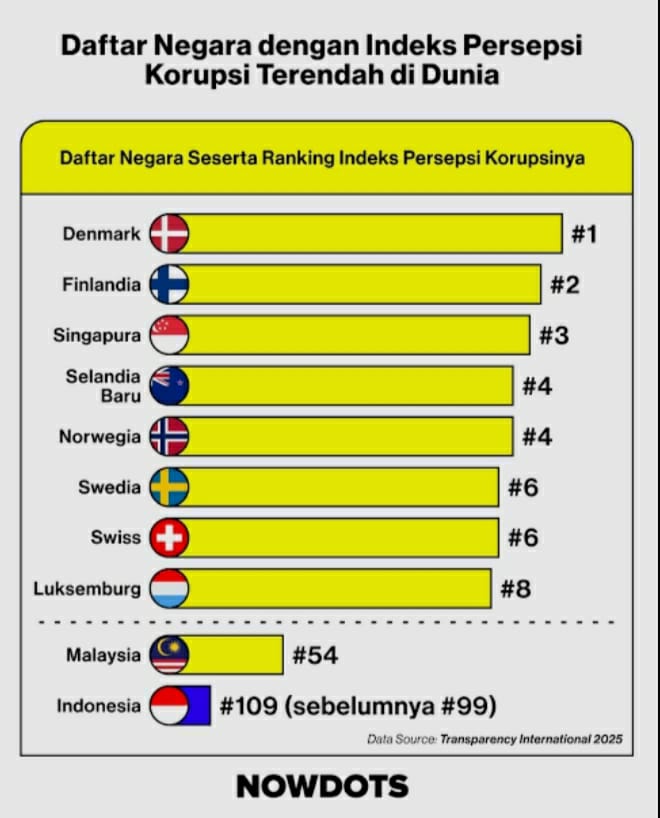
In 2025, Indonesia used 9 of 13 updated data sources. “Indonesia’s CPI score in 2025 was 34, a reduction of 3 points from 2024, and decreasing ranking from 99 to 109 of 182 countries” says Ferdian. Ferdian also suggests that countries with full democracy have a CPI score of 71, while non-democratic countries have a CPI score of 32, Countries with open civil space have average CPI score of 68, while countries with suppressed civil space have a CPI score of 30-38.
Ferdian adds that Transparansi Internasional Indonesia gives recommendation that there is a need to ensure vulnerable groups and those with low income to receive effective, affordable, and non-discriminatory legal aid, recovery of independence, and authority for monitoring agency to function effectively, and for democracy to blossom, as well as civil liberty by stopping criminalisation of activists, journalists, and indigenous communities.
Panelist Response
The Secretary General of TI Indonesia, Danang Widoyoko, Ph.D suggested that the reduction in CPI score happens because law enforcement often displays confiscation of funds borrowed from banks, yet does not reflect substantive solution. This is further undermined by weakening independence of State institutions from selection of Constitutional Court judges to the case dismissal such as Duta Palma that shows the weakening transparency in asset confiscation without due process. Law enforcement is not going to change without the supports of healthy democracy and widening public space, when the voice of indigenous people and vulnerable groups is ignored, and space for media and civil society keeps narrowing. Monitoring function on corruption becomes paralysed. “Without guaranteed access for all people, corruption eradication will only become empty gesture far from reality of justice that the people long for.” Says Danang Widoyoko.
Political Science and Social Movement Expert, Prof. Amalinda Savirani responds that increasing corruption is a consequence of narrowing civil space. When public space is limited, tool for community control of the State becomes blunt, and creates negative correlation where narrowing democratic freedom, goes in conjunction with increasing corruption. This phenomenon is not merely administrative issue, by humanitarian issue which has direct impact on social justice, climate destruction, and most vulnerable marginalised groups resulting from corruption-related policies.
Amalinda also explains that globally, the authoritarianism trend increased in conjunction with the gagging of activists, journalists, and suppression of academic freedom which now become key indicator in di Indonesia. “For this reason, broadening civil space is not merely an option, but a collective necessity as most critical pillar of democracy to control those in power and to eradicate corruption” she said.
Human rights activist and executive director of Amnesty International Indonesia, Usman Hamid, PhD responds that the horrible CPI finding is not surprising, and it becomes an indicator for the regress in corruption eradication, civil liberty, and access to justice in this country. Indonesia is at the same level as Laos, Bosnia, and Nepal in corruption perception and is below other ASEAN countries such as Singapura, Malaysia, and Timor Leste which used to be part of Indonesia, with plenty of nepotism in Indonesia such as elevating the President’s nephew to strategic position.
The flaw in power separation amongst the executive, legislative, and judiciary worsens the situation, leading to a politicised and manipulated law enforcement as a tool for political attack rather than substantial measures for justice. This situation leads to the fall of Indonesia as a result of corruption that has penetrated state institutions and systemic emasculation of Anti-Corruption Commission (KPK). Civil space should have been a last fortress to report crimes without fear now becomes a site for criminalising activists, which suggests that access to justice is in dire state. “Without State leadership based on transparency and coalition free of cartel politic mentality, the reduction in score is not merely a number, but a lurking danger to the future of democracy,” said Usman.
The Constitutional Law expert, Prof. Zainal Arifin Mochtar responded that the latest significant decrease in Indonesia’s CPI score is a major blow triggered by the collapse of AMD indicator score (reduction of 19 points) and Bertelsmann Foundation (reduction of 9 points), that specifically exposed bribes and the weakness of law enforcement. The reality shows that decision-making in the country tends to be manipulative and far from the principle of transparency, while standard of law enforcement is lagging. The problem worsens with acute conflict of interests, where there is obvious networking of business operators and the state with minimum and non-effective regulatory oversight. Without total reform in the Police and defence sectors, law enforcement will be captive forever to political intervention and internal decay. “If law enforcement culture is not structurally reformed, the fall in CPI score would worsen, which confirms that corruption eradication in this country is at its lowest point,” he explained. (Renny Talitha Candra)