



Reog Singo Kerti Community, Then and Now
That day, my colleagues and I came to a two-story house at Kelurahan Kerten, and we received a warm welcome. The chairperson of the committee, Daniel set up the meeting to discuss the high point of the 16-day Anti-Violence against Women and Children celebration that involved communities in Kerten. "But, children who were in the Reog Dance Group had permanent jobs now, and we had not done any Reog-related activities for a while. The last time we did it was during the COVID-19 pandemic," said a man known as "Pak Mul" the trainer of the Reog Singo Kerti founded in 2017, who was a retired civil servant at Rumah Sakit Jiwa Daerah (RSJD) dr. Arif Zainudin Mental Hospital while looking at his mobile phone.
I did not want the communication we had established to disappear, so I asked about Pal Mul’s experience when he was working at di RSJD Hospital and he revealed that he was active in Schizophrenia Care Community. "I established the Reog Dance in order to get the young people here together, so that they were not running into troubles associated with drugs or alcoholic drinks. Many of them had found formal jobs," he said. Soon, Pak Mul found the phone number he wanted to contact. He then called the person. After a while, Pak Mul was able to ascertain that Reog Singo Kerti Community would be available for the People’s Stage.
It turned out that ten young people participated in the Reog Singo Kerti performance, some of them playing the music. The rest were performing the Reog. For 40 minutes, Reog Singo Kerti performance captured the imagination of the young audience, who never blinked their eyes, as if they were really "thirsty" of such cultural attraction. Children’s enthusiasm was apparent as they waited patiently from around 2.30 p.m. at Lapangan Segitiga Kerten (Square). The committee informed them that the performance would play after dark, and children went home, but promised that they would come back later. And true to their words, they came and took the front seats.
As we all know, traditional Reog Ponorogo is in UNESCO’s Intangible Cultural Heritage list, in the category of In Need of Urgent Safeguarding. This was established at Intergovernmental Committee for the Safeguarding of the Intangible Cultural Heritage Session 19 in Asunción, Paraguay, on Wednesday (3/12/2024). So, when we witnessed the enthusiasm of the children and adults in Kelurahan Kerten that night during the Reog Singo Kerti performance, we were very proud of the local potential popular amongst people in Kelurahan Kerten.
The World-Famous Sanggar Semarak Candra Kirana, Grounded in the Local Community
Semarak Candrakirana Art Center was set up on 31 July 1998. Thousands of students had completed national classical and contemporary dance training at this Art Centre. Semarak Candrakirana was an important partner in Solo International Performing Art (SIPA), often performing in the opening session that awed both national and international audience. SIPA became a stage for Semarak Candrakirana to showcase their creativity and to widen their artistic range, while Semarak Candrakirana lent authenticity and grandeur to the event.
Yayasan YAPHI also involved Sanggar Semarak Candrakirana in the People’s Stage. The group had its headquarter on Jalan Kedasih, Kerten – which meant it was a local asset, which local people were happy to be involved to express their love of local art.
The committee talked intensively with the community through Ratna, a dance teacher. Five pieces were selected for the performance - Tari Tani, Burung Pisen, Gambyong Calung, Gambyong Mari Kangen, and Wiro Tamtoro Sindoro. Each of the five dances had extraordinary significance, for example Tari Tani represented the daily life of peasants, while Tari Butung Pisen showcased the beauty of local environment.
Tari Gambyong was a classical Javanese dance from Surakarta that showcased graceful and elegant moves, initially used for agricultural ritual (for Goddess of Fertility Dewi Sri), and then developed into a welcoming and entertaining dance, performed by women dancers.
Tari Gambyong developed beyond the palace’s walls. Its popularity prompted the Keraton Kasunanan Surakarta (local Palace) to further develop this dance and adjusted to the Palace artistic taste.
In time, Tari Gambyong developed into a variety of styles – one of which was Gambyong Mari Kangen. This dance was a new form of Tari Gambyong. Tari Gambyong Calung , for its part, was a dance that developed in Banyumas Region that was performed with Calung (bamboo xylophone) music.
The subsequent performance was Tari Wiro Tamtomo Sindoro, - a dance about nature and local community on the slope of Mount Sindoro, which depicted resilience or traditional life of people or heroism.
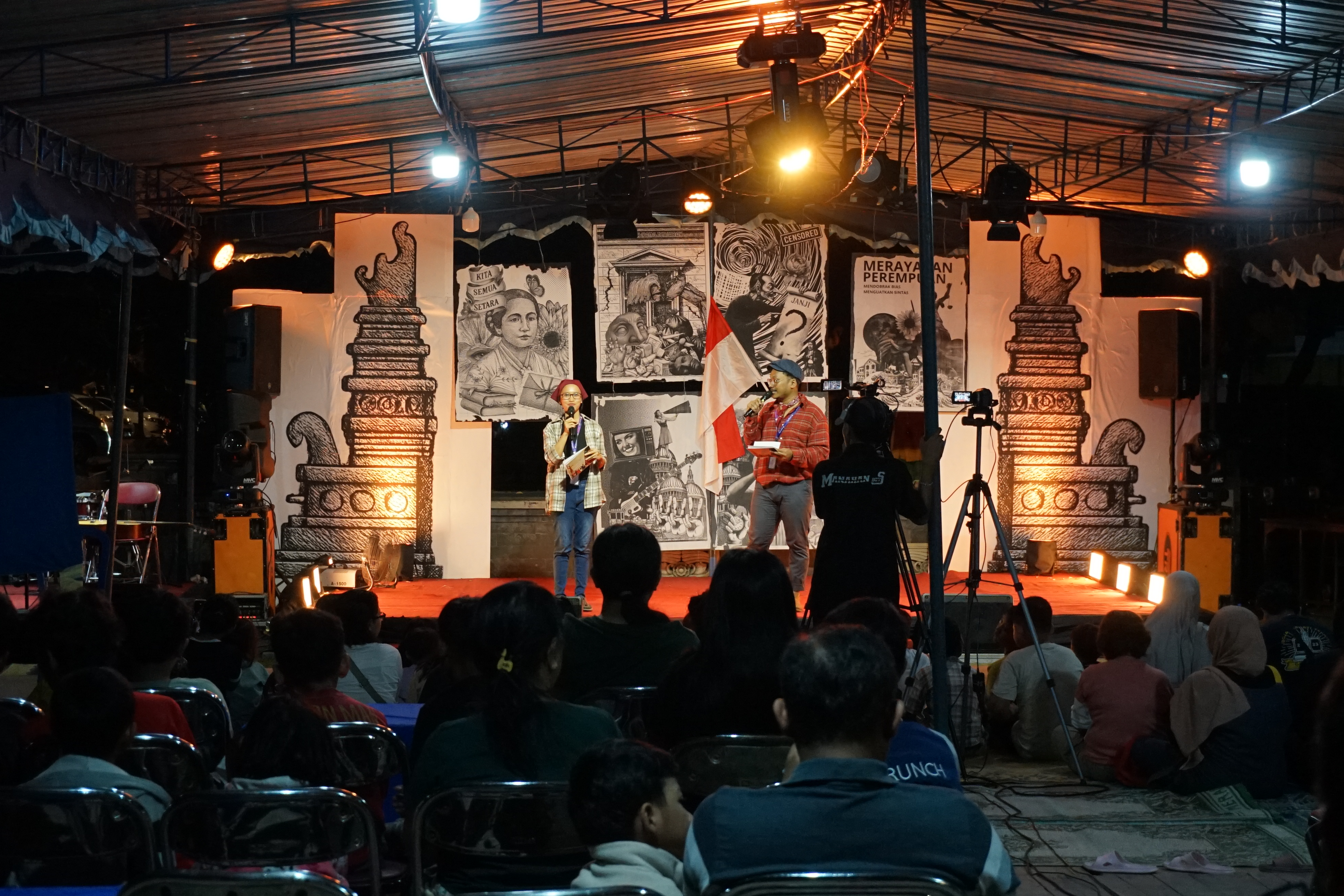
The master of ceremonies for the People’s Stage - Dorkas and Yosi from Yayasan YAPHI – called the dancers one-by-one, and narrated a short profile video of Sanggar Semarak Candra Kirana. They also informed that the program was broadcast live on Yayasan Yaphi YouTube.
As was evident to the dancers on stage that night, they were the centre of community (mostly children) attention in Kerten. The audience was pleased, and the parents of dancers were also pleased that the dance performed by their children was important not only to allow their children the change to perform but also to engage with the audience. "By training and performing on stage, children interacted more often with the real world. They would stop messing with their mobile phones, and start focusing on the arts now," said a mother.
Kelompok Bermain Bakat - Totality in Arts, Expressing the Local Voices
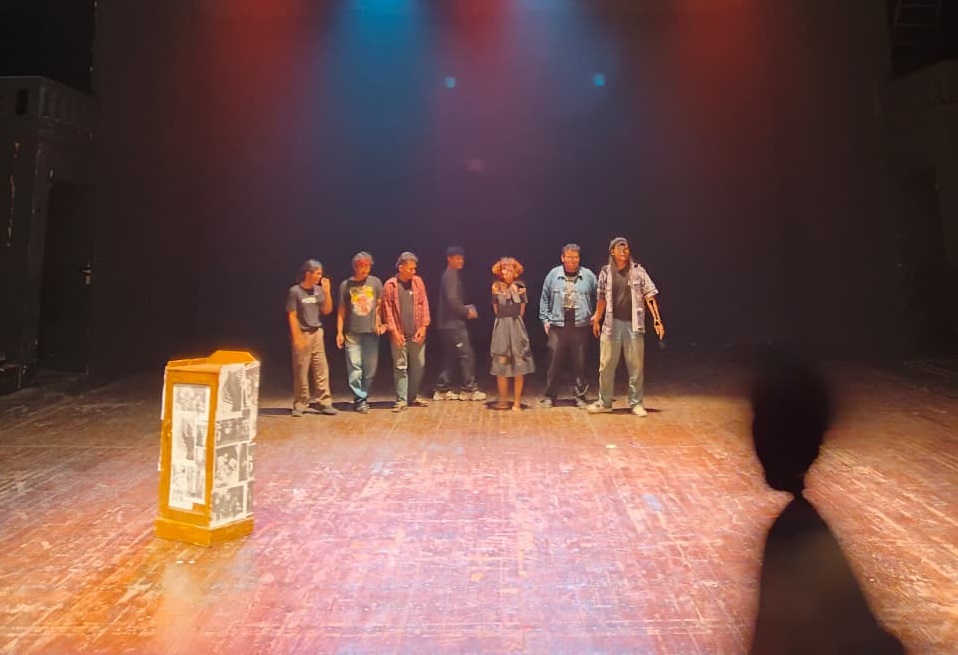
The script “Naar De Republik” was a theatre script written by DS. Aji – a cultural icon from Surakarta. Teater Kelompok Bermain Bakat (Theatre Group) performed the script in many occasions. One of which was during Yayasan YAPHI 16 HAKTPA – People’s Stage, entitled "Petruk Nagih Janji, Sejarah yang Terjarah" (Petruk demanded that promises be fulfilled – a plundered history).
To understand this story meant to understand the long history of the Nation of Indonesia when it experienced so much turbulence for its independence through diplomacy. It was a conscious decision to use a similar background as in the story of Ashabul Kahfi – young people who had fallen asleep for a long time in a cave. This may have been a metamorphosis of a nation lulled to sleep and became unconscious by the situation. As the May 98 that jolted the national consciousness to bring down bloody 32-year tyranny, the scene coming out of the cave was an illustration of a nation coming out into a united front.
A soothing music played - Cello and Guitar as well as vocal by Yosi who hypnotized the audience. The song “Mentari” (The Sun) by Iwan Abdurrahman played beautifully. Amidst the soothing Cello and Guitar, the collaboration also played “Bersuka Ria" (Joy) song, written by Soekarno. The song was first released in 1965 as an entertainment and political education with deep meaning about life, unity, and Indonesian character, and was often associated with the spirit of the Indonesian struggle.
It was interesting that the BPU PKI session covered a variety of issues, particularly those proposed by participants who interacted directly in the session.
Cholili opened the session and read the rule, while the participants applauded. The first idea came from a Xiao leaders from Balong. He wanted the new Republic to respect the rights of the Chinese population, as well as the rights of minority groups in general. The new republic should be borne out of commonality of experience of the oppressed people and not usurped by one group only.
A representative of Christelijke Studenten Vereeniging (CSV), Amir hoped that the future State would facilitate its citizens with special needs, because a State did not belong only to those who were deemed “normal.”
A Moslem leader, Kasman hoped that the new State would not persecute belief system and different thoughts.
A former Japanese comfort woman, Tinah wished a new republic that ensured equality, as women’s rights were always trampled by the imperialists and colonialists. She also expressed rights to education and equal employment, as well as protection for the children. The session scene became more intense, yet Cholili remained steadfast in taking control of it. The public, as the participants in the session, expressed their ideas and asked Cholili to relate those ideas to the authority. There were many peasants who wished to have a right to their land. They also wished for no closure of religious establishment, and no more burning of religious buildings. Session proceeding participants also voiced the aspiration of indigenous people, and there was a labour protest to demand wage system that was acceptable to workers.
There was also a call from the education sector about an education that liberated – that is a humanistic education that did not just focus on numbers at its core. Accessibility for people with disability was critical as illustrated by a number of participants – which included access to public services and to sign language. That night belonged fully to the people.
The session ended abruptly when there was loud commotion coming out of nowhere which signaled the Japanese attack.
The Naar De Republik performance was the finale that night. A number of people we interviewed during the performance expressed positive responses of the show. Some expected that such show should be regular on an annual basis because it encapsulated true moment of reflection for the people. Some said that it was great opportunity for the young people to express arts, and in doing so they avoided negative influence such as drug and addiction to games.
The director of Yayasan Yaphi, Haryati Panca Putri stated in her opening speech that she hoped the performance brought much joy to the spectators, and a moment of reflection for the community
That night, ground at Lapangan Segitiga Kerten (Square) was dry. The rain only came one hour after the show ended. Many police officers came to secure the square, while the theater was proceeding. Many of the spectators, most of them were children, were returning home right when the police officers arrived. (Astuti)